
The research team at Fonndure reviews XRP after a modest bounce that leaves the token in a poor position. The coin changes hands around $1.10, well beneath the averages that define its trend, and traders are asking whether the round $1 mark can stop the slide.
A Weak Recovery
XRP edged up on Tuesday together with the rest of the digital asset market. Yet the gain is small, and nothing in the data suggests that demand has returned in force. The price still sits under every average that traders normally follow, so the downward path remains intact.
Activity on the blockchain has also slowed, which makes the bounce look more like a brief pause than the start of something new.
What Large Players Are Doing
Reports on exchange flows show that very big investors, the so-called whales, have been busy in both spot and futures trading. Most of their large orders have been sales, so the heavy hands seem to be trimming positions instead of buying the dip. Spot trading volume is also elevated, which tells us that the market is paying attention to the drop, though not that buyers are confident.
Futures data is less one-sided. Among open contracts, bets on a rise now barely outnumber bets on a fall, with a ratio of about 1.01. Total money committed to open contracts shrank by a little more than 2.5% over a day and sits near $2.4 billion, which means some participants have closed their trades. The cost of holding long positions has moved slightly above zero, at about 0.01%, a hint that optimism is returning but slowly.
Averages Form A Ceiling
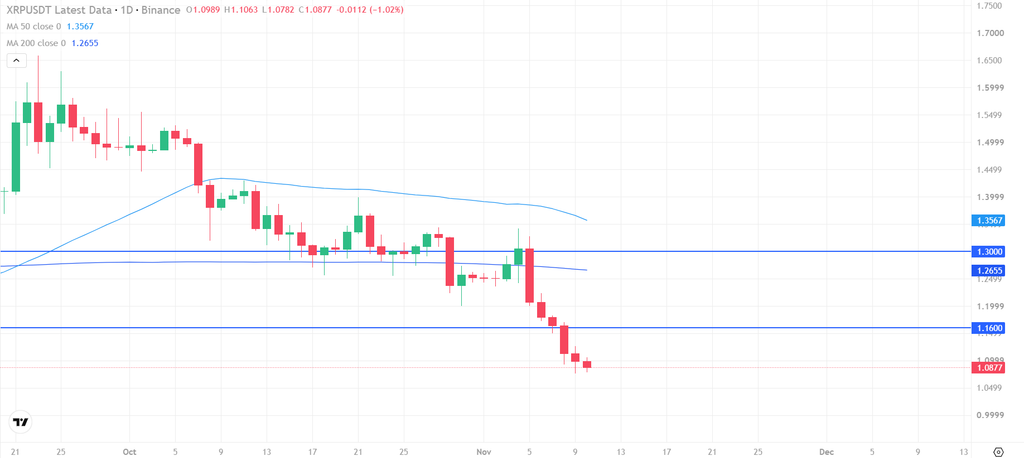
On the daily timeframe, the price is below three trend lines that react to recent closes more than older ones. The medium-term pair, built from the last 50 and 100 sessions, is almost glued together at roughly $1.29 and $1.30. The slower line, based on 200 sessions, hovers a little higher, near $1.36. All of them lie above the market, so any bounce runs into a thick band of potential selling.
Two oscillators tell the same story. The RSI, which measures how strong recent gains are compared with losses, is around 26. Anything below 30 is considered exhausted selling, and it can lead to a pause or a short rally. The MACD, another trend gauge, is negative, so the broader direction still points down.
Why The $1 Level Matters
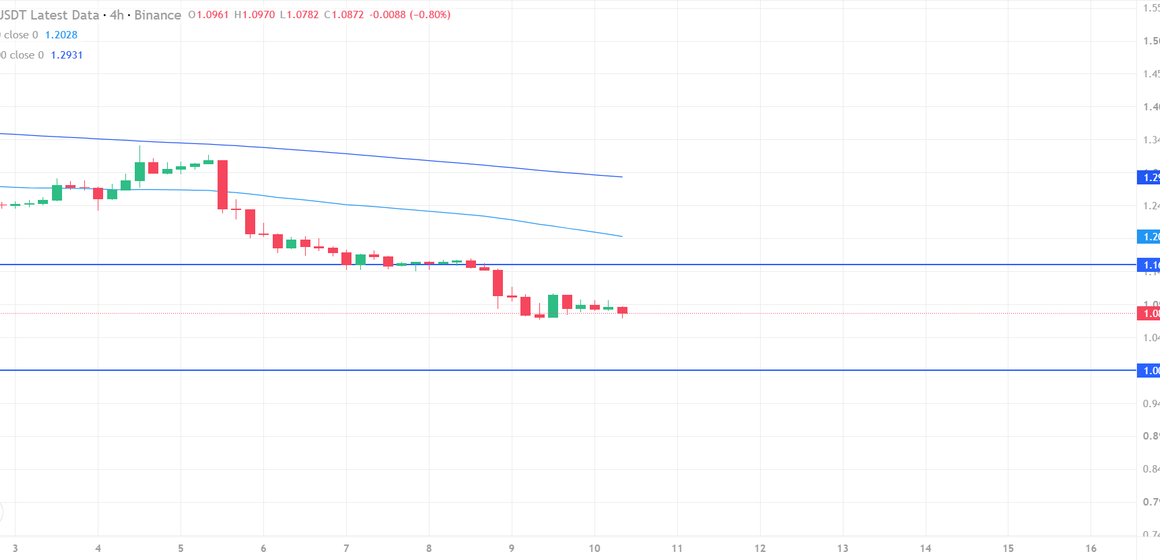
The number one dollar is the floor that traders watch most closely. Whole numbers attract orders, and many buyers could try to protect this line. If they succeed, XRP may produce a relief move.
If the price closes clearly under it, the damage would be larger. No major support appears immediately below, so a fall could continue without much resistance from buyers. For this reason, the coming sessions will probably show whether the market still has enough demand to hold that line.
Support And Resistance Levels
The first obstacle above the market is $1.160. A recovery through that line would suggest that buyers are gaining a bit of strength. After it comes the crowded area around $1.300, where a flat barrier and the two medium-term lines overlap, which makes it hard to cross.
Higher still are the slow line in the mid-$1.30s, then $1.540 and $1.900. Those prices would require a big improvement in mood, so they are long-term goals.
Below, $1 is the key support. A close under it would make the bearish picture clearer.
What Traders Can Do
While the trend is negative, careful behavior makes sense. Active traders may look for short-lived advances toward $1.160, with small size and a protective stop under the latest low. Followers of the trend may hold off until a daily close above $1.300 shows that the picture has changed.
It is also wise to plan for a drop under $1 instead of assuming it will hold, since that move would favor sellers.
Conclusion
XRP rose a little, but heavy selling by large players, weak indicators and a wall of averages above the price keep the outlook negative. The $1 floor will shape the next phase, and $1.160 is the first barrier for buyers.
Traders following Crypto strategies should watch how the price behaves near $1, what large investors do next and whether trading volume recovers, since these clues will show if the bounce has real strength.