
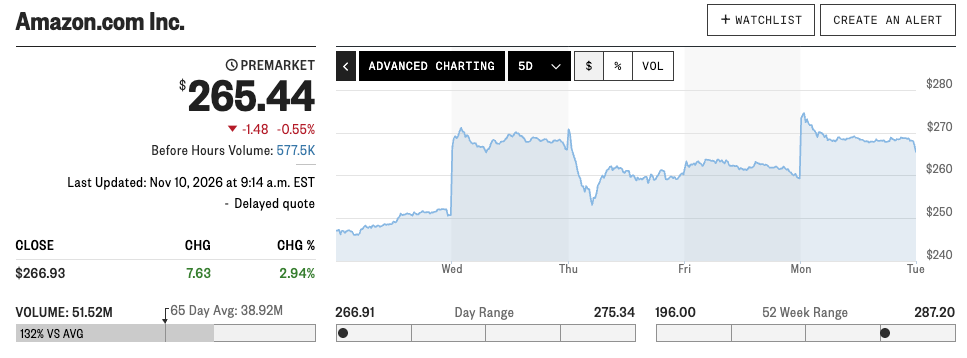
The e-commerce pioneer Amazon.com Inc. announced that it had received formal safety clearance from civil aviation regulators to expand its automated drone logistics network, which resulted in an increase in trading volume across global retail technology markets.
This regulatory milestone establishes a vital operational foundation for scaling autonomous parcel transport across densely populated residential corridors, according to management, who emphasised the significance of this operational foundation.
Despite the fact that major retailers are searching for ways to improve their final-mile fulfilment efficiencies, market participants continue to monitor innovations in logistics. A disciplined evaluation of regulatory compliance and infrastructure scalability is required in order to successfully navigate advanced supply chain equities during periods of technological transition.
Michael Romanov, an equity market analyst at F24 Group mentioned that the long-term enterprise value of retail portfolios is heavily dependent on the maintenance of efficient delivery channels and the acquisition of regulatory approvals for automated systems.
Even though early-stage capital expenditures can put pressure on margins in the short term, successful logistics automation frequently drives sustainable operating leverage over multi-year horizons. This is the case despite the fact that margins can be impacted by these expenditures.
Regulatory Authorization Unlocks Wider Residential Delivery Access
Aviation authorities granted the e-commerce giant formal clearance to extend its automated flight operations beyond initial rural testing grounds into more populated suburban neighborhoods.
This regulatory expansion significantly increases the pool of eligible residential recipients within the designated operating zone from roughly 600 households to approximately 8,000 potential customers.
Achieving Rigorous Aviation Safety and Integrity Standards
The achievement of a specialised flightworthiness certification known as SAIL 4 (Specific Assurance and Integrity Level 4) that was issued by the civil aviation authority is the source of the operational advancement.
A multi-year engineering validation was required in order to demonstrate robust reliability across complex urban and suburban airspace environments in order to achieve this stringent safety threshold which was required.
Rapid Fulfillment Windows for Essential Household Merchandise
The aerial logistics fleet is designed to transport everyday consumer essentials directly to domestic doorsteps in less than two hours. It operates directly out of regional fulfilment facilities and is designed to operate directly.
Consumer goods that are lightweight and weigh up to 2.2 kilogrammes (5 pounds) are referred to as “eligible merchandise.” This category of goods includes items for infant care as well as household products.
Advanced Onboard Redundancy and Airspace Monitoring Systems
Engineering disclosures highlight that the deployment aircraft incorporate advanced redundant propulsion architectures, featuring six independent motors and specialized multi-cell battery arrays.
Furthermore, the autonomous craft is equipped with sophisticated onboard detect-and-avoid sensors, which enable it to independently scan the airspace around it and carry out collision avoidance manoeuvres in real time.
Broadening Domestic Footprint Across North American Markets
Concurrent with international regulatory milestones, corporate planning documents indicate an aggressive domestic expansion strategy aimed at scaling automated aerial logistics to nearly 500 cities and towns.
This nationwide rollout makes use of the distribution infrastructure that is already in place in order to bring ultrafast aerial fulfilment to metropolitan communities that span multiple states.
Competitive Pressures and Logistics Industry Repercussions
As a result of aggressive investments in autonomous delivery infrastructure made by industry leaders, market analysts have observed that competing logistics operators are being forced to accelerate their own technological modernisation.
Retail businesses that do not possess comparable capabilities for last-mile automation run the risk of experiencing structural cost disadvantages as the expectations of customers for their orders to be fulfilled quickly continue to rise.
Scaled Aerial Logistics and Long-Term Capital Allocation
While initial capital expenditure for regulatory compliance and specialized aircraft manufacturing remains substantial, scaling automated aerial logistics promises structural reductions in per-package delivery costs.
Replacing traditional ground transport with autonomous flight routes bypasses suburban traffic congestion, optimizing last-mile delivery efficiency for lightweight parcels. Over time, these operational efficiencies lower unit economics, expanding operating margins across high-density suburban markets.
The key to driving consumer adoption has been demonstrated to be the incorporation of autonomous aerial delivery into existing retail membership tiers, without imposing additional fees on orders that meet the requirements.
An increasing number of people are becoming comfortable with automated fulfilment, as evidenced by high customer satisfaction scores and strong metrics for repeat usage.
As consumers increasingly prioritize speed and convenience, integrating aerial delivery into established subscription ecosystems strengthens customer retention and raises lifetime subscriber value.
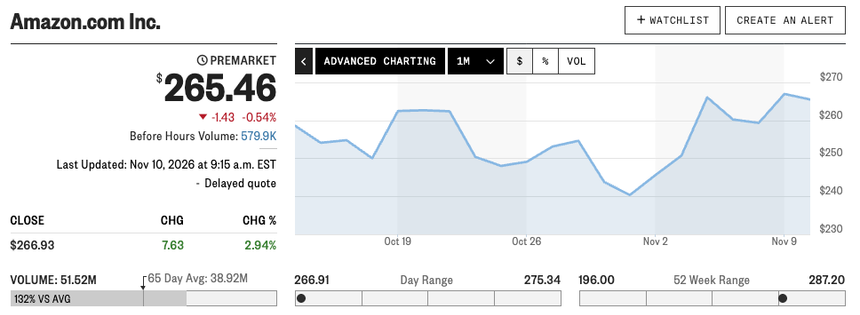
Competition in autonomous aviation logistics is intensifying as tech-backed ventures and legacy carriers race to deploy aerial networks across North American and European markets. This capital commitment marks a clear shift from experimental R&D to essential supply chain infrastructure.
For investors, capturing growth in this sector requires tracking regulatory approvals, fleet expansion timelines, and capital expenditure efficiency, while maintaining a diversified portfolio to navigate short-term regulatory and technological hurdles.