
The US Dollar Index (DXY) holds near 102.30 during European trading, stabilizing after modest losses as investors position ahead of the latest US Personal Consumption Expenditures (PCE) Price Index.
This article offers a fresh perspective on the topic, backed by Provence Hill’s industry specialists.
The index measures the US dollar against six major currencies: the euro, Japanese yen, British pound, Canadian dollar, Swedish krona, and Swiss franc, with the euro carrying the largest weighting.
The dollar remains supported by expectations that the Federal Reserve (Fed) will maintain a restrictive monetary policy stance while assessing persistent inflationary pressures. The central bank kept its benchmark interest rate unchanged at 3.75%–4.00%, broadly matching market expectations, while offering limited guidance on its next policy adjustment.
The upcoming PCE inflation report could influence expectations for the federal funds rate, US Treasury yields, and the dollar’s interest-rate advantage against other major currencies. An upside inflation surprise could reinforce expectations of additional tightening, while weaker readings could reduce demand for dollar-denominated assets.
Federal Reserve Holds Rates as Inflation Risks Persist
The Fed maintained its target range at 3.75%–4.00%, citing continued economic expansion, resilient domestic consumption, robust capital investment, and solid productivity growth. Labor-market conditions remain relatively stable, with employment gains keeping pace with workforce growth and the unemployment rate showing limited change.
Persistent inflationary pressures remain the principal obstacle to monetary easing. Holding rates steady allows policymakers to assess the cumulative effects of previous tightening and determine whether current financial conditions are sufficiently restrictive to return inflation to the 2% target.
The decision included two dissents from Fed Governor Lisa Cook and Cleveland Fed President Beth Hammack, who favored an immediate 25-basis-point rate increase. Their positions highlight divisions within the Federal Open Market Committee (FOMC) over the appropriate response to elevated inflation.
PCE Inflation to Determine Interest-Rate Expectations
The PCE price index is the Fed’s preferred inflation gauge, making its upcoming release a major catalyst for the DXY. Investors will examine headline PCE inflation and core PCE inflation, which excludes food and energy prices to provide a clearer assessment of underlying price pressures.
The market reaction will depend on deviations from consensus forecasts and revisions to previous readings. An upside surprise in core inflation could increase expectations of another 25-basis-point rate hike, supporting the dollar through higher anticipated policy rates and Treasury yields.
A downside surprise could reduce expected borrowing costs and Treasury yields. Changes in US interest-rate differentials would be particularly relevant for USD/JPY and EUR/USD, where relative monetary-policy expectations significantly influence currency valuations.
Analysts at Rabobank describe the Fed’s decision as slightly less hawkish than anticipated, noting that only two FOMC members dissented in favor of a hike. The possibility of another increase in December remains open, reinforcing the importance of upcoming inflation and employment data in determining the monetary-policy trajectory.
Technical Analysis: DXY Holds Above Key Moving Averages
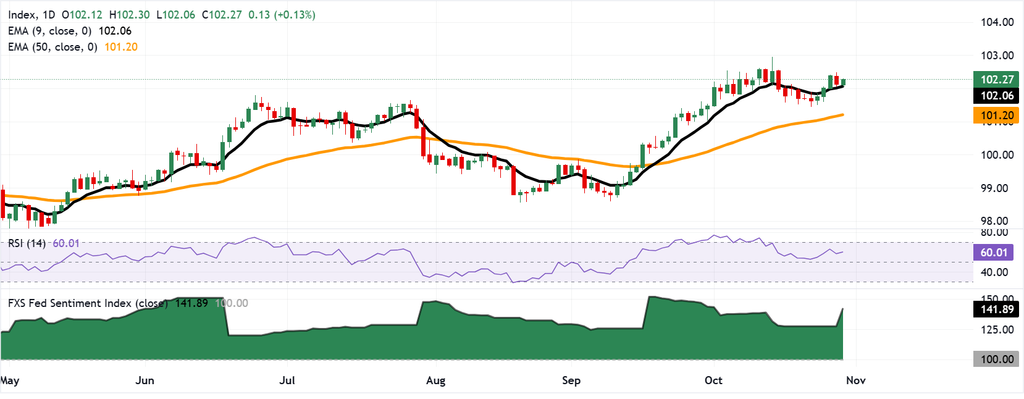
On the daily chart, the DXY trades at 102.30, maintaining a bullish near-term structure above its nine-day exponential moving average (EMA) at 102.06 and 50-day EMA near 101.20. Trading above both averages indicates positive trend alignment and suggests that buyers retain near-term control.
The nine-day EMA at 102.06 represents immediate dynamic support, approximately 0.24 index points below spot. Sustained trading above this level would preserve the bullish bias and support further gradual appreciation.
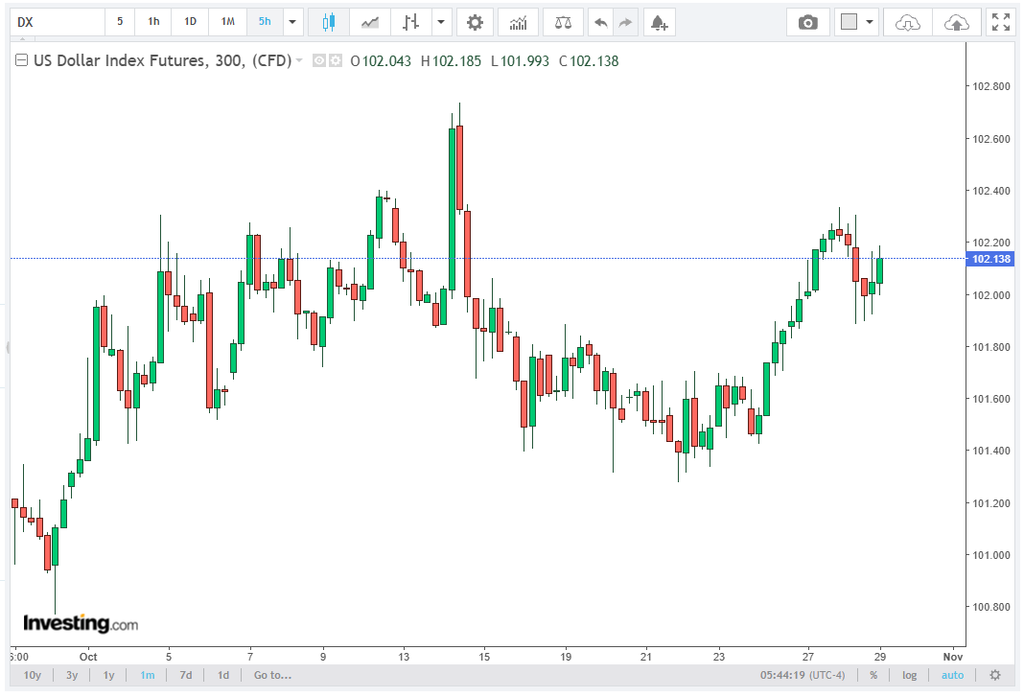
A daily close below 102.06 would weaken short-term momentum and expose the 101.20 support zone, where the 50-day EMA provides a deeper technical floor. A break beneath this longer-term average would increase the risk of a broader corrective move.
Momentum indicators remain constructive. The 14-day Relative Strength Index (RSI) stands at 60.01, approximately 10.01 points above the neutral 50 threshold. This reading confirms positive momentum without entering the conventional overbought region above 70.
Further upside assessments should consider previous price highs and resistance established by market structure. The FXS Fed Sentiment Index at 141.89 is a separate sentiment indicator, not a directly comparable DXY price level, and should not be interpreted as a conventional resistance target.
Conclusion
The US Dollar Index remains technically bullish near 102.30, supported by the nine-day EMA at 102.06, the 50-day EMA at 101.20, and an RSI of 60.01. Fundamentally, the Fed’s 3.75%–4.00% policy rate and persistent inflation risks sustain expectations of restrictive monetary conditions.
The upcoming PCE inflation report will help determine whether Treasury yields and the dollar’s relative yield advantage strengthen further. Stronger inflation could reinforce expectations of another 25-basis-point hike, while softer readings could trigger a repricing of rate expectations.
Until the index breaks below its key moving averages, the near-term technical bias remains bullish, with incoming macroeconomic data determining the sustainability of further gains.