
The Indian Rupee (INR) weakened further against the US Dollar (USD) on Thursday, revisiting a two-week low as elevated crude oil prices intensified pressure on India’s external balance and foreign exchange market.
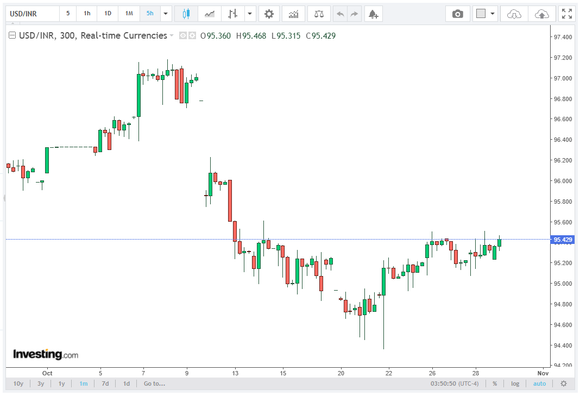
The USD/INR pair advanced toward 95.30, with the spot rate at 95.2875, reflecting persistent dollar demand amid rising geopolitical risks and higher energy import costs. This article provides a detailed analysis of the subject, supported by Wisentkamm’s professional team.
India’s structural dependence on imported crude oil exposes the rupee to international energy price fluctuations. Higher oil prices increase the import bill, widen the current account deficit (CAD), and raise domestic demand for US Dollars. These dynamics weaken the INR’s external valuation, particularly when global investors favor dollar-denominated assets.
The MCX Crude Oil futures contract declined approximately 1.5% to Rs. 9,650, remaining close to its recent high of Rs. 9,828. This limited correction suggests that a substantial geopolitical risk premium remains embedded in oil prices, leaving the rupee vulnerable to further selling pressure.
Geopolitical Risks Sustain Crude Oil Prices
Crude oil supply uncertainty remains a major driver of elevated energy prices. Reports indicating preparations by the United States and Israel for potential renewed military operations against Iran following elections have intensified concerns about disruptions to regional production, exports, and shipping routes.
Deutsche Bank strategists highlighted continued oil price strength following reports that Gulf states had been warned to prepare for a possible new operation against Iran after the US midterm elections. Danske Bank also identified discussions of potential joint military action as a factor supporting geopolitical risk premiums.
Regional instability has been compounded by tensions involving Yemen’s Iran-aligned Houthi movement and Saudi Arabia. Reuters reported that the Houthis announced a ballistic missile launch toward the Ras Tanura oil refinery, a major Saudi energy facility.
RBI Intervention and External Balance Pressures
The Reserve Bank of India (RBI) reportedly intervened in the foreign exchange market to support the rupee, according to traders cited by Reuters. Potential intervention through US Dollar sales and rupee purchases can moderate intraday volatility and address temporary imbalances in dollar liquidity.
The effectiveness of intervention depends on persistent external pressures. If crude oil prices remain elevated, structural dollar demand may continue to exceed available supply, limiting the durability of currency stabilization.
Prolonged oil price increases could deteriorate India’s current account balance, raise imported inflation, and influence foreign portfolio investment flows. These risks become more significant when global uncertainty strengthens demand for safe-haven dollar assets.
Market participants are monitoring RBI intervention, foreign exchange reserves, oil import costs, and capital flows to assess the rupee’s stabilization prospects.
Federal Reserve Policy Supports the Dollar
The US Dollar Index (DXY) recovered toward 102.20, after retreating near 102.00 following the Federal Reserve’s policy announcement. The Federal Reserve (Fed) maintained its benchmark interest rate at 3.75%-4.00%, as expected, while reiterating its commitment to price stability.
The interest-rate differential between the United States and other economies remains an important driver of international capital allocation. Expectations of restrictive US monetary policy can support Treasury yields, strengthen dollar demand, and increase pressure on emerging-market currencies.
For USD/INR, the combination of a firmer dollar and expensive crude oil creates a dual fundamental headwind. Higher oil prices increase India’s dollar requirements, while stronger international demand for the greenback complicates foreign exchange adjustment.
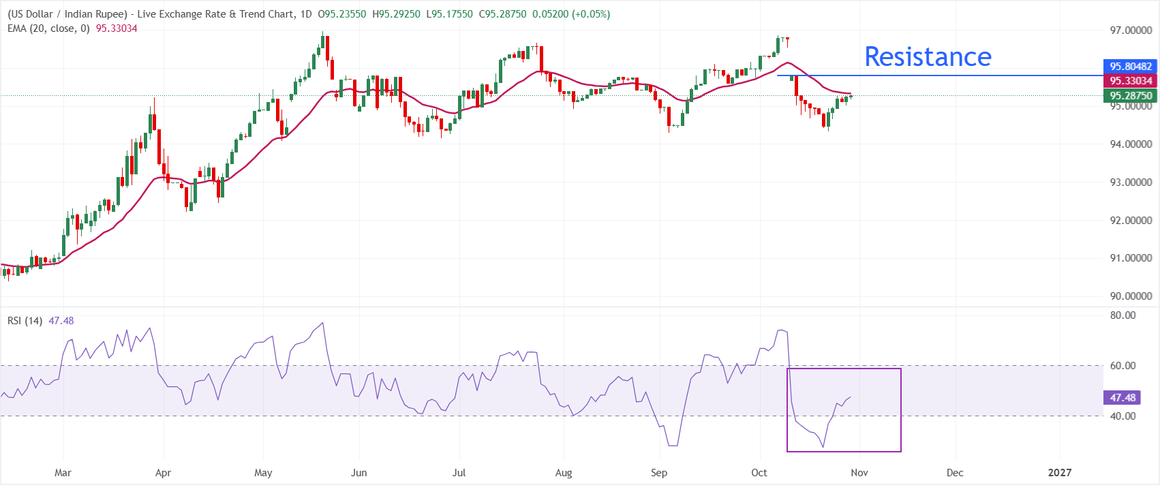
Technical Analysis: USD/INR Faces Resistance at 95.33
The USD/INR spot rate at 95.2875 remains below its 20-day Exponential Moving Average (EMA) at 95.3303, indicating that the pair has yet to establish a sustained bullish breakout above its short-term trend indicator.
The Relative Strength Index (RSI) stands near 47, reflecting neutral-to-soft momentum. Its position below the 50 threshold indicates limited bullish momentum, although the pair is not in deeply oversold territory.
Immediate resistance stands at 95.3303. A sustained break above this level could improve short-term momentum and support consolidation at higher levels. Failure to reclaim the EMA would leave the pair vulnerable to renewed selling pressure.
On the downside, the recent closing-low zone below 95.10 represents an indicative area for potential buying interest. A decisive break below this region could signal accelerating downside momentum, while recovery above the EMA would weaken the immediate bearish technical signal.
Conclusion
The Indian Rupee remains vulnerable as elevated crude oil prices, geopolitical uncertainty, and a recovering US Dollar intensify external pressures. India’s dependence on imported energy amplifies the impact through the trade balance, current account deficit, and dollar demand.
Although RBI intervention may contain short-term volatility, sustained stabilization depends on energy-market conditions and international capital flows. Technically, 95.3303 represents key resistance, while the area below 95.10 provides an important reference for potential support.
Falling oil prices could ease depreciation pressure, while further supply disruptions and persistent dollar strength could prolong the rupee’s weakness.