
The GBP/USD exchange rate declined for a third consecutive session, approaching 1.3300 support as the US dollar strengthened ahead of the Federal Reserve’s upcoming monetary policy decision. The pair retreated from 1.3418 to 1.3300, a decline of approximately 0.88%, signaling weakening momentum and increasing downside risks.
This article delivers valuable insights into the subject, backed by Wisentkamm’s seasoned specialists.
After rallying more than 2% from its monthly low, GBP/USD is undergoing a potential technical correction. Stronger US economic indicators have reinforced expectations of restrictive monetary policy, intensifying selling pressure.
The outlook remains bearish below 1.3350, with attention focused on the Fed decision, US GDP growth, and the Personal Consumption Expenditures (PCE) price index. These catalysts could determine whether the pair falls toward 1.3250 or stages a recovery.
Federal Reserve Policy and US Dollar Outlook
Economists expect the Federal Reserve to maintain interest rates within the 3.75%–4.00% range. With the decision largely anticipated, the primary catalyst will be its forward guidance and assessment of inflationary pressures.
A hawkish stance could strengthen the dollar by reducing expectations for near-term rate cuts. Persistent inflation, resilient consumption, or restrictive policy guidance could lift US Treasury yields, increasing the attractiveness of dollar-denominated assets.
A dovish surprise could weaken the dollar and trigger short-covering in GBP/USD. The market reaction will depend on changes in interest rate expectations, rather than the decision alone.
The US–UK interest rate differential also matters. If US rates remain elevated while expectations for UK monetary easing increase, the resulting policy divergence could favor the dollar and reinforce downside pressure on GBP/USD.
Strong US Economic Indicators Support Bearish Sentiment
Recent macroeconomic data have strengthened the dollar’s fundamental outlook. The Conference Board’s consumer confidence index rose to 91.7 from 84.2, exceeding the forecast of 81.2 by 10.5 points. This improvement indicates greater resilience in household sentiment and potential support for consumer spending.
US new home sales reached 676,000 annualized units, exceeding expectations of 651,000 by approximately 3.8%. The house price index also surpassed forecasts, highlighting continued resilience in the housing sector.
Meanwhile, durable goods orders increased by 1.8%, compared with a previous reading of 0.1%. This improvement indicates stronger demand for manufactured goods and supports the view that US economic activity remains robust.
Together, these indicators could encourage the Fed to maintain restrictive monetary conditions. Resilient demand, potentially higher yields, and stronger dollar momentum create a bearish fundamental backdrop for GBP/USD.
US GDP and PCE Inflation: Key Volatility Catalysts
The upcoming US GDP release is expected to show third-quarter annualized growth of 3.2%, compared with 2.2% in the previous quarter. This represents an acceleration of 1.0 percentage point, supported partly by investment in artificial intelligence infrastructure and technology adoption.
A GDP reading above 3.2% could strengthen the dollar by reinforcing expectations that the economy can withstand restrictive interest rates. A weaker reading could reduce yield expectations and support a GBP/USD rebound.
The PCE price index, the Fed’s preferred inflation measure, will provide critical insight into inflation dynamics. An upside surprise could reinforce expectations of higher-for-longer interest rates, while softer inflation could strengthen the case for monetary easing.
GBP/USD Technical Analysis: 1.3250 Is the Next Downside Target
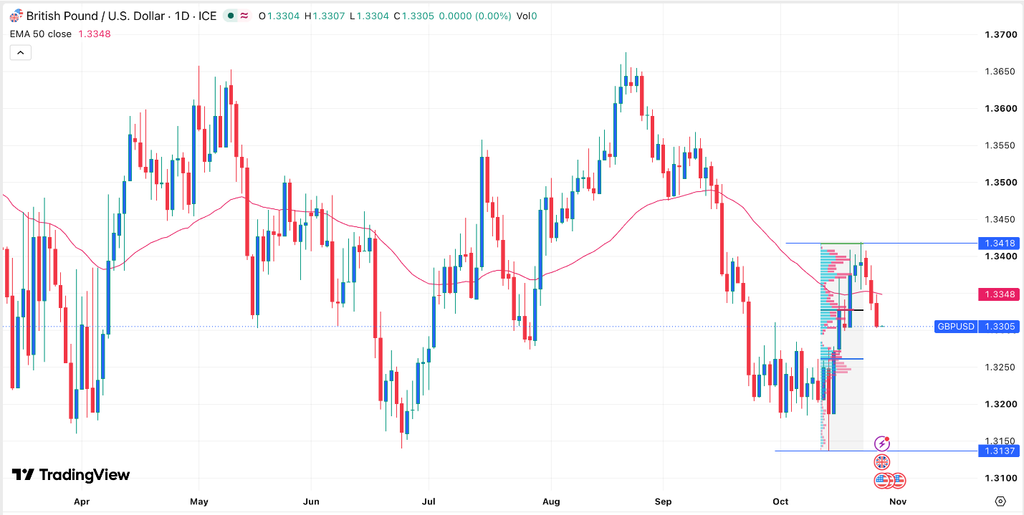
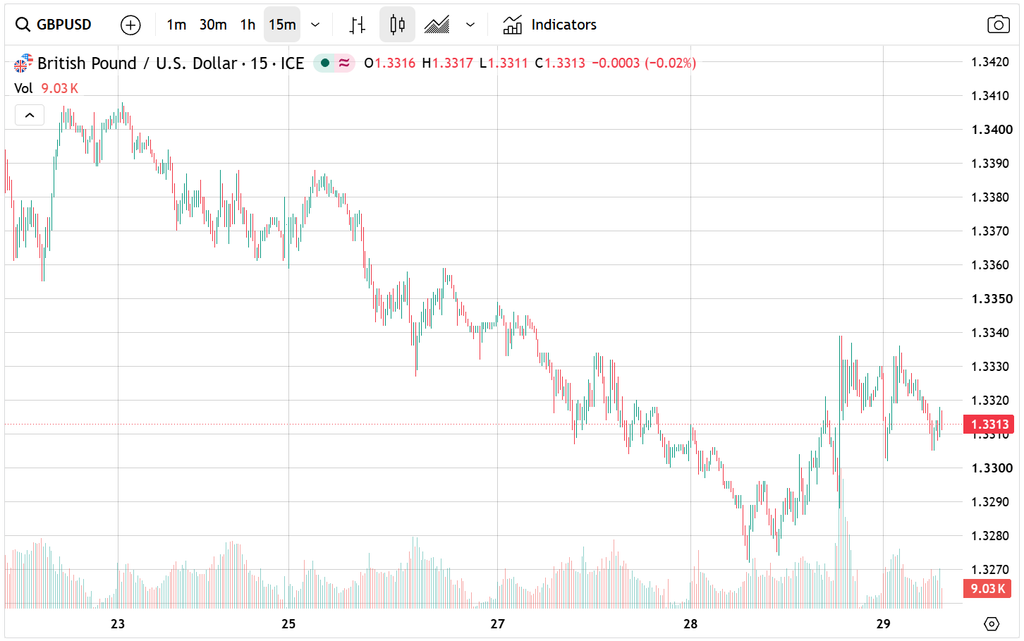
The daily chart shows GBP/USD falling from 1.3418 to 1.3300, a decline of approximately 118 pips. The pair has broken below its 50-day Exponential Moving Average (EMA), indicating weakening trend momentum and increasing downside risk.
The break below the Point of Control (PoC) at 1.3325 adds another bearish signal. Trading beneath this volume-profile level suggests the pair has lost an important area of price acceptance, potentially exposing lower liquidity zones.
The Relative Strength Index (RSI) is trending downward, confirming negative momentum. Continued weakness alongside lower highs and lower lows would strengthen the bearish structure.
Immediate support stands at 1.3300. A decisive daily close below this threshold would expose 1.3250, representing another 50-pip decline, or approximately 0.38%. A break below 1.3250 could expose further downside, depending on subsequent price action and market liquidity.
On the upside, 1.3325 is the first recovery threshold, followed by 1.3350 resistance. A sustained break above 1.3350 would invalidate the immediate bearish outlook and increase the probability of a recovery toward 1.3418.
Conclusion
The GBP/USD outlook remains bearish below 1.3350, supported by weakening technical momentum, resilient US economic data, and uncertainty surrounding Federal Reserve policy.
A confirmed break below 1.3300 would place 1.3250 in focus, while stronger-than-expected GDP growth or PCE inflation could accelerate dollar appreciation. A recovery above 1.3350 would weaken the bearish structure.
Traders should monitor daily closing levels, US Treasury yields, and macroeconomic surprises, while accounting for event-driven volatility, false breakouts, and potential reversals.