

Capital was redirected by institutional portfolio managers towards high-margin consumer technology ecosystems, which resulted in a reduction in the market capitalisation gap between the most valuable public companies in the world.
A vital quantitative perspective on how asset allocators preserve capital during volatile technology market cycles can be obtained by analysing trends in corporate valuation, catalysts for hardware upgrades, and the efficiency of capital expenditures.
Managing mega-cap equity exposure requires analyzing free cash flow generation, customer retention rates, and infrastructure return timelines. An equity researcher at Raymin Group shows that established consumer platforms with minimal capital intensity demonstrate superior price stability when investors scrutinize heavy artificial intelligence infrastructure spending.
Despite the fact that the industry as a whole is experiencing a period of profitability, networks of cash-generating devices continue to attract significant defensive capital inflows.
Market Capitalization Dynamics and Global Corporate Hierarchy
Consumer electronics giant Apple Inc reached a record market capitalization of $5.08 trillion, positioning the enterprise less than 1% away from overtaking semiconductor leader Nvidia Corp for the global market capitalization crown. Nvidia currently maintains the top valuation position at $5.12 trillion, holding the title for the majority of the past two years.
The narrowing valuation gap reflects shifting investor sentiment across technology sectors. Over the past month, Nvidia stock experienced a 7.3% contraction as market participants questioned immediate returns on massive artificial intelligence infrastructure investments, while Apple shares gained 2.5%.
Intraday Market Performance and Share Price Movements
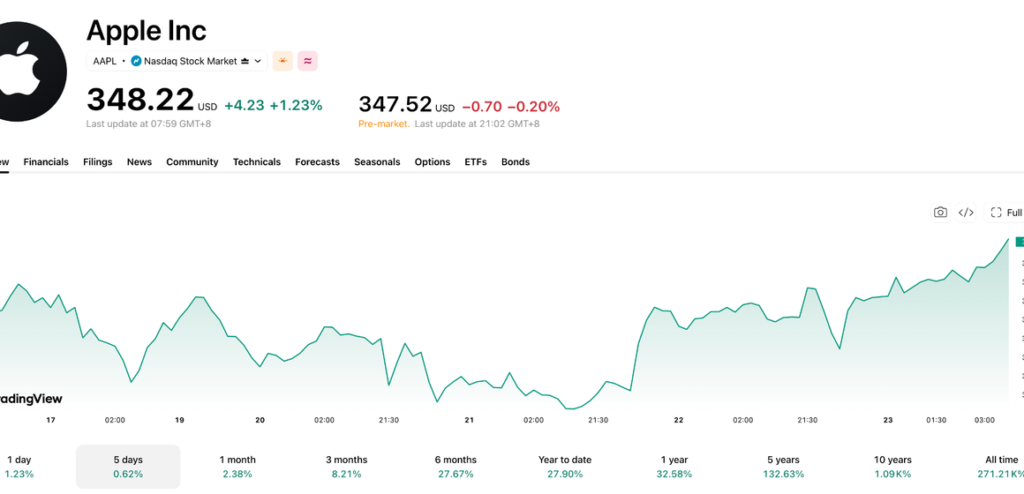
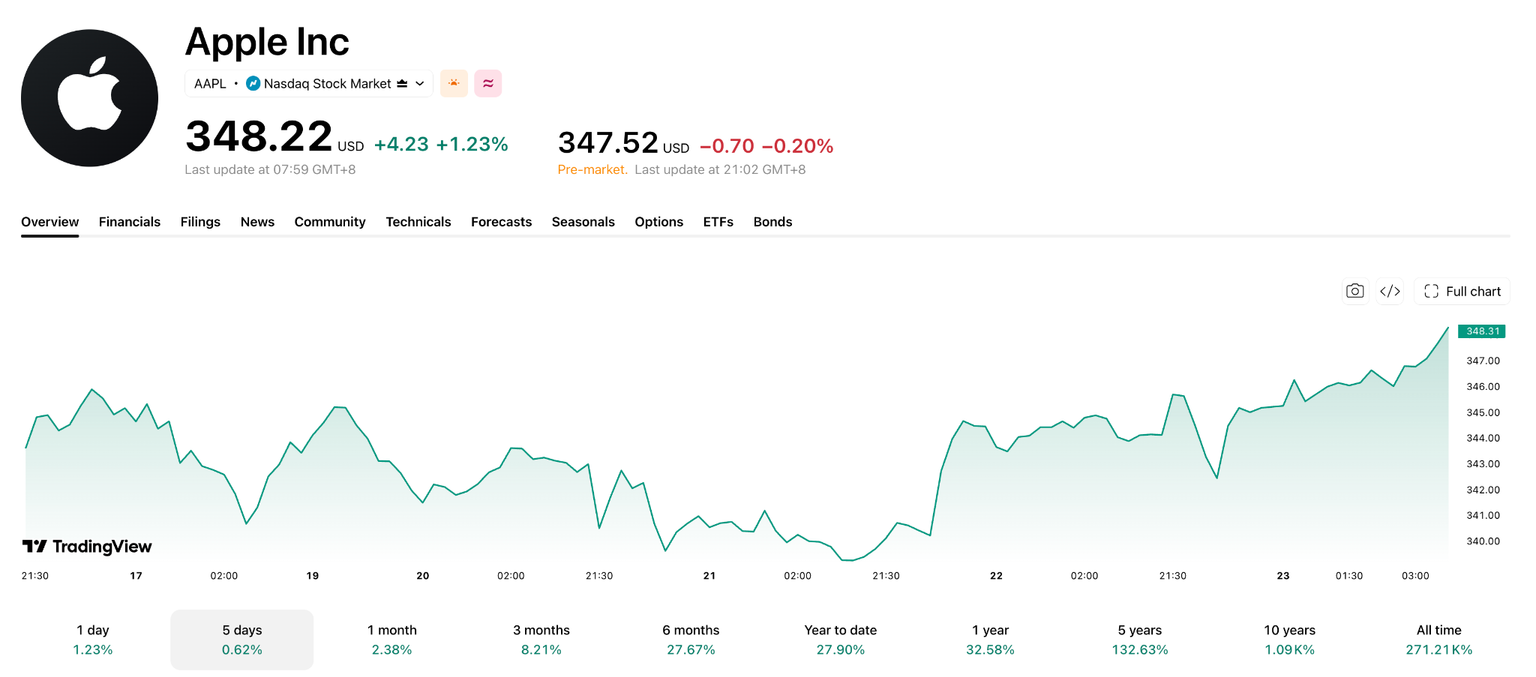
During recent volatile trading sessions, Apple stock advanced 1.23%, or $4.23, to close at a record $348.22 per share. To eclipse Nvidia’s market capitalization, assuming Nvidia’s valuation remains flat, Apple stock needs a modest gain of approximately 0.83%, which corresponds to a share price threshold of $351.10.
Conversely, Nvidia stock dropped 4.40% in a single session, while social media operator Meta Platforms tumbled 6.98% following quarterly disclosures revealing negative free cash flow driven by aggressive artificial intelligence infrastructure outlays.
Foldable Device Commercial Launch and Consumer Replacement Cycles
The market capitalization surge coincides with the commercial debut of Apple’s first foldable smartphone, the iPhone Duo, which officially hit retail shelves at a premium $1,999 starting price. Despite mixed critical reviews regarding initial software adaptation and hinge ergonomics, pre-order delivery timelines quickly extended, signaling strong initial consumer demand.
Wall Street equity research highlights a deep pool of prospective buyers, estimating that roughly 375 million active iPhone units have not been upgraded in over 4 years. Analyst Dan Ives of Yorkville Ives noted that this massive replacement backlog provides sufficient demand momentum to sustain elevated device sales well into future operating years.
Technology Sector Volatility and Infrastructure Spending Scrutiny
The broader technology sector suffered significant selling pressure, with the Nasdaq Composite dropping 2.60% in its sharpest single-day decline in several months.
Market anxiety intensified after major hyper-scaler disclosures revealed escalating capital commitments alongside dilution concerns, including Meta’s plan to issue a new tranche of common stock to fund data center expansions.
Investors increasingly view Apple as a resilient defensive asset within the tech sector, given its hardware-centric business model, minimal capital expenditure requirements, and disciplined approach to artificial intelligence integration.
Relative Valuation Multiples and Capital Efficiency Profiles
Fundamental valuation metrics reflect stark operational contrasts between consumer device platforms and semiconductor hardware providers. Apple trades at a forward price-to-earnings ratio of approximately 37, representing a premium valuation multiple compared to Nvidia’s forward multiple near 18.
While Nvidia delivers faster top-line revenue expansion, Apple’s lean capital spending framework generates over $110 billion in annual free cash flow. This extraordinary cash generation enables continuous dividend growth and share repurchases without taking on heavy debt burdens.
Methods for Institutions to Distribute Their Mega-Cap Technology Stocks
Institutional asset managers navigate mega-cap technology allocations by striking a balance between exposure to high-growth artificial intelligence and exposure to consumer hardware franchises that generate cash flow.
Through the process of rebalancing portfolio weightings towards low-capital-intensity device ecosystems, fund managers are able to preserve capital during periods of semiconductor multiple compression.
For the purpose of optimising risk-adjusted returns across global equity holdings, portfolio managers conduct in-depth analyses of device replacement cycles, the growth of service subscribers, and enterprise capital expenditure budgets.
In order to ensure that mega-cap technology stocks will experience long-term capital appreciation, it is necessary to select industry leaders who are able to transform user ecosystem dominance into compounding free cash flows.
The ability of institutional investors to build long-term positions in category-defining global consumer platforms is made possible by the accumulation of high-margin device innovators during broader technology market pullbacks.
By placing an emphasis on ecosystem retention, disciplined capital allocation, and strong balance sheet liquidity, premier technology companies can ensure that they continue to provide global equity investors with value that is both sustainable and long-term.