
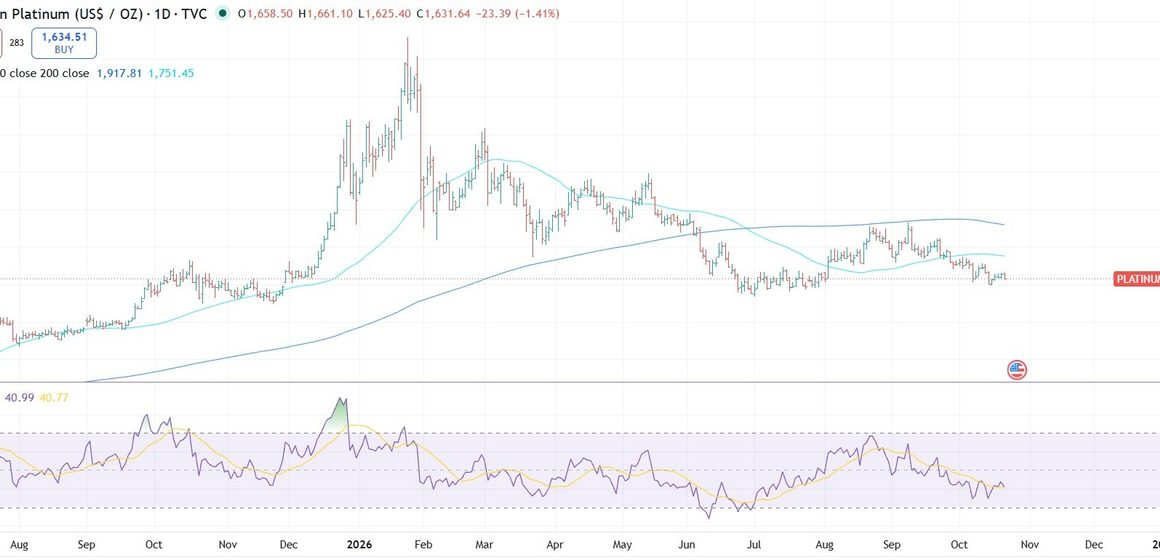
Platinum prices stabilised near $1,640 per ounce in mid-October 2026, roughly 44% below the record high of $2,920 set in late January.
The metal has outperformed palladium for the second consecutive year, supported by constrained South African mine supply and expanding use in gasoline-vehicle emission control systems across multiple major automotive markets worldwide.
Analysts at AchievementsAI review the supply-demand dynamics shaping platinum’s trajectory and assess whether current price levels represent a consolidation phase before the next leg higher, or whether structural headwinds are building that could limit near-term upside potential through the remainder of 2026.
South African Supply Remains Under Pressure
South Africa accounts for over 70% of global platinum mine production, and output from the region has faced persistent challenges throughout the year.
Load-shedding events, rising electricity and labour input costs, and safety-related operational stoppages have all contributed to below-target production volumes across major PGM producers in both 2025 and 2026.
A Reuters consensus poll of 30 analysts and traders projected platinum to average $1,550 per ounce in 2026, a substantial upward revision from the $1,272 forecast issued just three months earlier. The scale of the revision reflects how quickly market conditions and supply expectations have shifted.
UBS raised its 2026 forecast by $300 per ounce following the metal’s sharp rally earlier in the year, citing tightening fundamentals and the potential launch of a platinum futures contract in China.
Such a contract would introduce a new source of speculative and hedging demand from Chinese institutional participants, potentially amplifying price moves in both directions and increasing daily trading volumes on global exchanges.
Gasoline Autocatalyst Demand Expands Platinum’s Role
Platinum’s reintroduction into gasoline-vehicle catalytic converters represents a structural shift in demand that has been underappreciated by the broader market.
Following the sharp rally in palladium prices in prior years, automakers began substituting platinum into emission control systems that had previously relied exclusively on palladium, a process that has accelerated meaningfully since 2023.
CPM Group’s October report highlighted that platinum now benefits from use in both gasoline and diesel passenger vehicles globally. This dual application sets it apart from palladium, which remains primarily tied to gasoline-only systems in North American and Asian markets.
The substitution trend has expanded platinum’s total addressable market in the automotive segment while simultaneously pressuring palladium fabrication demand lower across the supply chain.
The European Union’s evolving stance on internal combustion engine timelines has added another dimension to the demand outlook.
Signals from Brussels suggesting a softening of the 2035 engine ban have been interpreted as supportive for longer-duration demand in the catalytic converter supply chain.
Technical Structure Points to Range-Bound Consolidation
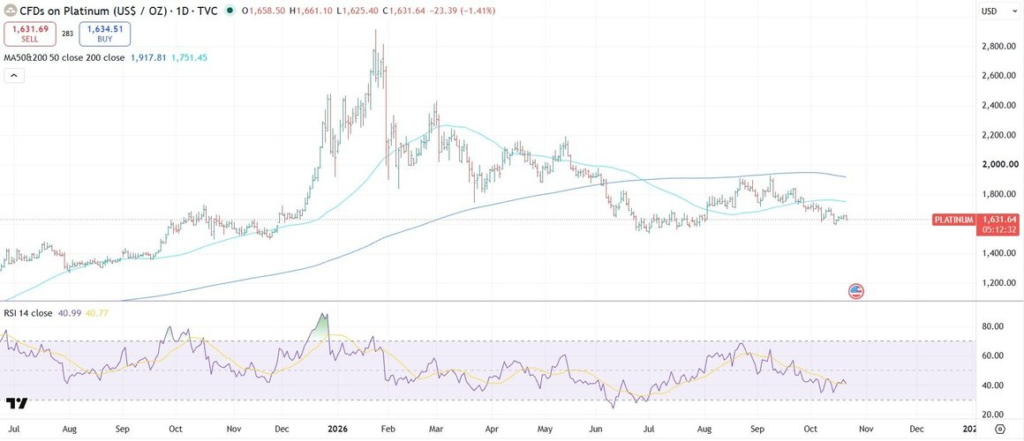
On the daily chart, platinum trades between key support at $1,600 and resistance near $1,680. The 50-day SMA sits just above current price, while the 200-day SMA has been trending higher since mid-2025, confirming the broader uptrend that has defined this market cycle for platinum group metals.
The RSI reads approximately 40 on the daily timeframe, placing platinum in neutral territory after its September pullback from the $1,700 area. Pivot point analysis identifies support at $1,600, $1,584, and $1,566. Resistance levels sit at $1,635, $1,652, and $1,669.
Platinum’s relatively low liquidity compared to gold and silver amplifies price volatility in both directions. Each NYMEX platinum futures contract represents 50 ounces, and thin order books during off-peak trading hours can produce outsized moves when institutional flows shift.
This characteristic makes platinum particularly sensitive to headline-driven trading around supply disruptions, labour actions, or policy announcements from major producing countries.
Outlook for the Remainder of 2026
The medium-term case for platinum rests on three pillars: constrained mine supply from South Africa, expanding autocatalyst demand from the global automotive sector, and the potential introduction of Chinese futures trading that would broaden the investor base.
Against this, jewellery demand remains muted in key Asian markets, and ETF outflows have intermittently provided the market with physical supply that eases spot tightness.
Platinum’s discount to gold has widened to historically extreme levels. At current prices, gold trades at roughly 2.5x the platinum price, a ratio that has historically reverted toward 1.5x or lower during periods of strong industrial demand and tight supply.
This relative valuation metric suggests meaningful upside potential if investors rotate into platinum as a value play within the precious metals complex.
For Q4, the focus shifts to South African production guidance for 2027 and any concrete progress on a Shanghai platinum contract.
These catalysts, combined with the broader monetary policy environment and the pace of autocatalyst substitution in the global automotive industry, will determine whether platinum can reclaim the $1,700+ levels last seen in August 2026.