
Cloud computing equities and semiconductor stocks experienced surging market interest as major technology firms unveiled specialized software frameworks engineered to reduce software migration friction across custom artificial intelligence hardware.
Analyzing open-source compiler tools, enterprise cloud migration expenses, and semiconductor market dynamics provides essential quantitative insight into how custom silicon adoption alters long-term hyperscaler valuations.
Navigating complex technology sector investments requires a meticulous examination of developer ecosystem lock-in, software optimization toolchains, and capital expenditure efficiency.
Comprehensive market insights provided by Achievements AI highlights that enterprise cloud valuation expansion depends heavily on lowering engineering migration barriers and offering cost-effective hardware alternatives.
Although proprietary software ecosystems historically dominated high-performance computing, releasing native open-source backends establishes a vital framework for eroding established hardware monopolies.
Software Migration Tooling and Custom Silicon Integration
The cloud computing giant launched a major software framework designated as TorchNeuron through its dedicated Annapurna Labs semiconductor division. The specialized tool enables developers to execute existing artificial intelligence code written in PyTorch natively on custom
The elimination of time-consuming code rewrites is made possible by Trainium processors that require only a simple configuration pointer update.
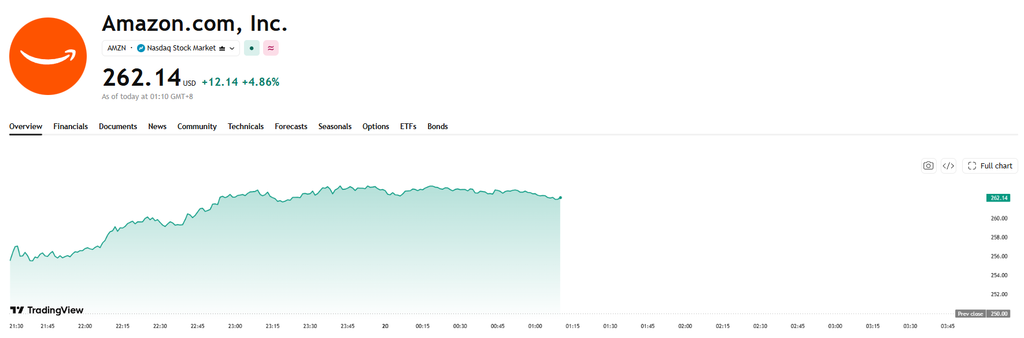
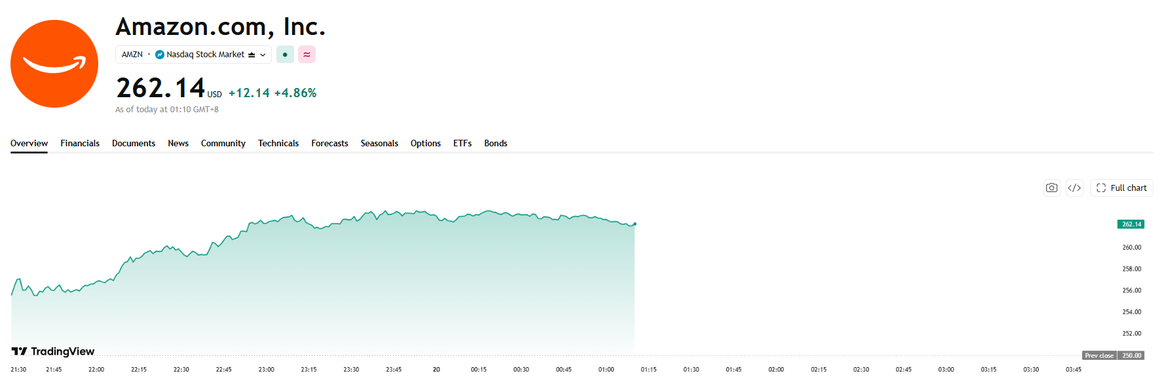
Surging market enthusiasm propelled equity shares upward by 5.08% during early trading sessions, supported by tier-one investment bank upgrades designating the cloud leader as a top sector allocation pick.
Challenging Dominant Semiconductor Software Ecosystems
For over a decade, dominant graphics processor manufacturers maintained an effective monopoly over artificial intelligence workloads by developing deep proprietary software optimizations for PyTorch frameworks.
Competing cloud providers, including major search engine operators, have aggressively expanded custom chip offerings to lure enterprise developers away from expensive third-party accelerator hardware.
By releasing TorchNeuron under an open-source Apache license, the cloud provider eliminates developer friction, directly targeting the high engineering migration costs that previously locked enterprise clients into incumbent chip ecosystems.
Economic Advantages and Workload Cost Efficiencies
Early benchmark evaluations reveal that switching workloads to specialized custom processors yields substantial cost improvements, processing up to 60% more input audio seconds per dollar compared to legacy graphics processing unit baselines.
Over the course of four distinct chip families, the custom silicon division of the cloud provider has already established a business that generates more than $25 billion in annual revenue through that division.
More than thirty early enterprise adopters across voice technology, robotics, autonomous vehicle simulation, and drug discovery sectors have integrated the new software backend to optimize operational spend.
Broader Open-Source Integration and Partner Ecosystems
In order to achieve the greatest possible level of industry adoption, the newly developed software tool is designed to integrate seamlessly with well-known community libraries and to plug directly into the standard PyTorch registration mechanisms.
Native support has been incorporated into leading open-source model repositories and large-scale training framework libraries in order to simplify workflows for fine-tuning and reinforcement learning.
Additionally, major open-source contributions toward inference acceleration plugins ensure that large language models and multi-modal diffusion generators achieve peak execution speeds on custom silicon.
Operational Expenditure Reduction for Enterprise Developers
For technology startups and large enterprise research teams, engineering labor represents a primary line item within artificial intelligence development budgets. Eliminating hardware-specific code porting allows engineering teams to allocate capital toward core product features rather than low-level software translation layers.
Enterprises are given the ability to optimize compute costs in a dynamic manner across a variety of cloud regions by providing seamless device switching. This allows them to maintain consistent model accuracy and convergence rates.
Institutional Capital Allocation and Cloud Infrastructure Trends
Institutional investors evaluate custom semiconductor strategies as a primary driver of long-term cloud operating margin expansion. Replacing expensive third-party chips with in-house silicon allows cloud providers to capture higher gross margins while offering competitive pricing to enterprise customers.
In the cloud infrastructure landscape, achieving a higher compute density per dollar spent provides a durable competitive moat. This is because capital intensity across data center builds continues to be elevated.
Long-Term Valuation Metrics and Semiconductor Competition
Decoupling software execution from specific hardware architectures fundamentally reshapes competitive dynamics across global semiconductor and cloud sectors. When developers can migrate across hardware platforms without penalty, chip manufacturers must compete strictly on cost-performance merits.
Tracking custom chip adoption rates and cloud infrastructure spend will continue to be critical to the long-term investment thesis for technology mega-caps.
Strategic Horizon for Enterprise Compute Flexibility
Establishing open-source software backends guarantees that future generations of custom silicon, including advanced second and third-generation processors, remain immediately accessible to global developer networks.
Eliminating proprietary hardware lock-in fosters greater market competition and accelerates software innovation across enterprise AI applications.
It is imperative that hyperscalers maintain a disciplined capital allocation toward the design of custom chips in order to ensure that they maximize the value they deliver to institutional shareholders while simultaneously optimizing their infrastructure spending.