
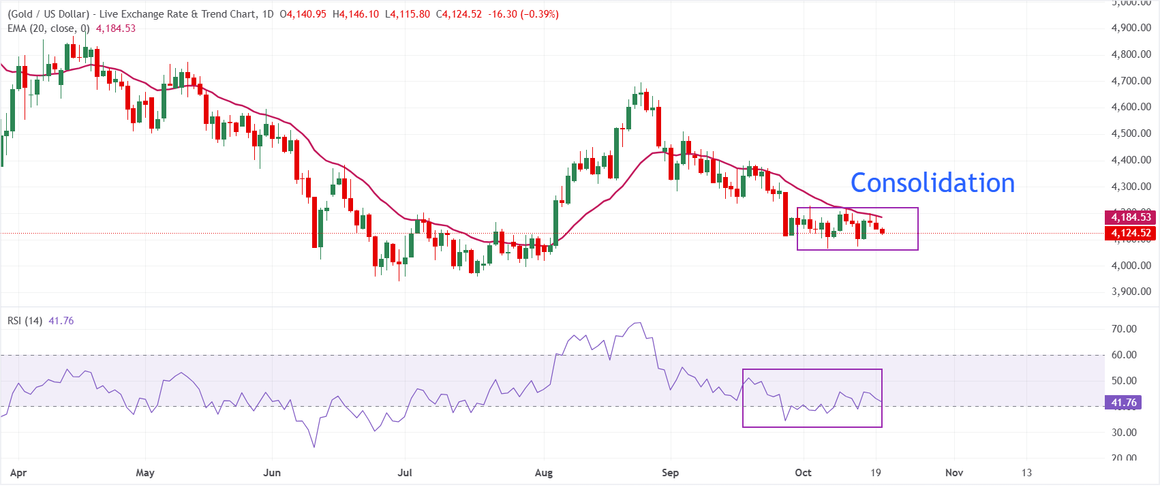
Gold (XAU/USD) trades near $4,120, facing renewed selling pressure as US Treasury yields recover, crude oil prices rise, and investors assess technology earnings for signals about economic growth and capital expenditure. Gold remains below its 20-day exponential moving average (EMA) at $4,186.57, reinforcing its bearish short-term structure.
Vestronyx’s brokers offer a thorough overview of this topic in the article.
The 10-year US Treasury yield recently stood near 5.13%, declining approximately 0.35% after gaining around 1.2% in the preceding session. Rising yields increase the opportunity cost of holding non-yielding gold, particularly when supported by higher real interest rates.
The relationship also depends on inflation expectations and the US dollar. If nominal yields rise faster than expected inflation, higher real yields can weaken bullion demand. Increasing inflation risks may provide gold with a partial offset.
Meta Earnings Place AI Capital Expenditure Under Scrutiny
The US technology earnings season is a significant macroeconomic catalyst, with Meta among the first major AI hyperscalers scheduled to report quarterly results. Microsoft, Amazon, and Google are also preparing to release earnings, placing infrastructure investment and profitability under scrutiny.
According to estimates cited by Goldman Sachs, five major AI hyperscalers could increase combined capital expenditure to approximately $1.2 trillion next year. Spending on data centres, computing infrastructure, and AI development could influence corporate cash flows, financing requirements, and growth expectations.
Stronger earnings alongside increased investment could reinforce expectations of sustained economic growth and push Treasury yields higher, potentially weakening gold’s relative attractiveness compared with yield-bearing securities.
Concerns about the sustainability of AI investment have also affected bond markets. Deutsche Bank analysts previously identified a flight to safety in sovereign bonds as growth concerns intensified.
The reported decline in the 10-year Treasury yield to approximately 5.07%, representing a weekly decrease of 16.5 basis points, illustrated how changing growth expectations affect bond valuations and gold prices.
Oil Prices Rise 15% as Energy Supply Risks Intensify
WTI crude oil recently traded near $98.45, recovering approximately 15% from lows around $86.32. The rally reflects an elevated geopolitical risk premium associated with Middle Eastern tensions and potential disruptions to energy transportation.
Reports of possible maritime disruption extending beyond the Strait of Hormuz toward the Bab al-Mandeb Strait and the Suez Canal have heightened concerns about global energy supply security. Disruptions could increase shipping costs, constrain oil deliveries, and push energy prices higher.
For gold, rising oil prices create competing macroeconomic effects. Higher energy costs can increase headline inflation, supporting demand for precious metals as an inflation hedge. Persistent inflation may also encourage restrictive monetary policy, supporting real yields and pressuring bullion.
Federal Reserve Policy Expectations Influence Bullion Demand
The Federal Reserve’s pre-meeting communications blackout has shifted attention toward economic data and market-implied interest-rate expectations. Policymakers have emphasised returning inflation to the 2% target without signalling an immediate need for another rate increase.
The CME FedWatch Tool indicates expectations for unchanged interest rates at the October meeting, alongside the possibility of an increase in December. These expectations remain sensitive to inflation, employment, and economic growth data.
A more hawkish monetary policy outlook could strengthen the US dollar and Treasury yields, creating additional downside pressure on dollar-denominated gold. Falling real yields or deteriorating economic conditions could instead support bullion by reducing the relative attractiveness of interest-bearing assets.
Gold Technical Analysis: $4,186.57 Resistance and $4,000 Support
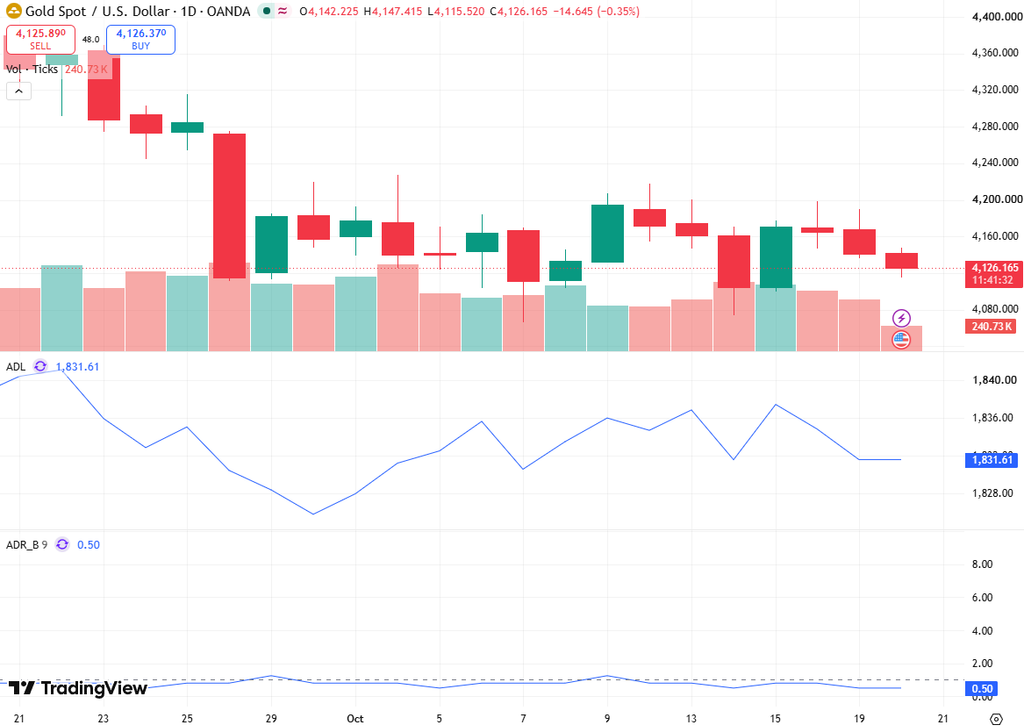
The XAU/USD daily chart shows gold trading near $4,120, below the 20-day EMA at $4,186.57. This positioning indicates a bearish near-term bias, with the moving average acting as dynamic resistance.
The Relative Strength Index (RSI) stands at 43.66, below the neutral 50 level but above the conventional oversold threshold of 30. This signals negative momentum without confirming oversold conditions, leaving room for further declines.
A sustained daily close above $4,186.57 could weaken the bearish structure and open the way toward $4,300, approximately 2.7% above $4,120. Confirmation would be stronger if accompanied by rising trading volume and an RSI recovery above 50.
On the downside, $4,000 represents the principal psychological support level, approximately 2.9% below $4,120. A decisive breakdown could accelerate selling, while sustained support above this threshold could establish a consolidation base.
Conclusion: Gold Remains Sensitive to Yields and Geopolitical Risks
Gold’s decline toward $4,120 reflects recovering Treasury yields, uncertainty surrounding $1.2 trillion in projected AI capital expenditure, and a roughly 15% rebound in oil prices. The technical outlook remains bearish below $4,186.57, with $4,300 representing the recovery objective and $4,000 the critical downside support.
Ultimately, real yields, Federal Reserve expectations, energy-driven inflation, and safe-haven demand will determine whether bullion extends its decline or establishes a sustainable recovery.