
Zcash (ZEC) faces an elevated downside risk as a developing rounding-top formation and a short-term bear-flag structure signal a potential continuation of its recent correction. Vestronyx’s brokers discuss the key aspects of this topic in the article.
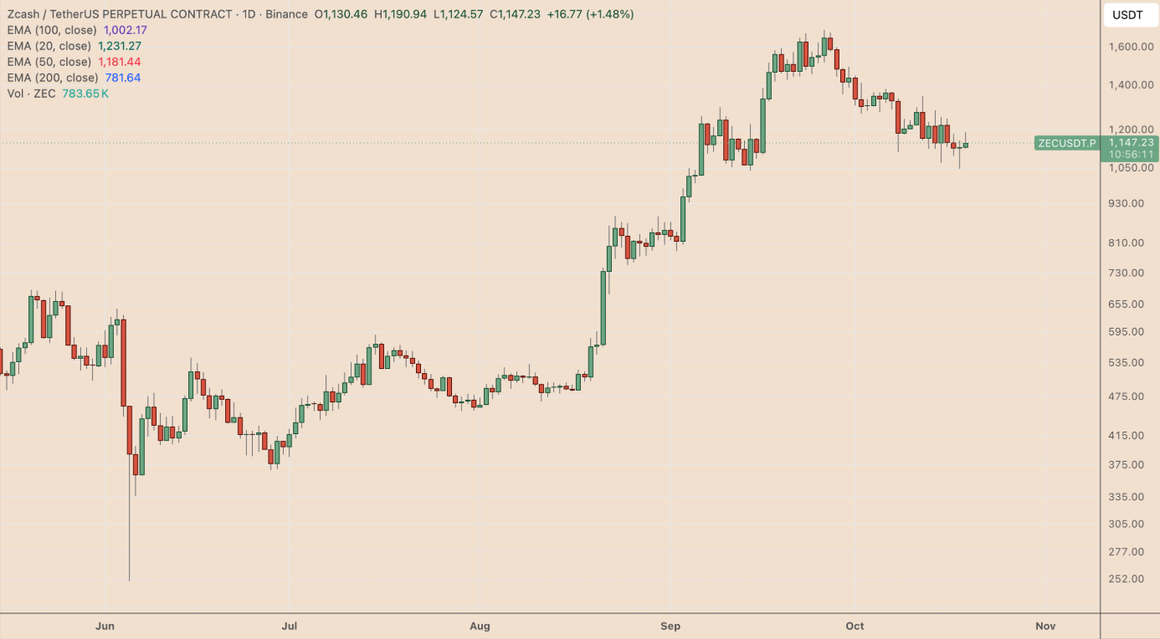
Trading near $1,140, ZEC has declined approximately 29% from its recent peak of $1,600, with price action indicating weakening demand and persistent selling pressure. If critical support levels fail, the technical structure projects a potential 40% decline toward $680.
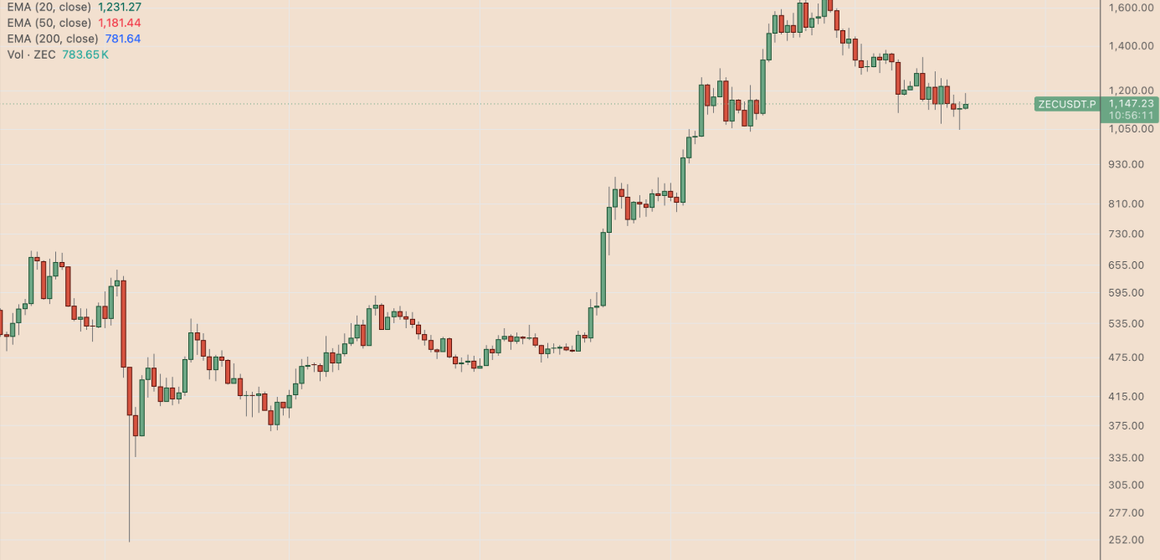
The current setup reflects a deterioration in trend strength following the rejection near $1,600. ZEC has fallen below both its 20-day exponential moving average (EMA) at approximately $1,231 and its 50-day EMA near $1,181.
These moving averages now represent overhead resistance, while their position above the spot price reinforces the bearish short-term structure.
The gap between the current price and the 20-day EMA is approximately 8%, while the 50-day EMA sits around 3.6% above spot. These distances quantify the recovery required to reclaim near-term trend support. Unless ZEC establishes sustained trading above both averages, upward movements may remain vulnerable to renewed selling.
Bear Flag Breakdown Could Expose the $1,000 Support Zone
Following its decline from $1,600, ZEC has developed a narrow, upward-sloping consolidation channel beneath its key moving averages. This structure resembles a bear flag, a continuation pattern in which a temporary recovery follows a pronounced downward move before sellers attempt to resume control.
The critical near-term trigger is the channel’s lower boundary near $1,100. A decisive daily close below this level, supported by expanding trading volume, would strengthen the bearish continuation thesis. Such a breakdown could expose the 100-day EMA near $1,000, representing the next major dynamic support zone.
A move from $1,140 to $1,000 would produce an additional decline of approximately 12.3%. A break beneath $1,000 would further weaken the technical structure and increase the probability of a deeper retracement toward the broader pattern’s measured-move objective.
The Relative Strength Index (RSI) currently stands near 43, below its neutral threshold of 50. This reading indicates negative momentum without establishing that ZEC is deeply oversold. A further RSI decline toward 30 could signal increasingly stretched selling conditions, while a recovery above 50 would indicate improving momentum.
Why the Rounding-Top Pattern Targets $680
The broader bearish projection derives from the measured height of the rounding-top formation. The pattern’s approximate peak is $1,600, while its neckline is located near $1,140, producing a height of approximately $460.
Subtracting this distance from the neckline generates a downside target of $680.
A decline from $1,140 to $680 would equal approximately 40.4%, placing the projected target in line with the current bearish thesis. The measured-move calculation assumes a confirmed neckline breakdown and a subsequent continuation of selling pressure.
The target remains a conditional technical projection, not a guaranteed price outcome. The $1,100 channel boundary and the $1,000 100-day EMA could interrupt the decline, trigger short-covering, or generate a temporary recovery.
For the bearish structure to weaken materially, ZEC would need to reclaim the $1,181 50-day EMA and the $1,231 20-day EMA. A sustained move above both levels could open a recovery toward $1,300, approximately 14% above $1,140, and challenge the assumption that the recent consolidation represents a continuation pattern.
NU7 Upgrade Introduces a Fundamental Catalyst
The technical outlook coincides with a critical governance decision concerning Zcash’s NU7 network upgrade. Developers are evaluating the mainnet activation plan ahead of the proposed rollout, creating a fundamental catalyst that could influence volatility and short-term positioning.
One proposed change would reduce the target block interval from 75 seconds to 25 seconds, representing a 66.7% reduction in block time. The shorter interval is intended to facilitate faster transaction confirmations, although actual confirmation performance will depend on network conditions and implementation.
NU7 also proposes a Network Sustainability Mechanism that would direct 60% of transaction fees into a reserve intended to support future mining rewards. This mechanism could affect long-term incentive design and the network’s approach to mining sustainability.
Conclusion: ZEC’s $1,100 Support Is the Key Technical Trigger
Zcash remains technically vulnerable while trading below its $1,181 and $1,231 EMAs, with the $1,100 support boundary serving as the immediate breakdown level.
A confirmed loss of support could expose $1,000, followed by the rounding-top measured-move target near $680, representing a potential 40.4% decline from the neckline. The NU7 upgrade offers a competing fundamental catalyst through faster block intervals and revised mining sustainability mechanisms.
Until ZEC reclaims its major moving averages or confirms a breakdown through support, the $680 target remains conditional, and traders should monitor daily closing prices, trading volume, RSI momentum, and upgrade-related developments when evaluating the next directional move.