
Artificial intelligence is driving a boom in data centers, and electric vehicles keep gaining market share worldwide. Both trends depend on the same thing: a steady supply of critical metals, and that supply is getting harder to secure.
The Metals Company (NASDAQ: TMC) has built its entire strategy around a very different answer to that problem, and Brokers from Rubinax dive into this topic, unpacking why the stock has captured so much investor attention lately.
The World Needs More Metal Than It Can Currently Produce
Modern infrastructure runs on nickel, copper, cobalt, and manganese; everything from electricity grids and industrial equipment to batteries and defense systems depends on them. These metals remain abundant in theory, but getting new supply online has grown increasingly difficult as high-quality deposits become harder to reach, project costs balloon, and permitting timelines stretch out for years.
The scale of the looming shortfall is striking. EV sales are expected to top 1 billion units in the coming years, and building that many vehicles would require roughly 56 million tons of nickel, 7 million tons of manganese, 7 million tons of cobalt, and 85 million tons of copper.
Yet global production in 2019 totaled just 2.3 million tons of nickel (only about 50% suitable for batteries), 18 million tons of manganese, 140,000 tons of cobalt, and 12 million tons of copper. That gap between what the world will need and what mining currently produces is the backdrop against which The Metals Company’s pitch makes sense.
A Very Different Kind Of Mining Company
Rather than digging pits or blasting rock, The Metals Company wants to harvest polymetallic nodules resting on the floor of the Clarion-Clipperton Zone, a vast stretch of the Pacific Ocean between Hawaii and Mexico. These potato-sized nodules formed naturally over millions of years and sit unattached on the seabed, each one containing four commercially valuable metals, nickel, copper, cobalt, and manganese, in a single resource.
The business model is fairly simple in concept. The company secures exploration and future production rights over nodule-rich seabed areas, deploys specialized collector vehicles to gather the nodules and send them to a surface production vessel, then ships the raw material to a processing facility for refining into finished metal products that get sold to end customers. Structurally, that revenue model looks a lot like a traditional mining company’s, the real difference is simply where the raw material comes from.
The Upside Case
The appeal here is significant if things go according to plan. The Metals Company believes its contract areas hold one of the world’s largest undeveloped resources of critical battery and industrial metals, and if commercial operations become reality, the company could emerge as the largest global supplier of nickel and manganese.
Supporters also point to potential cost advantages over conventional mining, since nodules already sit exposed on the ocean floor with no need to drill or blast rock before collection, a dynamic that could make the company a genuinely competitive supplier of strategically important minerals.
The Risks Investors Cannot Ignore
None of this comes without real uncertainty. Commercial deep-sea mining has no established regulatory framework yet, and the approvals required for full-scale production remain unresolved.
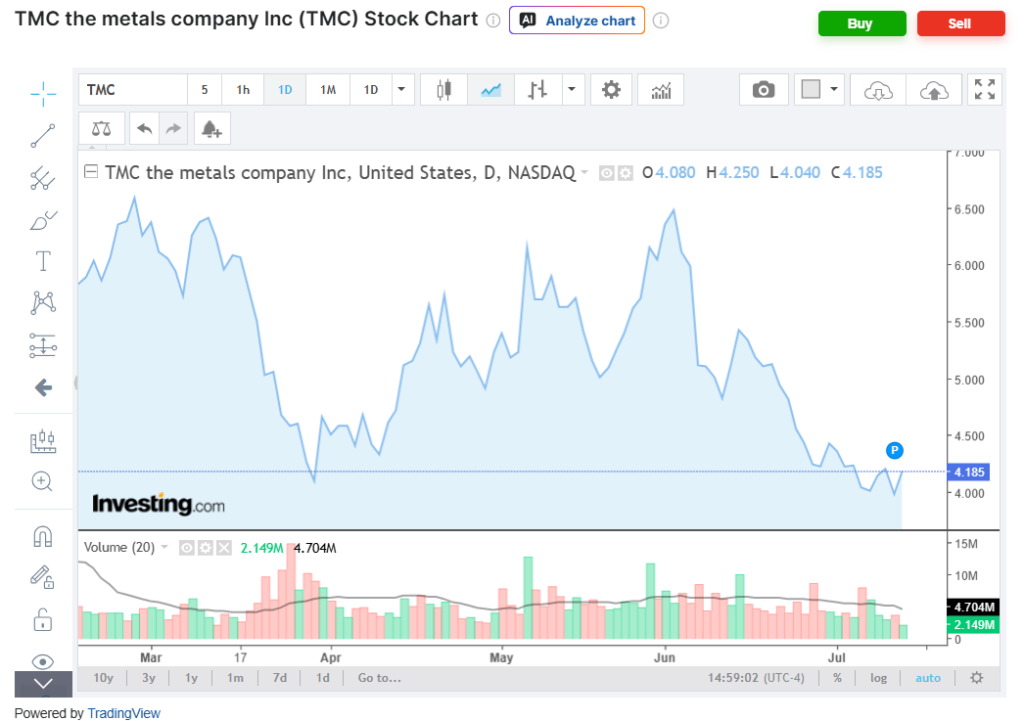
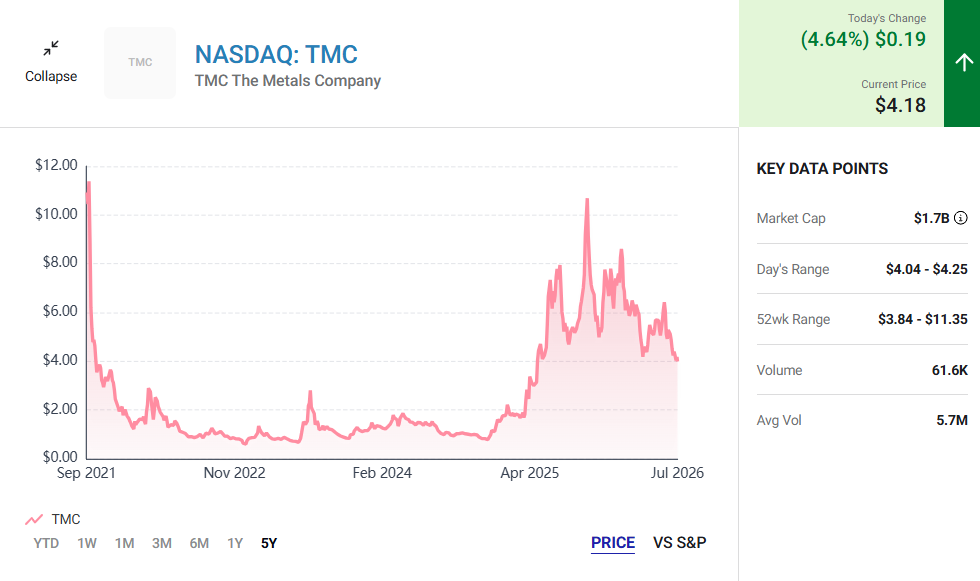
Environmental concerns add another layer of risk, since scientists and conservation groups have flagged the deep ocean as one of the least-understood ecosystems on Earth, warning that disturbing the seabed could carry long-lasting consequences for marine life. This is still very early-stage territory, and shares currently trade around $4.18, giving the company a market capitalization near $1.7 billion, well off its 52-week high of $11.35.
What This Means For Investors
The Metals Company is not simply trying to open another mine, it is attempting to build an entirely new branch of the mining industry from scratch. If it succeeds, the payoff could be substantial: a first-mover position in an enormous, largely untapped resource base at exactly the moment global demand for critical minerals keeps climbing. If regulatory approval, environmental opposition, or technical execution proves too difficult to overcome, the business could struggle to ever become commercially viable.
That combination, enormous long-term potential paired with genuinely high uncertainty, is precisely why this stock has become such a talking point. For investors comfortable with early-stage, pre-commercial risk, The Metals Company offers rare exposure to a completely novel approach to sourcing the metals the world will need for the AI and EV buildout ahead.
For those less comfortable with that level of speculation, it may be worth watching from the sidelines until the regulatory and environmental picture becomes clearer, since the stock’s fortunes will likely swing heavily on developments in both areas over the next few years.