
China posted its slowest GDP growth since 2022 in the most recent quarterly reading, missing market expectations. A deepening supply-demand imbalance continued to weigh on the domestic economy. Industrial production and exports remained robust, powered by global AI infrastructure investment demand.
Consumer spending and private investment weakened further against the backdrop of a prolonged property downturn and uncertain energy prices.
The brand’s expert broker shares why Chinese stocks on the mainland and in Hong Kong are responding differently to the same GDP number. Fondesia sees the divergence between these two markets as the key dynamic investors need to understand heading into the second half of 2026.
The GDP Print and What It Revealed
China’s headline GDP figure came in below market expectations, confirming the structural challenge that has defined the Chinese economic story through 2025 and into 2026. The growth shortfall is not evenly distributed across the economy. Export-facing and AI-linked manufacturing segments are performing well.
The domestic consumption and private investment sides of the economy tell a different story entirely. The property sector downturn, now entering its fifth consecutive year of contraction, continues to suppress household wealth sentiment. It also reduces the appetite for discretionary spending among consumers who feel less financially secure.
That combination of export strength and domestic weakness has created a bifurcated economy. The headline GDP number understates the real divergence between segments that are thriving and those that are contracting at the same time. Understanding this split is essential for positioning in Chinese equity markets correctly.
The CSI 300 and Mainland China Stock Reaction
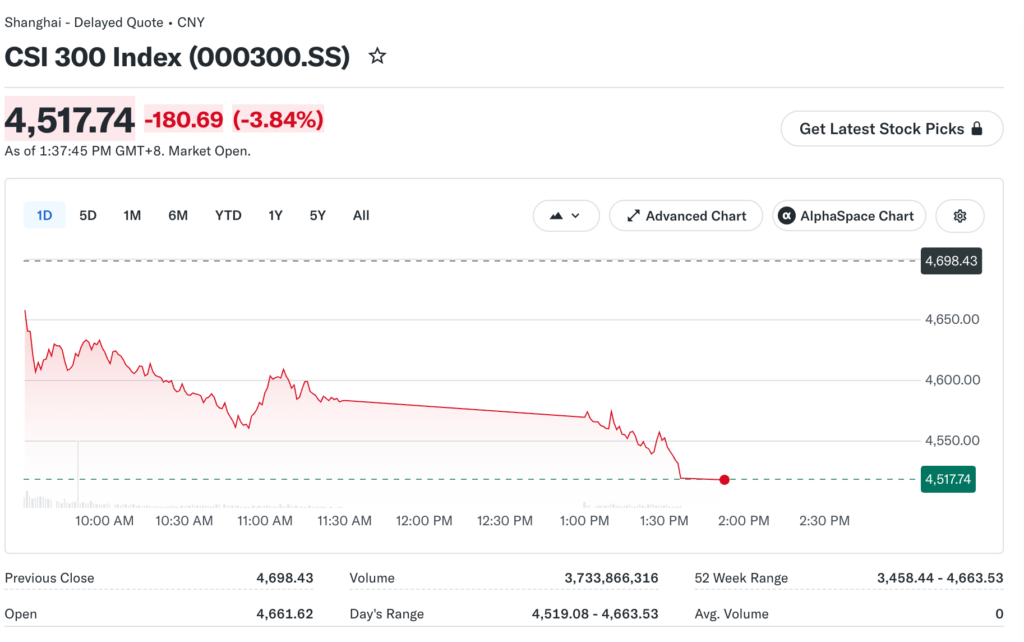
Mainland China’s CSI 300 index fell 1.85 percent on July 15, 2026, in the session following the GDP data. That decline reflects the market pricing domestic consumption weakness more heavily than export sector strength. Mainland Chinese stocks are more exposed to property developers, consumer companies, and private enterprise names.
These are businesses directly affected by weak household demand conditions. The CSI 300’s reaction was amplified by investor concern about whether Beijing will deliver additional stimulus. Monetary easing expectations in China have been building through 2026, but the timing and scale of any further policy response remains uncertain.
Infrastructure names, bank stocks, and consumer discretionary companies are watching for that policy signal most closely. A credible stimulus announcement would change the calculus for these sectors quickly. Without it, the domestic demand story remains a headwind for mainland-listed names.
Hong Kong’s Hang Seng Responded Differently
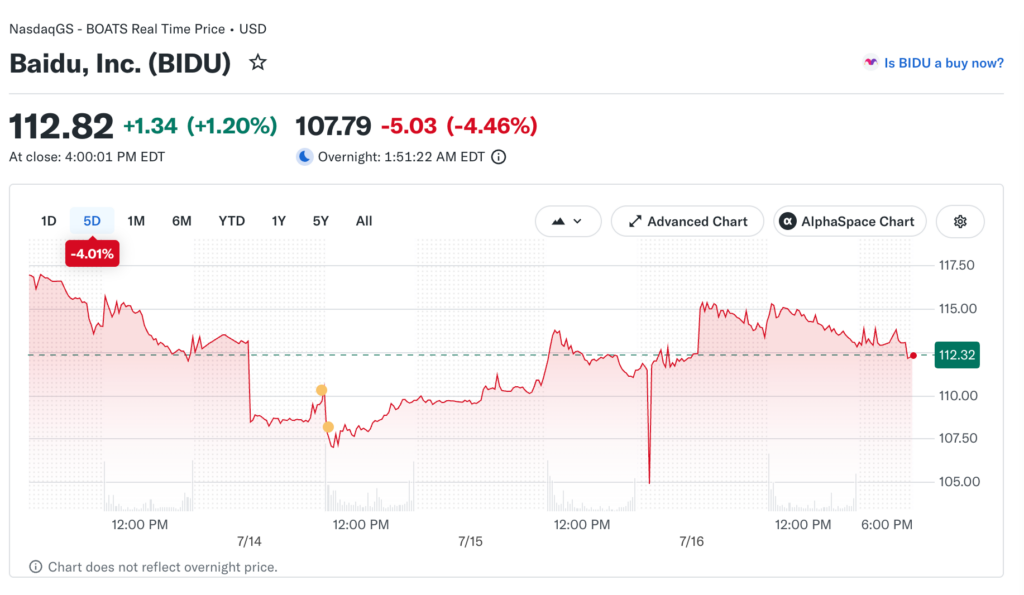
Hong Kong’s Hang Seng index gained 1.29 percent in the same period. Real estate and consumer cyclical stocks were among the biggest movers. Alibaba rose 3.26 percent and Baidu gained 2.51 percent, both driven by the announcement of an AI partnership with Apple.
The partnership involves deploying AI tools in the Chinese market through Alibaba and Baidu’s infrastructure platforms. The divergence between Hang Seng and CSI 300 captures a meaningful structural difference. Hong Kong-listed Chinese technology names benefit from foreign investor appetite for AI-linked China exposure, while domestic A-share investors are focused on property sector headwinds.
The Apple-Alibaba-Baidu Partnership as a Separate Signal
The AI partnership between Apple, Alibaba, and Baidu deserves attention as a standalone data point.
It creates a direct commercial relationship between the world’s most valuable consumer electronics company and two of China’s largest technology platforms. That partnership generates contracted revenue independent of the property sector recovery or domestic consumption improvement.
For investors evaluating Hong Kong-listed Chinese technology names, the Apple partnership provides a concrete earnings catalyst. It reduces dependence on broad macroeconomic conditions.
Names that demonstrate AI monetization tied to international partnerships are trading on a more defensible growth thesis than property-exposed or consumption-dependent mainland stocks.
What July 17 Looks Like for Chinese Markets
Chinese markets face a mixed backdrop entering July 17. The GDP miss creates pressure for additional policy support, which has historically been a positive catalyst for certain domestic sectors. The global chip selloff creates some spillover concern for Hong Kong technology names, even those with AI-specific positive catalysts.
The key question for investors watching mainland China is whether any policy response to the GDP shortfall arrives before the next major economic data release.
A targeted stimulus announcement focused on consumer spending support would change the calculus for CSI 300 consumer and retail names considerably. The timing of that signal, rather than its eventual certainty, is the variable that matters most for mainland China positioning.
Two Markets, Two Different Frameworks
Investors holding Chinese equity exposure across both mainland and Hong Kong markets should maintain a clear analytical distinction between the two. The two venues are responding to different drivers simultaneously. Mainland China’s CSI 300 is a domestic policy and consumption story right now.
Hong Kong’s Hang Seng is an international technology and AI monetization story. Treating both as a single China trade misses the divergence that has been visible in performance data since the GDP print landed. The Apple partnership changed the narrative for Hong Kong-listed technology names, while mainland A-shares remain at the mercy of domestic stimulus timing.