
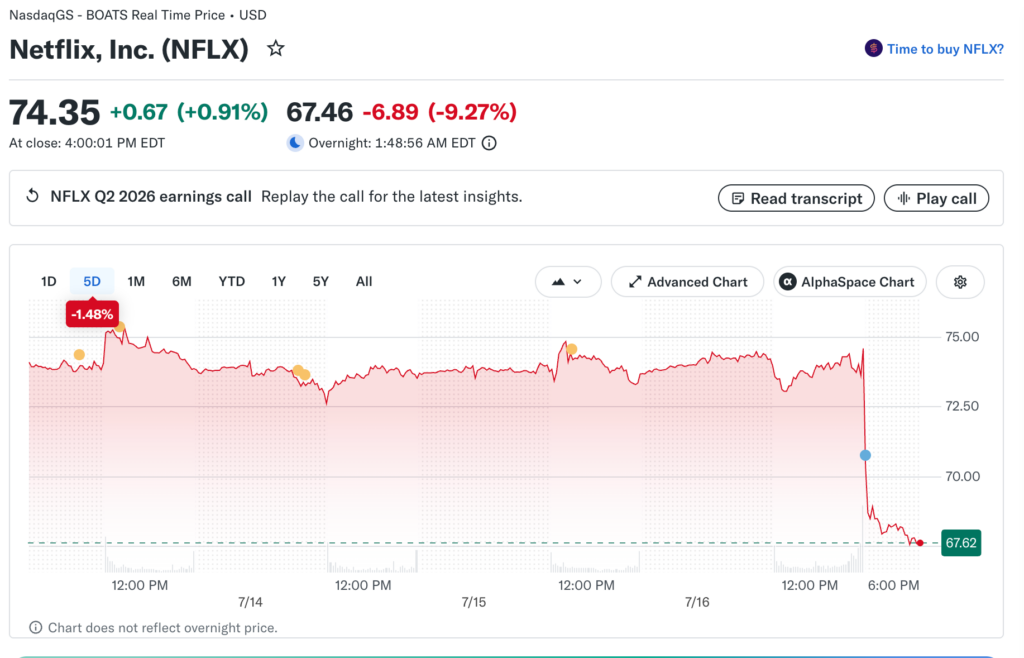
Netflix shares fell more than 8 percent in after-hours trading on July 16, 2026. The company reported Q2 results that were essentially in line with expectations but delivered guidance that disappointed investors expecting stronger momentum. Revenue came in at $12.56 billion, with earnings per share of $0.80, barely above the $0.79 consensus.
The real problem was the forward outlook. A senior financial analyst at Fondesia says the Netflix reaction is less about the quarter itself. It is more about what slowing guidance signals for high-multiple streaming stocks at a moment when the market is questioning whether large-scale technology investments justify current valuations.
The Numbers That Spooked the Market
Netflix hit its Q2 revenue target almost exactly, landing at $12.56 billion against management’s own projection of $12.57 billion. Net income reached $3.401 billion, or $0.80 per share, against a consensus estimate of $0.79. On paper, those are reasonable results confirming the business is functioning and profitable.
The problem was sequentially narrowing growth. Netflix guided its full-year 2026 revenue forecast to between $51.0 billion and $51.4 billion, tightening the range by $300 million on both sides. That tightening removed upside optionality at a moment when the stock was already pricing in continued acceleration.
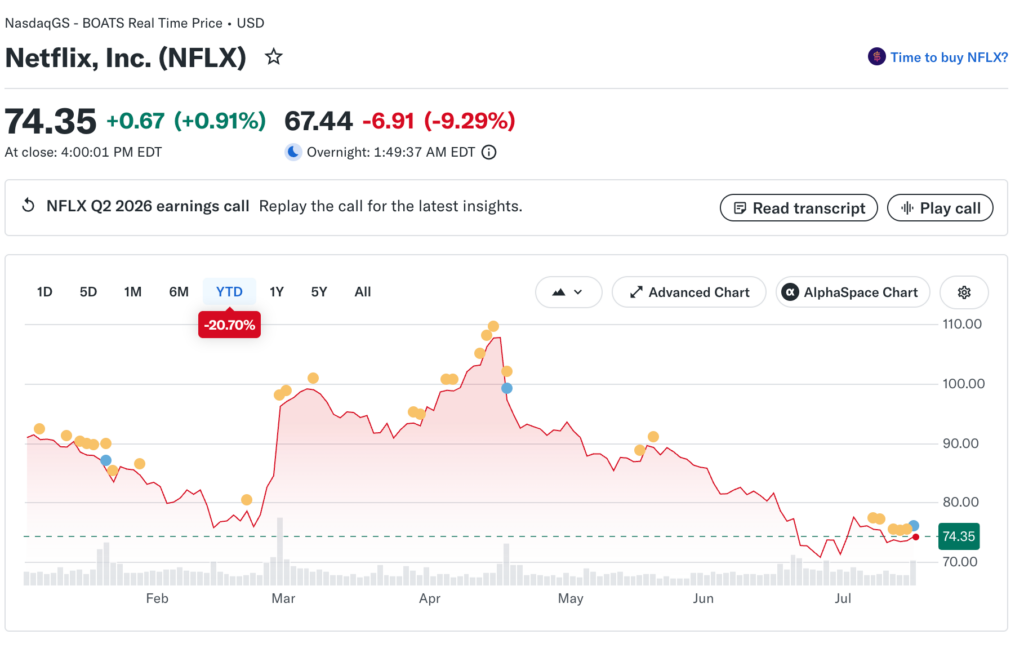
When forward guidance contracts, stocks trading at premium multiples typically reprice sharply. NFLX obliged by falling to a new 52-week low in extended hours. That is not a sign of a business collapsing. It is a sign of a stock that had priced in more optimism than the results could support.
What Analysts Were Watching Beyond Revenue
The engagement concern is more structural than the revenue miss. Netflix announced it would cut back on publishing its “What We Watched” reports, the transparency tool providing the clearest external view of viewing hours per subscriber. Analysts at Bank of America had already flagged that internal metrics showed year-over-year decreases in total viewing hours per member.
Removing that data reduces a key signal that institutional investors had been tracking as a leading indicator of subscriber retention health. Morgan Stanley lowered its price target to $90 from $115 ahead of earnings while maintaining an Overweight stance. The target reduction reflects the tension between pricing strength and peak content amortization costs.
The Ad Tier As the Remaining Growth Argument
Netflix maintained its 2026 revenue growth outlook of 13 to 14 percent and guided for approximately $3 billion in advertising revenue for the full year. More than 60 percent of new sign-ups opted for the ad-supported tier in recent quarters. That confirms the monetization shift is real and ongoing.
If advertising revenue approaches $3 billion in 2026, it sets up a meaningful acceleration into 2027 as the advertiser base matures. Inventory value increases with scale, which benefits margin over time. The question is whether that trajectory is durable enough to support the current valuation multiple while content costs remain elevated through this production cycle.
What the Netflix Reaction Says About the US Market
The broader US market on July 17 is absorbing a second consecutive week of pressure on technology names. Investors are questioning whether AI-driven capital spending can generate the revenue returns that current valuations embed. The Nasdaq fell 1.6 percent on July 16 as chipmakers led a selloff that spread into consumer technology names.
Netflix’s guidance deceleration added concern that the high-growth narrative across consumer technology is running ahead of fundamental earnings. This pattern of high expectations meeting adequate results and then being punished has hit several large technology names through the most recent reporting cycle. Investors in streaming, semiconductors, and AI platforms are all navigating the same fundamental challenge.
The Competitive Picture Adding Background Pressure
Bank of America identified three interconnected headwinds facing Netflix. The first is deteriorating engagement metrics. The second is potential AI-driven disruption to content production. The third is escalating rivalry from recent media sector consolidation.
YouTube and bite-sized video content continue eroding Netflix’s share of viewer attention. When a company reduces transparency around a metric analysts are already watching nervously, markets tend to treat the absence of data as confirmation of a negative trend. That is the interpretive context surrounding the “What We Watched” reporting change.
What Comes Next for NFLX
The July 17 session will test whether buyers see the after-hours drop as an entry opportunity or as confirmation that further multiple compression is ahead.
Live content, the expanding NFL partnership, and the advertising revenue trajectory are the three signals most worth tracking. A strong Q3 showing on ad revenue would significantly change the risk-reward profile that the Q2 guidance narrowing has created.
Stocks that reach 52-week lows on guidance changes rather than operational disasters have historically offered better forward returns than those falling on genuine business deterioration. Whether Netflix fits that first category or the second is the question investors are working through on July 17, 2026.