
Brokers from Rubinax dive into this topic, unpacking why one of the market’s most closely watched stocks failed to rally on what looked, at first glance, like unambiguously good news.
If you only looked at the headline number, you’d assume Tesla had a great quarter. The automaker shipped 480,126 vehicles in Q2, a jump of roughly 25% from a year earlier and well above the roughly 406,000 units Wall Street had penciled in. That’s the kind of beat that normally sends a stock higher.
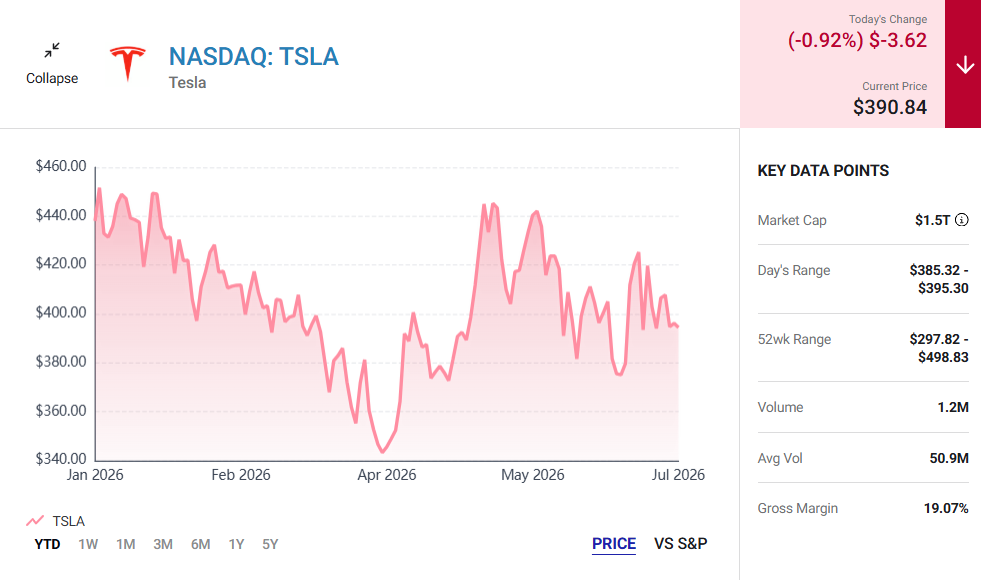
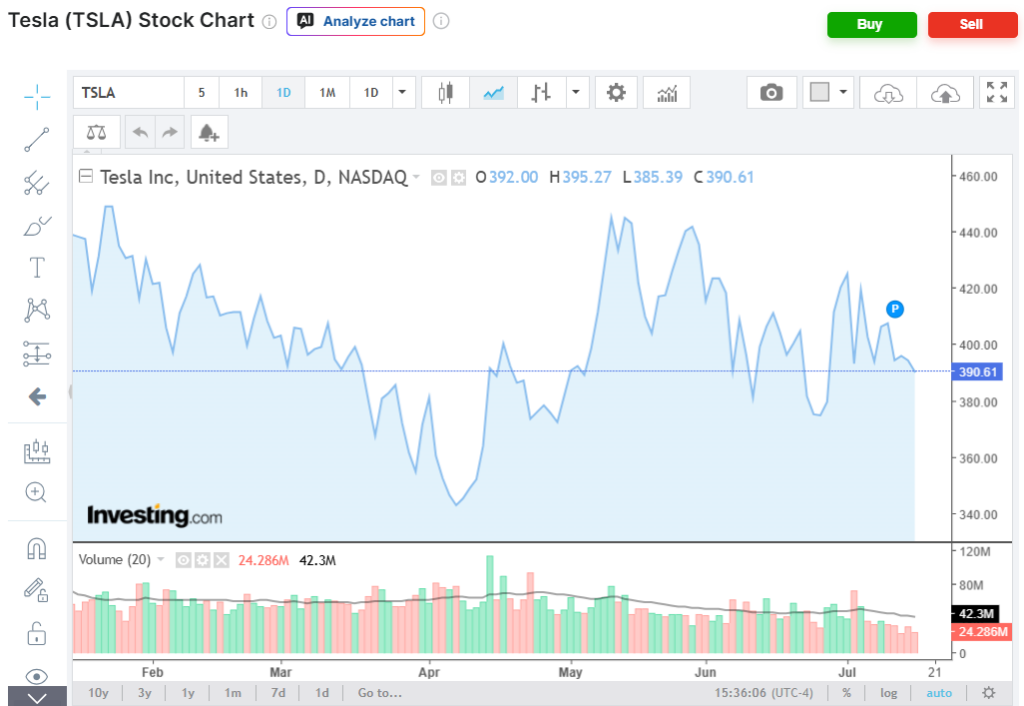
Instead, Tesla shares dropped on the news and have basically gone nowhere since, even as the broader market has managed to grind higher over the same stretch. For a lot of investors, that disconnect is confusing. For anyone who’s followed this stock for a while, it’s business as usual.
A Company That’s Hard to Price
Here’s the core problem: Tesla isn’t really one business anymore. It’s an automaker, an energy storage company, a solar installer, and, increasingly, a bet on AI and robotics, with the company’s chief executive describing the robotics push as potentially the biggest product Tesla has ever built.
When a business is stitched together from that many moving parts, analysts and investors have a hard time agreeing on what it’s actually worth. So the stock price ends up reflecting sentiment as much as fundamentals.
That helps explain the sell-off. Shares had already run up sharply in late June, heading into the delivery report. A strong number gave short-term traders a convenient excuse to lock in gains, regardless of what the actual figures said. Add in a valuation north of 170 times projected earnings, and it doesn’t take much bad news, or even good news interpreted skeptically, to trigger a pullback.
This kind of reaction isn’t unusual for high-multiple growth stocks. When a company trades on the promise of future businesses rather than the profitability of its current ones, even solid quarterly execution can get overshadowed by questions about what comes next.
It’s Not Just a Tesla Story
Some of the pressure on the stock isn’t really about Tesla at all. It’s about the EV market broadly, which had a rough quarter. Ford’s EV sales fell 41% year over year, and General Motors wasn’t far behind with a 33% drop. Much of that comes down to U.S. EV subsidies winding down, which has cooled demand across the industry, not just for Tesla.
Meanwhile, China’s BYD bounced back from a soft first quarter to retake the global EV delivery crown, shipping about 557,000 battery-electric vehicles in the quarter, more than Tesla managed. That’s not a direct hit to Tesla’s own numbers, but every unit BYD and other rivals sell chips away at Tesla’s pricing power in a market that’s already gotten far more competitive than it was just a couple of years ago.
Taken together, these numbers suggest the EV sector is entering a tougher, more mature phase. Growth is slowing industry-wide, subsidy support is fading, and competition from Chinese manufacturers is intensifying. Tesla, despite outperforming its estimates, is not immune to any of these headwinds.
The Takeaway for Investors
None of this means Tesla is a bad business. It means Tesla is a genuinely hard stock to hold with a normal, moderate time horizon. The gap between what’s known and unknown about this company is wide, and the market keeps filling in that gap with whatever narrative dominates that week. One month it’s robotaxis, the next it’s delivery numbers, the month after that it might be something in the AI or robotics pipeline entirely.
If you’re holding, or considering holding, Tesla stock, it helps to pick a lane. Either treat it as a name that will keep getting knocked around by short-term headlines and size your position accordingly, or treat it as a long-duration bet on the EV and AI combination and commit to riding out the noise along the way.
Trying to time something in between, based on quarterly deliveries or any single data point, is a tough way to make money with this particular stock, as this month has shown once again.
Rubinax’s analysts note that this is a useful reminder for investors across the board, not just those holding Tesla. When a company’s valuation depends heavily on future businesses that haven’t yet proven themselves at scale, near-term price swings often say more about shifting sentiment than about the underlying fundamentals.
Understanding that distinction, and being honest with yourself about which type of investor you are, can make the difference between reacting emotionally to volatility and sticking with a strategy built to withstand it.
For now, the 480,126 delivery figure stands as a genuine operational win. Whether it translates into a higher stock price depends less on the number itself and more on which story investors choose to believe about where this company is headed next.