
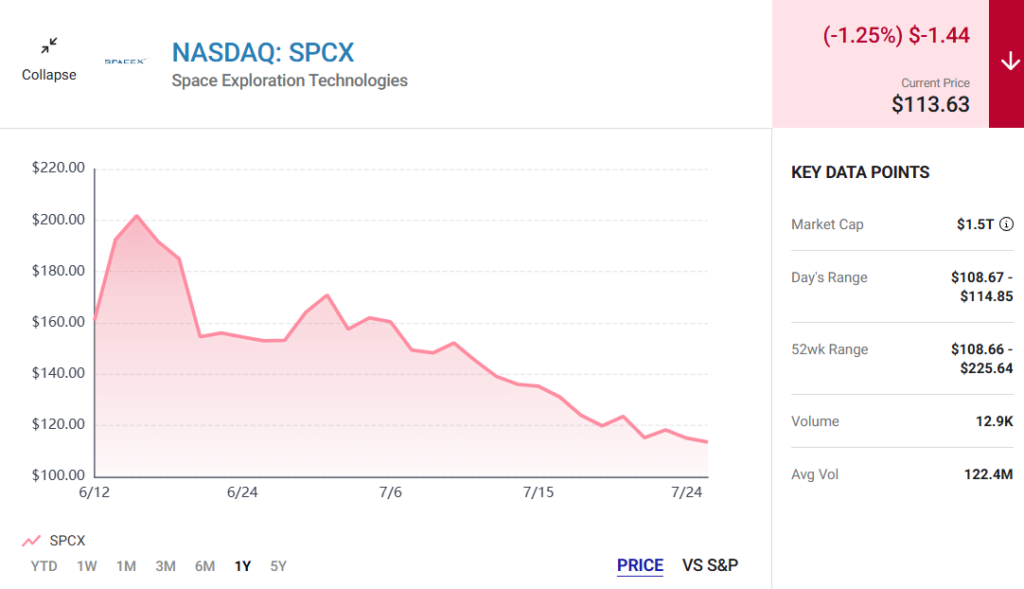
SpaceX heads into its first earnings report as a public company facing a stock that has already slid 43% from its highs. Brokers from Gammance dive into what a $10,000 investment could be worth the day after the report, and why a rare share-unlock provision makes this earnings date more consequential than most debuts.
A Record-Breaking IPO Now Under Pressure
SpaceX went public last month in the largest IPO in history, quickly surging past expectations. The stock briefly climbed above $225 per share, a sharp rise from its $135 IPO price, and at one point overtook Amazon in market value, underscoring the intensity of early investor enthusiasm.
Despite a recent pullback, the company still ranks as the seventh most valuable in the United States, even sitting ahead of Meta Platforms by market capitalisation. However, that decline has had a meaningful impact on sentiment.
Early IPO investors are now sitting on significant paper losses heading into the earnings report, adding another layer of pressure. This dynamic increases the likelihood of heightened volatility, as some investors may look to exit positions while others wait for clearer signals on performance and valuation.
What Wall Street Is Actually Expecting
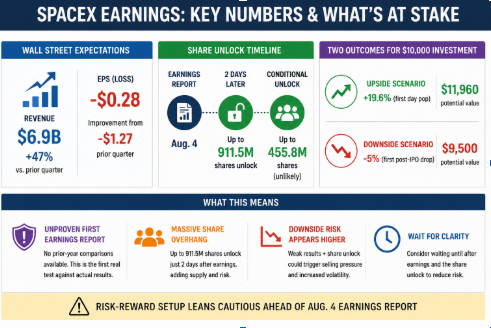
Analysts are projecting $6.9 billion in revenue alongside a loss of $0.28 per share for the quarter, setting a high bar for the company’s first earnings release. The revenue estimate represents a 47% increase compared to the previous quarter, signalling strong expected growth momentum.
At the same time, the projected loss marks a notable improvement, narrowing from $1.27 per share in the prior quarter, which suggests the business may be moving toward better cost efficiency and operational discipline.
With no prior-year comparisons available, this report becomes especially significant. It will serve as the first meaningful benchmark for investors, allowing the market to evaluate performance based on actual results rather than initial projections outlined in the prospectus.
The Share Unlock That Makes This Earnings Date Different
Most newly public companies operate under a standard six-month lockup period, preventing insiders from selling shares immediately after listing. In this case, however, the structure is far more aggressive and staggered, introducing additional uncertainty.
Up to 911.5 million shares become eligible for sale just two days after the earnings report, a significant influx of potential supply that could weigh on the stock. On top of that, an additional 455.8 million shares could unlock if the stock trades above its IPO price for five out of the ten days leading into the release.
At present, that threshold appears unlikely to be met, but even without it, the sheer volume of shares becoming available creates a substantial overhang. This setup increases the risk of heightened volatility and downward pressure, particularly if investor sentiment weakens around the earnings announcement.
Two Very Different Outcomes for a $10,000 Stake
The math on both sides of this report is stark. If SpaceX shares rally the way they did on their first day of trading, up 19.6%, a $10,000 investment would grow to $11,960 by the following day. A repeat of that initial post-IPO pop would likely be driven by strong enthusiasm from the company’s most devoted long-term believers rather than broad market consensus.
The Downside Scenario Looks More Likely
The more probable path points the other way. If the stock declines as it did on its first post-IPO drop, falling 5%, a $10,000 investment would decrease to $9,500, highlighting how quickly downside risk can materialise in volatile conditions.
A weaker-than-expected earnings report, combined with nearly a billion shares becoming eligible for sale just two days later, creates a particularly fragile setup. This overlap of negative catalysts could trigger selling pressure from multiple directions at once, as early investors look to exit while new buyers hesitate amid uncertainty.
In such a scenario, the imbalance between supply and demand may intensify short-term volatility, increasing the likelihood of sharper price swings and further downside movement.
What This Means Heading Into Next Week
For investors weighing a position ahead of the report, the risk-reward setup leans cautious. The combination of an unproven first earnings release and a significant wave of newly unlocked shares introduces meaningful downside risk, especially when compared to a relatively limited near-term upside.
Rather than attempting to time a potential rally into Aug. 4, a more measured approach may be to wait for clarity after the earnings report and observe how the market absorbs the additional share supply in the days that follow. This strategy could provide a more informed and lower-risk entry point, particularly in a situation where volatility is likely to increase around key catalysts.