
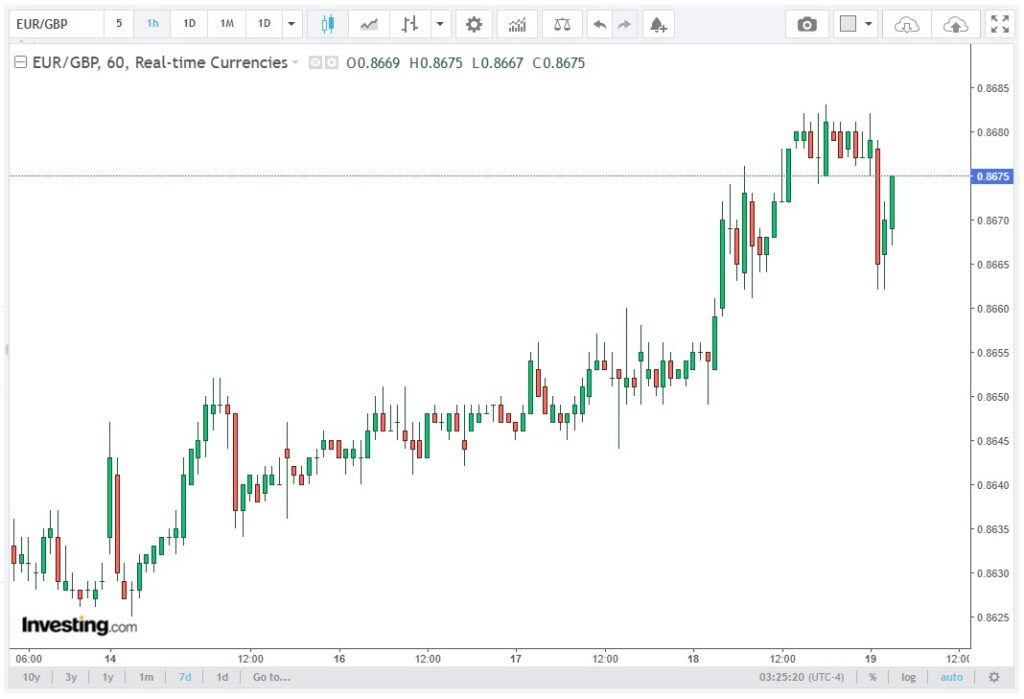
The Euro (EUR) regained some ground against the British Pound (GBP) on Friday, with EUR/GBP recovering from an intraday low near 0.8660 to trade around 0.8670.
This modest rebound suggests that markets are still carefully assessing a mixed set of UK economic signals, where healthy consumer spending is being weighed against growing fiscal concerns. Fondesia‘s team takes a closer look at the factors currently influencing the pair.
While UK domestic data has generally been encouraging, the Pound’s upward momentum has remained somewhat limited, indicating that investors may still have questions about the country’s broader economic and fiscal outlook. Recent price action reflects an ongoing balance between resilient demand-side fundamentals and heightened fiscal and policy uncertainty.
EUR/GBP Holds Its Ground Above Session Lows
Technically, EUR/GBP showed some resilience after testing support near 0.8660, a level that drew dip buyers back in. The bounce toward 0.8670 suggests Euro selling pressure was running out of steam, even with stronger-than-expected UK data on the tape.
Traders seem to be second-guessing how durable Pound strength really is, especially with fiscal concerns offsetting the good news. The fact that GBP couldn’t extend gains after the Retail Sales beat points to a market unwilling to price in a lasting Sterling rally without more confirmation from the broader macro picture.
UK Retail Sales Beat Expectations by a Wide Margin
The clearest driver of Sterling’s intraday strength was the latest UK Retail Sales report, which came in well ahead of forecasts.
According to the Office for National Statistics (ONS), retail consumption rose 1.2% in May, more than double the 0.5% forecast and a sharp turnaround from April’s 1.0% decline. That’s a meaningful bounce in consumer activity after a soft prior month.
Stripping out fuel, underlying sales also climbed 1.2%, compared with a 0.1% contraction the month before, pointing to broad strength across retail categories. Household spending looks fairly resilient despite high interest rates and ongoing cost-of-living pressure.
Under normal conditions, a print this strong would typically give the Pound sustained support. Here, though, the reaction has been muted by other developments on the fiscal side.
Government Borrowing Numbers Undercut the Good News
Working against the strong retail data, the UK also reported a surprise jump in Public Sector Net Borrowing, reviving questions about the country’s fiscal path.
Borrowing climbed to GBP 23.29 billion in May, up from GBP 23.03 billion in April and well above expectations for a drop to GBP 18.5 billion. That surprise suggests government finances remain stretched even as parts of the economy pick up.
Higher borrowing levels could reignite worries about the UK’s fiscal deficit, particularly with interest rates remaining elevated and debt-servicing costs staying high. For currency markets, that represents a structural headwind for the Pound, as persistent deficits can gradually erode investor confidence in the country’s long-term fiscal sustainability.
German Factory Prices Send a Mixed Signal on the Euro Side
On the Euro side, attention has turned to Germany’s latest Producer Price Index (PPI), a forward-looking gauge of upstream inflation in Europe’s largest economy and an early read on broader price trends.
Factory-gate inflation rose to 2.2% year-on-year in May, up from 1.7% in April, but still fell short of the expected 2.5%. Month-over-month, PPI growth slowed sharply to 0.3%, down from 1.2% previously, showing a clear loss of momentum versus the prior month.
The mixed reading suggests cost pressures are creeping back into parts of the Eurozone’s industrial sector, but unevenly and at a slower pace than markets had expected. For the European Central Bank (ECB), that supports a cautious stance, with little urgency to tighten policy aggressively in the near term, though it keeps the door open to watching whether inflation rebuilds later in the year.
What’s Next: A Tight Range With Lopsided Risks
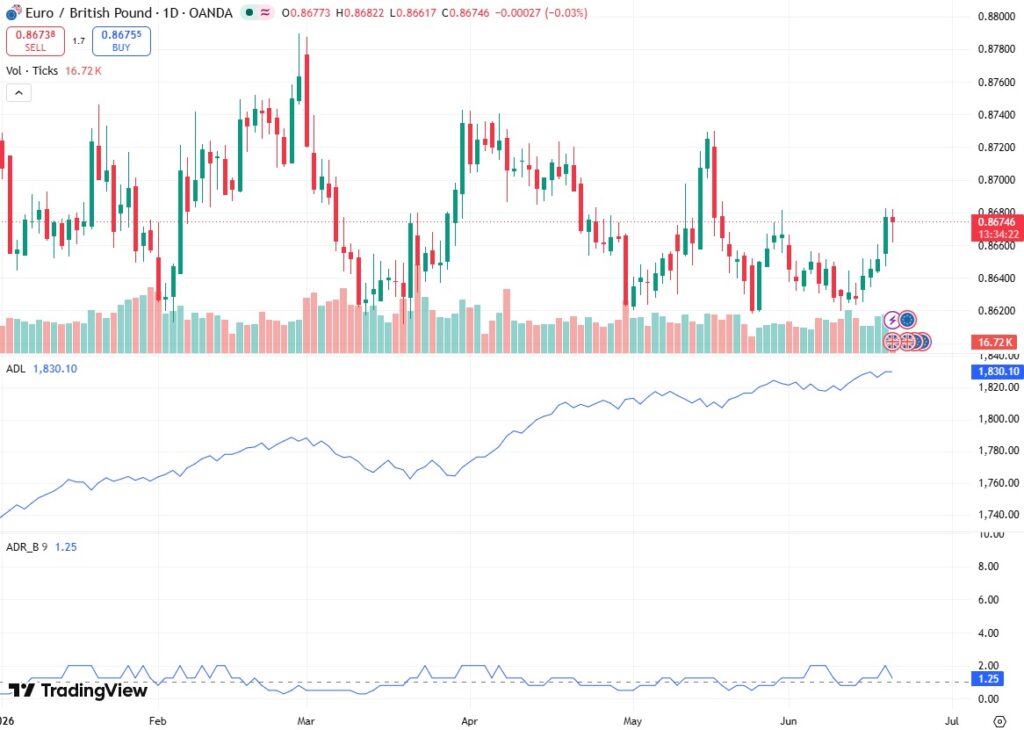
Looking ahead, EUR/GBP looks likely to stay in a narrow consolidation range as markets weigh forces pulling in opposite directions.
For the Pound, strong consumer demand offers support, but rising fiscal deficits and unclear monetary policy direction cap the upside. For the Euro, soft inflation expectations and a cautious ECB limit aggressive strength, while also providing relative stability.
In the near term, traders will likely keep an eye on UK fiscal data, BoE commentary, and Eurozone inflation trends for direction. Until a clearer macro divergence emerges, EUR/GBP may struggle to break decisively out of the 0.8650 to 0.8700 range, leaving it technically balanced but fundamentally sensitive to the next data surprise.