
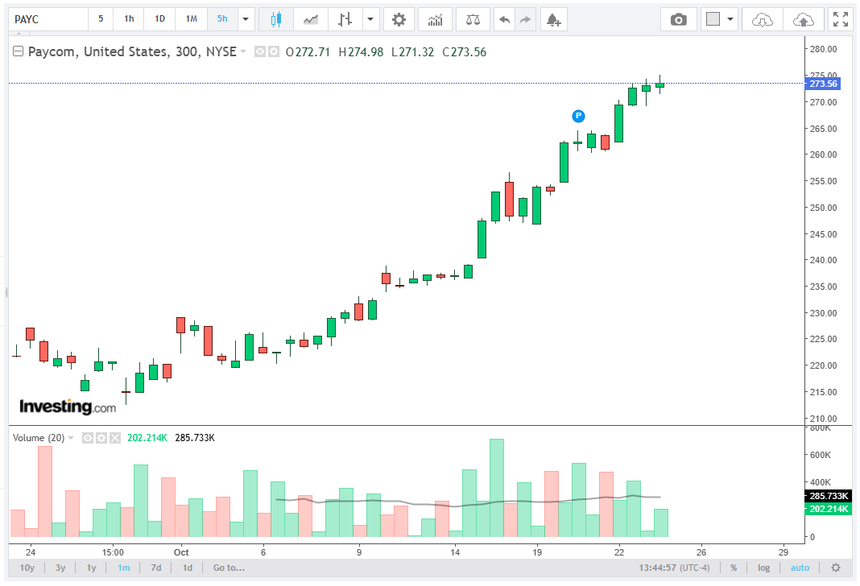
Paycom Software, Inc. (NYSE: PAYC) reached a new 52-week high of $274.25, reflecting strong upward momentum in the human capital management (HCM) software market. The stock has gained 37.35% over the past 12 months, advanced 72% year-to-date, and surged 118% over six months.
These returns indicate a substantial revaluation of the company’s equity as investors reassess its earnings potential, operational efficiency, and product innovation. With insights from Raymin Group’s expertise, this article delivers a thorough analysis of the subject.
A 118% six-month gain means a hypothetical $10,000 investment would have increased to approximately $21,800, excluding dividends, taxes, and transaction costs. Such performance can reflect improving fundamentals, expanding valuation multiples, or both.
Investors must distinguish between earnings-driven appreciation and multiple expansion when assessing the sustainability of the rally.
Paycom provides cloud-based payroll and workforce management software through a software-as-a-service (SaaS) business model. Its integrated platform supports payroll processing, tax administration, employee management, and human resources functions, generating recurring revenue from business customers.
Profitability, Margins, and Operating Leverage
Paycom’s reported 88% gross profit margin is central to its investment thesis. For every $100 in revenue, the company generates approximately $88 in gross profit before operating expenses and other costs.
High margins characterize scalable software platforms, where additional customer activity can generate revenue without proportionate increases in direct service delivery expenses.
Recent market data indicate approximately $2.14 billion in trailing-12-month revenue and $487.6 million in net income, equivalent to a net profit margin of roughly 22.8%. These figures illustrate the distinction between gross profitability and bottom-line earnings after operating costs, taxes, and other expenses.
Operating leverage remains an important performance variable. If revenue grows faster than selling, administrative, and research expenses, operating margins can expand, allowing earnings per share (EPS) to increase faster than sales.
Sustained margin expansion could support higher equity valuations, provided growth remains durable, and cost controls remain effective.
Valuation Metrics and Fair Value Assessment
Paycom appears potentially undervalued based on its Fair Value assessment, despite substantial share price appreciation. This analysis suggests that estimated intrinsic value may exceed the prevailing market price under the platform’s growth and profitability assumptions.
Relevant valuation indicators include the price-to-earnings (P/E) ratio, enterprise value-to-revenue (EV/revenue), free cash flow yield, and projected earnings growth. Recent market data have placed Paycom’s trailing P/E ratio near 29 times earnings, indicating that investors are paying a substantial multiple for current profitability.
A discounted cash flow (DCF) model estimates the present value of projected future cash flows using assumptions about revenue growth, operating margins, capital expenditure, and discount rates.
Small changes in these variables can materially affect fair value. Investors should compare multiple valuation methodologies rather than relying exclusively on a single estimate.
Analyst Price Targets and Implied Returns
Analyst revisions reveal differing expectations for Paycom’s outlook. Guggenheim raised its price target to $300, maintaining a Buy rating and implying approximately 9.4% upside from $274.25. The firm cited anticipated revenue growth and potential free cash flow margin expansion.
KeyBanc increased its target to $280, implying approximately 2.1% upside, supported by expectations for margin expansion and product innovation. UBS raised its target to $285, equivalent to approximately 3.9% upside, highlighting the company’s transformation initiatives and payroll automation technology.
More cautious assessments include BMO Capital Markets’ $235 target, representing approximately 14.3% downside, and BofA Securities’ $200 target, implying approximately 27.1% downside. BofA initiated coverage with an Underperform rating, citing concerns about Paycom’s mature payroll customer base and limited opportunities for additional sales.
These implied returns are estimates, not guaranteed outcomes. The substantial target-price range reflects uncertainty regarding revenue growth, customer expansion, competitive pressures, and valuation multiples.
Beti Automation and Revenue Growth
Paycom’s Beti payroll automation platform is central to its product differentiation strategy. The technology transfers more payroll responsibilities to employees, potentially reducing manual processing, identifying payroll errors, and improving administrative efficiency.
Successful adoption could strengthen customer retention and increase the value of Paycom’s integrated platform. Automation may also reduce the resources required to support payroll workflows. Its financial impact will depend on customer adoption, implementation costs, product effectiveness, and measurable revenue growth.
A key risk is the maturity of Paycom’s existing payroll customer base. If opportunities to upsell additional products become limited, new customer acquisition and market expansion will become increasingly important growth drivers.
Conclusion
Paycom Software’s $274.25 52-week high reflects strong market momentum, an 88% gross profit margin, and renewed confidence in its payroll automation strategy. Its share price gains and analyst targets reaching $300 support an optimistic outlook, while targets of $200 and $235 highlight significant downside risks.
Ultimately, sustainable valuation growth will depend on revenue acceleration, earnings expansion, margin improvement, and successful product adoption. Investors should evaluate these fundamentals alongside valuation multiples, cash flow generation, and competitive positioning before determining whether Paycom offers an attractive risk-adjusted investment opportunity.