
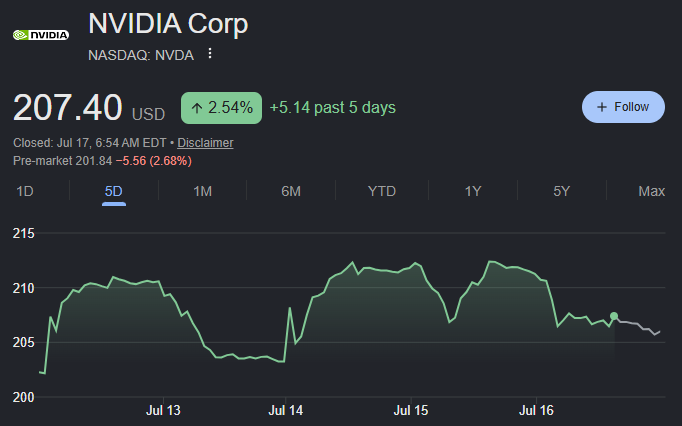
The current market valuation of Nvidia (NVDA) presents an intriguing anomaly for equity analysts. Despite delivering a staggering 85% year-over-year revenue growth in its most recent quarter, the company’s stock trades at a price-to-earnings (P/E) ratio of approximately 32, a figure that aligns directly with the broader S&P 500 average.
This compression in valuation, despite hyper-growth, suggests that the market is applying a significant discount to the company’s future earnings power.
Market intelligence provided by Sollventis indicates that this disconnect is likely driven by two primary factors: the law of large numbers impacting its $5.1 trillion market capitalization and an overarching fear that the current artificial intelligence (AI) spending spree mirrors the unsustainable boom-and-bust cycles of the past.
As investors weigh these concerns, the question remains whether historical precedents of tech bubbles should dictate the current investment thesis for the world’s most valuable chipmaker.
Dissecting Patterns From Prior Tech Cycles
The caution surrounding Nvidia is deeply rooted in historical economic cycles. Experienced market participants draw direct parallels between the current AI infrastructure build-out and the dot-com boom of the late 1990s, or even the rapid industrial expansion of the 1920s automobile sector.
In both instances, exuberant capital expenditure preceded a significant market correction. Current data shows that key hyperscalers have pledged a combined $725 billion in capital expenditures (capex), a substantial portion of which is being funneled directly into Nvidia hardware.
This level of investment supported Nvidia’s $81.6 billion revenue milestone during the first quarter of fiscal year 2027. However, analysts are already bracing for a transition. While current forecasts project an 82% revenue surge for fiscal 2027, growth expectations are anticipated to decelerate to a 41% increase by fiscal 2028.
This slowing trajectory is a natural consequence of scaling within an already massive enterprise, yet it remains the primary driver of the current market discount.
Assessing The Valuation Floor Amidst Skepticism
Despite the risks of a cyclical downturn, Nvidia’s current valuation multiples suggest a high degree of “baked-in” skepticism. With a forward P/E ratio of 24 and a one-year forward P/E of 17, the stock appears positioned at a level that assumes significant earnings pressure in the future.
Even if an “AI bust” were to occur, these valuation levels provide a strong argument that the stock is currently priced as a defensive asset rather than a speculative growth play.
This valuation floor is critical for long-term investors. A forward multiple of 17 is arguably reasonable even for a cyclical industrial company, let alone a market leader in semiconductor technology.
This suggests that while a pullback in price is a distinct possibility as growth normalizes, the long-term downside for current investors may be limited by the fact that the market has already factored in a significant portion of the growth slowdown.
Transitioning Into A Phase Of Infrastructure Dominance
Investors should not allow historical fear to entirely undermine the investment thesis for a company that remains the backbone of global compute. While it is logical to assume that the current pace of AI spending will eventually reach a plateau, Nvidia’s role in the tech ecosystem is increasingly foundational.
The company is effectively shifting from a phase of explosive, cyclical growth to a phase of sustainable, long-term infrastructure dominance.
For investors, this transition period is a test of patience. The robust revenue growth expected through fiscal 2027 remains the primary objective, even if the subsequent years show lower percentage gains.
Navigating Volatility In Semiconductor Equities
While some market analysts warn of future pain, the current state of Nvidia appears to provide enough insulation to withstand a market normalization. It is prudent to assume that the AI boom will eventually experience a cooling-off period, but the transition need not be catastrophic for shareholders.
By maintaining a realistic outlook on growth, investors can mitigate the risk of being blindsided by shifts in capital expenditure budgets.
Strategic Final Outlook
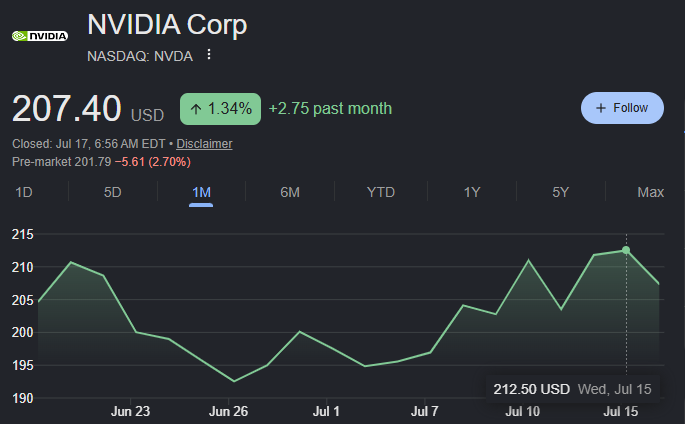
In conclusion, the perceived “cheapness” of Nvidia stock is a reflection of a market trying to reconcile historical trauma with unprecedented current performance. The fear of a tech bubble burst is a valid concern for any cycle, but current forward multiples indicate that the market is already pricing in a much slower growth environment.
Investors who prioritize long-term fundamentals over near-term speculative noise may find that the stock’s current valuation offers an attractive entry point for the latter half of the 2026 fiscal year.
As investors monitor the 2026 reporting cycles, the focus should remain on sustainable margin improvement and the diversification of revenue streams outside of core hyperscaler demand.
By anchoring portfolio decisions in these objective metrics, shareholders can remain confident that Nvidia is built to endure even if the history of tech boom cycles points to future headwinds.