
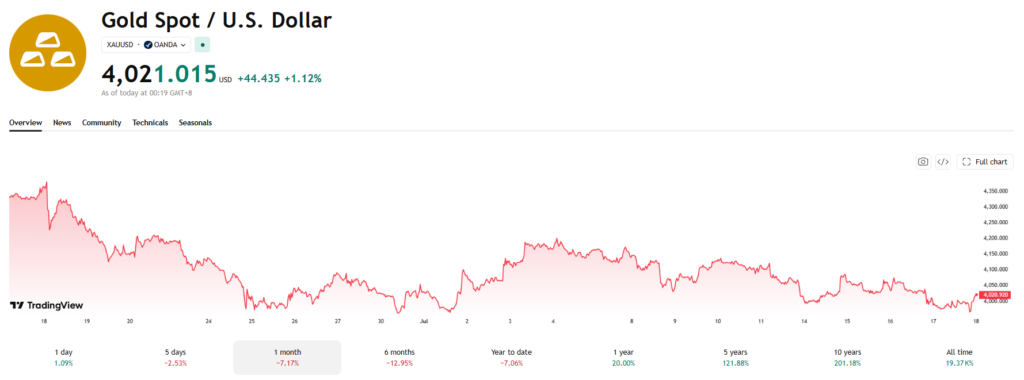
Gold (XAU/USD) is facing persistent selling pressure, struggling to maintain its footing near the $4,000 level as a confluence of geopolitical instability and macroeconomic headwinds weigh on the precious metal.
In spite of recent efforts to find support, gold is forecast to suffer a second consecutive weekly loss. This is due to the fact that investors are increasingly placing a higher priority on interest-bearing assets than they are on commodities that do not yield.
The market remains in a state of flux as participants weigh conflicting signals between safe-haven demand and the rising opportunity cost of holding gold in a high-interest-rate environment.
The traditional safe-haven narrative for gold has been upended by the current economic landscape. An investment analyst at Risance mentioned that this momentum is driven by the company’s unique position at the center of the global economic environment.
Escalating military hostilities have disrupted traffic through the Strait of Hormuz, leading to a surge in Oil prices. While higher energy costs typically trigger safe-haven buying, the current environment has instead revived inflation concerns, reinforcing expectations that the Federal Reserve (Fed) may need to maintain or even increase interest rates to stabilize the economy.

The Mechanics Of The Interest Rate Pressure
For the gold market, this creates a “rates asset” dynamic where rising yields increase the opportunity cost of holding bullion. As of mid-July, CME FedWatch data suggests a 76% probability of a Federal Reserve rate hike by September, a significant increase from prior weeks.
The US Dollar (USD) has simultaneously staged a recovery, further capping the upside potential of gold after its recent retracement from the all-time highs reached earlier this year. Market participants are closely monitoring central bank commentary for clues regarding the duration of the current tightening cycle.
Recent hawkish remarks from officials have kept the possibility of tighter monetary policy firmly on the table. With inflation not appearing to head sustainably back toward the 2% target on its own, policymakers have signaled that higher interest rates would better balance the outlook and associated risks.
This rhetoric has forced a repricing of expectations, particularly as traders scale back their earlier, more optimistic bets on a near-term interest rate pivot.
Technical Evaluation Of Bearish Momentum
In terms of technical positioning, the market is currently experiencing a pronounced bearish bias, as the metal trades below the Bollinger Bands’ 20-day Simple Moving Average, which is situated near $4,072.
Momentum indicators further reflect this downward trend, with the Relative Strength Index hovering around 39.12, signaling that sellers remain in control of the price action. Regarding key levels, immediate support is currently anchored near the lower Bollinger band at $3,945; should the metal break below this horizontal floor, sellers may likely target the $3,800 level.
Conversely, any potential recovery faces stiff resistance at the $4,072 middle band and the $4,200 confluence zone. Traders are watching these technical thresholds closely, as a failure to hold current levels could accelerate the current sell-off, while a successful defense of the floor might invite fresh buying interest from participants looking for a bargain after the recent slide.
Geopolitical Instability And Energy Price Volatility
The duration of the disruption to traffic through the Strait of Hormuz remains a primary concern for energy traders and gold investors alike. If the situation persists, the upside risks to energy prices and broader inflation could remain elevated, which historically tends to weigh on the appetite for non-yielding precious metals.
Iran’s Revolutionary Guard Corps has indicated that exports might face further obstacles if regional tensions remain high. This uncertainty creates a volatile environment where gold is caught between its dual roles as a safe-haven asset and a commodity sensitive to inflationary inputs.
Investors are balancing the fear of further conflict against the reality that central banks are focused on curbing the inflationary effects that arise from energy price spikes, a scenario that currently favors the strength of the dollar over gold.
Broader Outlook For The Precious Metals Sector
While the short-term outlook remains pressured, the structural case for gold as a long-term portfolio stabilizer continues to attract institutional interest. Strong central bank gold purchases throughout May and June have provided a solid demand base, which could eventually establish a price floor.
The range across major financial institutions remains wide, with the consensus often placing gold in a valuation band that sits well above current trading prices. As the market navigates the remainder of the summer, the focus will stay locked on the Federal Reserve’s next policy meeting.
The interaction between incoming economic data and the Fed’s stance on rates will be the ultimate arbiter of whether gold can recover from its recent correction or if the bearish phase is set to extend further into the second half of the year.