
The S&P 500 is up roughly 9% this year, but that headline number masks a real concentration problem: a heavy weighting toward a handful of mega-cap tech names like Nvidia means the index carries more risk than its steady climb might suggest.
For genuinely risk-averse investors, particularly those worried about a tech bubble deflating, the question becomes which alternative actually deserves the “safe haven” label. Brokers from Achievements AI compared gold, silver, Bitcoin, and dividend-focused ETFs to see which one holds up best under that test.
Gold: The Classic Safe Haven That’s Lost Some of Its Shine
Gold has long been the default destination when investors get nervous about the economy. The track record backs that reputation up in some environments. Gold rose 25% in 2020 as the pandemic hit, but it isn’t universal.
In 2022, as interest rates climbed, gold’s performance went flat because higher rates make yield-bearing alternatives more attractive and reduce the appeal of an asset that generates no cash flow on its own.
That’s the core issue with gold as an investment: its value isn’t tied to earnings or revenue the way a stock’s is, which makes it more of a speculative store of value than a productive asset.
With rates potentially moving higher again this year, gold’s setup looks less favorable than its reputation suggests. It still has a role in long-term diversification, but it doesn’t look like the strongest safe-haven pick under current conditions.
Silver: An Industrial Metal Playing a Risky AI Game
Silver shares some of gold’s diversification appeal, but with a twist: it’s an industrial metal as much as a monetary one, and demand has been getting an extra lift from the ongoing buildout of AI data centers. That dual-use case gives silver a more compelling growth story than gold, at least on paper.
The numbers reflect that enthusiasm: the iShares Silver Trust, which tracks silver prices, climbed 80% over the past year. But that kind of move is a double-edged sword for risk-averse investors. A rally that steep, driven heavily by retail investor enthusiasm and tied to a still-unproven AI infrastructure cycle, isn’t the kind of stability a true safe haven is supposed to provide, and the recent pullback in silver prices is a reminder of how quickly that enthusiasm can reverse.
Bitcoin: “Digital Gold” That Acts Nothing Like Gold
Bitcoin’s pitch as “digital gold” was always going to be tested in a real downturn, and so far the results haven’t been kind to that branding. Bitcoin is a highly speculative asset whose price depends heavily on retail sentiment and government policy direction not exactly the ingredients of a defensive holding.
The pattern over the past couple of years makes the point clearly. Bitcoin surged to record highs when the current administration was perceived as crypto-friendly early on, but that momentum has since faded as retail attention rotated toward AI stocks instead. This year, Bitcoin has fallen close to 30%, a swing far too volatile to function as a hedge against economic uncertainty, whatever the “digital gold” label might imply.
Dividend ETFs: The Boring Choice That Might Be the Smartest One
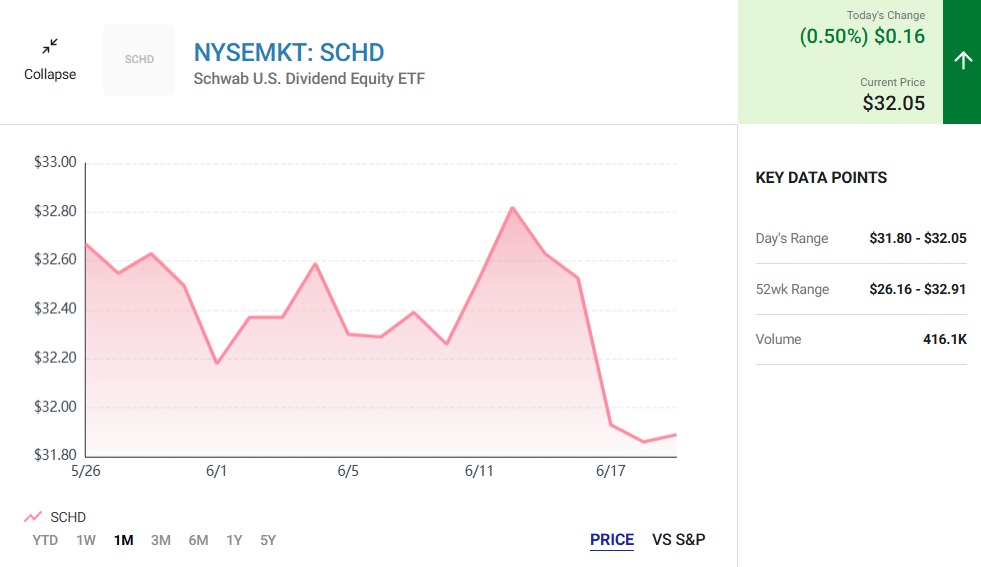
That leaves dividend-paying equities, and specifically diversified dividend ETFs, which solve the single-stock risk problem that comes with betting on any one dividend payer. The Schwab U.S. Dividend Equity ETF (SCHD) is a clear example of how this can work: it yields 3.3%, well above the S&P 500’s average yield of just 1.1%, while spreading that income across roughly 100 holdings.
No single position accounts for more than 5% of the fund, and the portfolio leans on blue-chip names like UnitedHealth Group, Procter & Gamble, and Home Depot companies with long histories of generating consistent cash flow. The fund trades at a modest price-to-earnings multiple of 19, a valuation that doesn’t require aggressive growth assumptions to justify, unlike gold, silver, or Bitcoin, none of which generate any underlying cash flow at all.
Outlook: The Safe Haven That Actually Behaves Like One
Of the four options, dividend ETFs are the only choice offering recurring income, broad diversification, and exposure to companies whose value is supported by actual earnings rather than sentiment-driven or speculative demand.
Gold and silver still provide meaningful long-term diversification benefits, but under current market conditions, neither appears to be the strongest option. Meanwhile, Bitcoin’s high volatility effectively removes it from the safe-haven asset discussion.
For investors focused on reducing risk rather than simply diversifying speculation, a broad dividend ETF such as SCHD appears to be the most defensible choice at the moment.