
The british pound sterling is demonstrating a highly constrained trading profile against the United States dollar as cross-currency markets enter a phase of absolute short-term equilibrium.
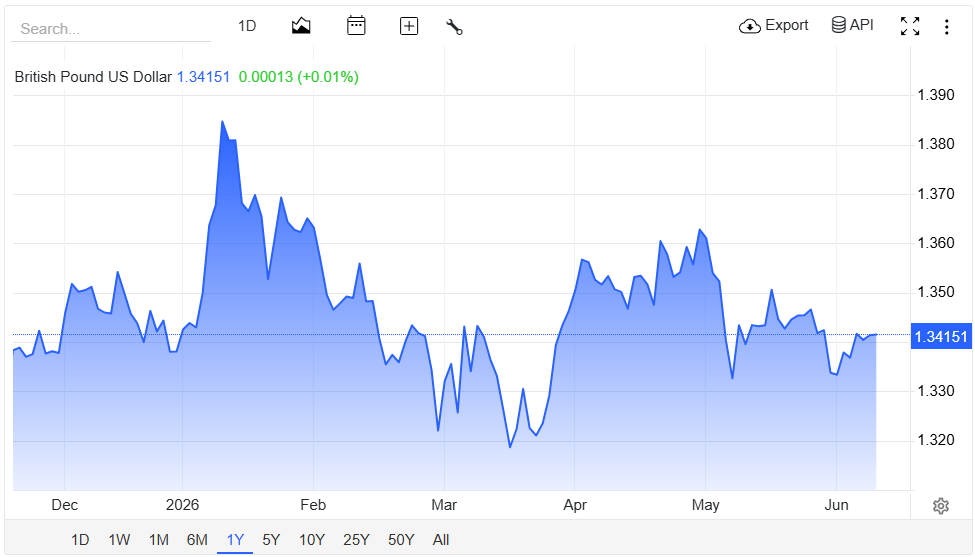
Market data monitored by the currency research team at Rubizio indicates that spot transactions continue to hover tightly around the critical psychological threshold of 1.3400, reflecting a profound lack of direction across international brokerage desks.
The emergence of back-to-back Doji candlestick formations on the daily charts highlights an exceptionally indecisive marketplace. Portfolio managers are refusing to commit massive capital pools until definitive clarity emerges regarding cross-border treaty frameworks and multi-national interest rate trajectories.
This protective market posture intensified following structural diplomatic updates regarding maritime shipping lines and regulatory energy oversight. Senior executive officials from major Western administrations recently declared that upcoming international accords will ensure that zero transport tariffs are imposed on maritime vessels routing through vital global shipping straits.
Additionally, preliminary diplomatic understandings dictate that official nuclear observation teams will safely return to active regional monitoring sites. Despite these positive updates, risk-sensitive institutions remain highly reluctant to scale up their structural exposures until sovereign leadership formally ratifies the final documentation.
Concurrently, global macro desks are parsing the upcoming policy agendas of major central banks to project how sovereign regulators will react to these geopolitical transitions. The domestic banking committee in the United States is widely projected to maintain its current benchmark borrowing costs during the upcoming mid-week session.
Institutional analysts anticipate that the newly appointed leadership of the American central bank will likely adopt a more accommodative, dovish monetary stance than previous administrations. This potential policy shift has kept the greenback from executing an aggressive upward breakout against major G10 currency pairings.
Sovereign Policy Meetings And Forward Guidance Metrics
Following the mid-week American policy update, global focus will shift immediately toward the subsequent monetary announcement by the domestic banking authority in the United Kingdom.
Local banking governors are overwhelmingly expected to keep baseline borrowing rates frozen while delivering an exceptionally steady, neutral outlook for the coming quarters. Because the primary interest rate decision is heavily anticipated to remain unchanged, market volatility will likely stem from the internal committee vote distribution.
The detailed meeting minutes are expected to provide critical forward guidance regarding the potential path of sovereign quantitative tightening. Until these multi-layered monetary events conclude, cross-currency asset classes are remaining confined within tight, highly algorithmic boundaries.
Commercial spot brokers note that corporate order books are completely balanced, with heavy buy and sell orders clustering on opposite sides of the immediate spot price. This structural gridlock has effectively stripped the currency pair of any sustained trend momentum over the last forty-eight hours.
Technical Analysis And Core Consolidation Zones
From a strict technical chart perspective, the cross-currency pair is locked within an explicit four-week consolidation channel bounded tightly between 1.3300 and 1.3500. Short-term momentum studies displayed on the four-hour chart confirm an absolute depletion of directional velocity.
The Relative Strength Index is trending completely flat along the 50 neutral midline, while the Moving Average Convergence Divergence histogram remains stuck fractionally below the zero threshold.
These compounding indicators collectively point to an extended consolidative bias, signaling that immediate breakout attempts face high statistical failure rates. Sellers successfully defended the upper bounds of the local range yesterday, rejecting intraday upward spikes near the 1.3460 horizontal level.
On the other hand, the primary structural line of defense for medium-term bears continues to be established between the resistance zones of 1.3485 and 1.3505. The aggressive buying behavior that has been observed since the middle of May has been successfully capped by this persistent ceiling.

Long Term Structural Support And Target Baselines
Should a hawkish central bank surprise trigger an upward extension above this immediate ceiling, macro buyers will likely target the previous multi-month high registered near 1.3550. Conversely, if shifting interest rate differentials trigger a sudden round of long liquidation, the immediate downside cushion is located near the 1.3380 support floor.
A clean break beneath this minor level will open the path for a direct test of the range floor located at the 1.3300 baseline area.
This major historical support area successfully repelled aggressive short campaigns during late May and early June trading sessions. If sellers manage to breach this deep psychological support zone on high institutional volume, the broader technical structure will tilt decisively bearish.
Under that extended liquidation scenario, the next major downside target rests near the historical spring baselines around 1.3170. For the immediate sessions, cross-currency traders must continue to manage short-term positions defensively while the pair churns within its established consolidation box.