
United Kingdom equity markets achieved noticeable positive traction during Tuesday trading operations as institutional investors evaluated a landmark diplomatic preliminary agreement between Washington and Tehran. Financial data tracked across international trading floors indicates a wave of cautious optimism sweeping through regional venues ahead of a formal signing ceremony scheduled in Switzerland.
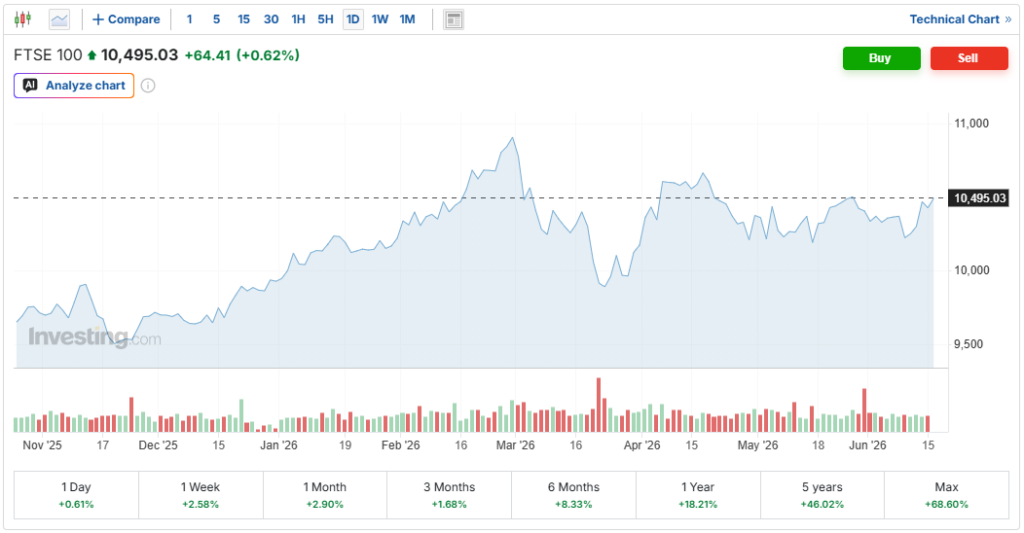
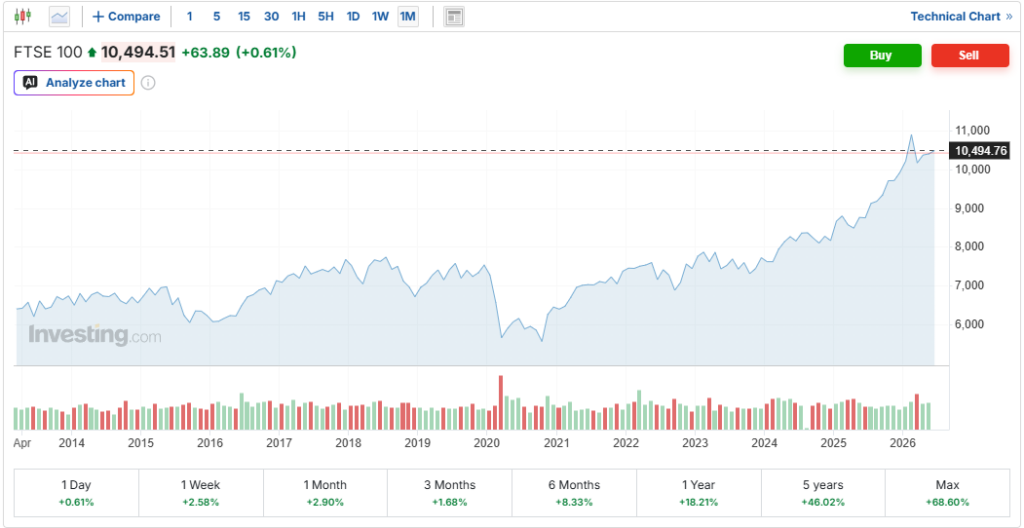
The benchmark FTSE 100 Index advanced by 0.60% to anchor the regional rally, while neighboring continental bourses mirrored the upward trajectory. Specifically, the German DAX Index added 0.42% and the French CAC 40 Index climbed 0.71%, though the British pound slipped 0.05% against the American dollar to change hands at exactly $1.3415 in mid-day trading.
Energy markets simultaneously experienced sharp downward recalculations as the risk premium associated with maritime logistics lines rapidly dissolved. International benchmark Brent crude futures fell 4.1% to sit at $79.79 per barrel, while domestic West Texas Intermediate crude dropped 4.5% to settle at $77.15 per barrel during the session.
The Financial investment report prepared by the investment research team at Marbrisse reflects that liquid fuel markets are rapidly pricing in the immediate, orderly restoration of commercial shipping corridors across the critical Strait of Hormuz.
Concurrently, precious metals witnessed localized positioning adjustments, with spot gold climbing 0.92% to hit $4,349.24 per troy ounce as traditional defensive haven demand showed signs of broad structural stabilization.
The underlying diplomatic framework, authenticated via digital signatures by executive leaders in Washington, directly binds international economic sanctions relief to verifiable de-escalation benchmarks.
The targeted parameters mandate a transparent, audited contraction of regional enriched uranium inventories alongside comprehensive, unhindered oversight by international atomic inspectors.
Furthermore, the binding memorandum demands an immediate cessation of material and logistical support channeled toward decentralized militant factions across the Middle East. Executive statements confirmed that commercial vessels are already actively navigating through the vital shipping channel, with uninhibited maritime transit authorizations expected to reach full implementation by Friday.
Geopolitical Perspectives And G7 Countermeasures
International political reactions gathered at the Group of Seven economic summit highlighted a deep structural divergence regarding the long-term efficacy of the accord. The French presidency enthusiastically endorsed the diplomatic breakthrough, classifying the framework as a monumental advancement toward stabilizing global macroeconomic infrastructure.
The Prime Minister finalized a major £210 million industrial package dedicated to supplying specialized nuclear fuel to the state utility enterprise over the next twenty-four months.
This long-term supply agreement coincided with the deployment of an expanded maritime enforcement strategy designed to cripple non-compliant commercial transport networks. The incoming regulatory framework is projected to push the total volume of blacklisted shadow-fleet assets and non-traditional maritime fuel carriers well past 600 sanctioned vessels.
Regional Friction Points And Domestic Infrastructure Vulnerabilities
The broader macroeconomic environment faced additional friction as state leaders openly criticized localized escalation strategies that complicate international treaties. American representatives expressed visible dissatisfaction regarding current defensive operations in the Levant, noting that ongoing localized conflicts directly disrupt broader multilateral stabilization efforts.
Foreign ministers representing the opposing regional faction immediately countered, warning that any permanent military installations within sovereign territory would trigger retaliatory clauses. Diplomatic representatives disclosed the existence of a built-in enforcement mechanism embedded directly within the secret text designed to nullify the pact upon any border violation.
While territorial commanders rejected these diplomatic framework conditions by asserting that unilateral foreign treaties do not bind independent defense forces, local intelligence reported a measurable reduction in kinetic operations. Field observers recorded merely two targeted aerial operations across the northern border zone alongside a total cessation of cross-border rocket deployments.
Internal Regulatory Hurdles And Sovereign Intervention Risks
Back on the domestic front, localized regulatory updates injected fresh volatility into the utilities sector as environmental ministers intervened in corporate restructurings. Government officials expressed deep institutional skepticism regarding a proposed £10 billion private capitalization package engineered to stabilize a critically indebted water management entity.
The administrative oversight body characterized the current structural offer put forward by primary creditors as fundamentally insufficient to protect public interests. With the utility provider presently buckled under a massive debt legacy approaching nearly £20 billion, the threat of complete state nationalization remains highly elevated.
The administrative agency tasked with overseeing the utility sector is under intense pressure to deliver a market-conforming solution before emergency liquidation protocols trigger automatically. State representatives are scheduled to deliver an extraordinary address to the legislature to outline emergency contingency protocols should private capital markets fail to reach an equilibrium.
Portfolio managers are consequently adjusting exposure across regulated infrastructure assets, fearing that a sovereign asset seizure could establish an unfavorable precedent for corporate property rights. The convergence of macro diplomatic shifts and volatile internal utility policies kept broader market volumes heavily constrained through the final trading bell.