
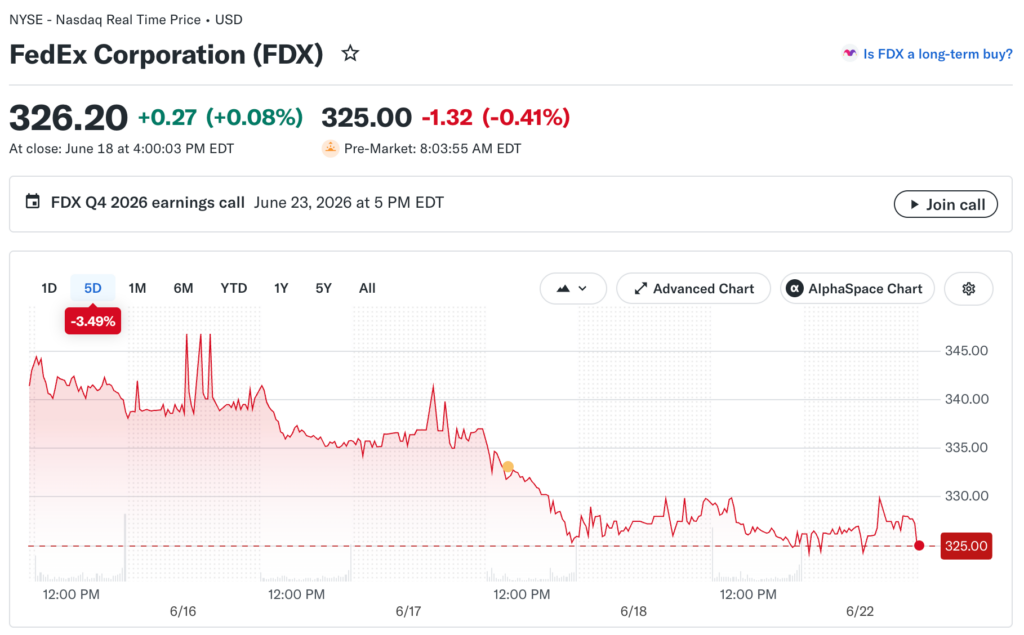
FedEx (FDX) reports fiscal fourth-quarter 2026 results on Tuesday June 23, 2026, and the print arrives under conditions that make it more analytically meaningful than a typical quarterly update. It is the company’s first earnings report following the June 1 spinoff of FedEx Freight, transforming FDX into a pure-play parcel and logistics business for the first time in the company’s history.
A financial analyst at Bankolla notes that what investors see in Tuesday’s numbers is genuinely new information about a structurally different company, not simply a continuation of the FedEx most analysts have tracked for decades.
What the Freight Spinoff Actually Changed
Before June 1, FedEx operated across three primary segments: FedEx Express international air freight, FedEx Ground domestic parcel delivery, and FedEx Freight less-than-truckload trucking. The Freight division was the lowest-margin segment and the one most exposed to industrial economic cycles rather than the e-commerce and consumer parcel demand that commands premium equity multiples.
Spinning off Freight creates a cleaner investment thesis for the remaining FDX. The company now derives essentially all of its revenue from Express and Ground, both carrying higher margins and more direct exposure to e-commerce growth and international trade flows. The separation simplifies the financial model, making it easier for analysts to value FDX against pure-play peers like UPS.
The Iran War’s Logistics Impact
International air freight volumes were meaningfully disrupted throughout the Iran conflict period, which ran from late 2025 through the ceasefire framework signed in mid-June 2026. FedEx Express routes through the Middle East and Central Asia were rerouted or reduced, adding measurable cost and extending delivery times for customers shipping through those corridors at the conflict’s peak.
The Q4 fiscal 2026 period being reported Tuesday captures the tail end of that disruption. Investors should expect management commentary on whether route normalization is already contributing to improving Express margins, or whether the cost recovery from the rerouting period will take additional quarters to fully work through the income statement.
That distinction has significant implications for the second half of 2026 revenue guidance that the market will focus on most closely.
E-Commerce Volume Trends and Ground Profitability
FedEx Ground has been the division carrying the most structural improvement story in recent years through the company’s DRIVE efficiency program. The program targets billions in annual cost reduction through network consolidation, package handling automation, and route density improvements that lower cost per package delivered.
The June 23 report will reveal how much of the DRIVE program’s projected savings materialized in Q4. Management had guided for significant incremental cost improvement in the back half of fiscal 2026. If the delivery rate on those savings matches or exceeds earlier guidance, it validates the bull case for FDX as a margin expansion story rather than simply a parcel volume recovery play.
What Carnival’s Earnings Add to the Picture
FedEx’s results this week will be read alongside Carnival Corporation earnings as a paired read on consumer and business spending durability across different sectors simultaneously. Logistics volumes are a leading indicator of economic activity because they capture actual goods movement rather than sentiment surveys.
A strong FedEx result showing both Express and Ground volumes holding up would be a meaningful positive signal for consumer discretionary and industrial stocks heading into Q3 2026.
The Iran ceasefire framework, which includes reopening the Strait of Hormuz, removes the most acute supply chain risk weighing on international shipping since late 2025. FedEx management will almost certainly address those implications for its international Express business in Tuesday’s prepared remarks.
Analyst Expectations and the Bar for a Positive Reaction
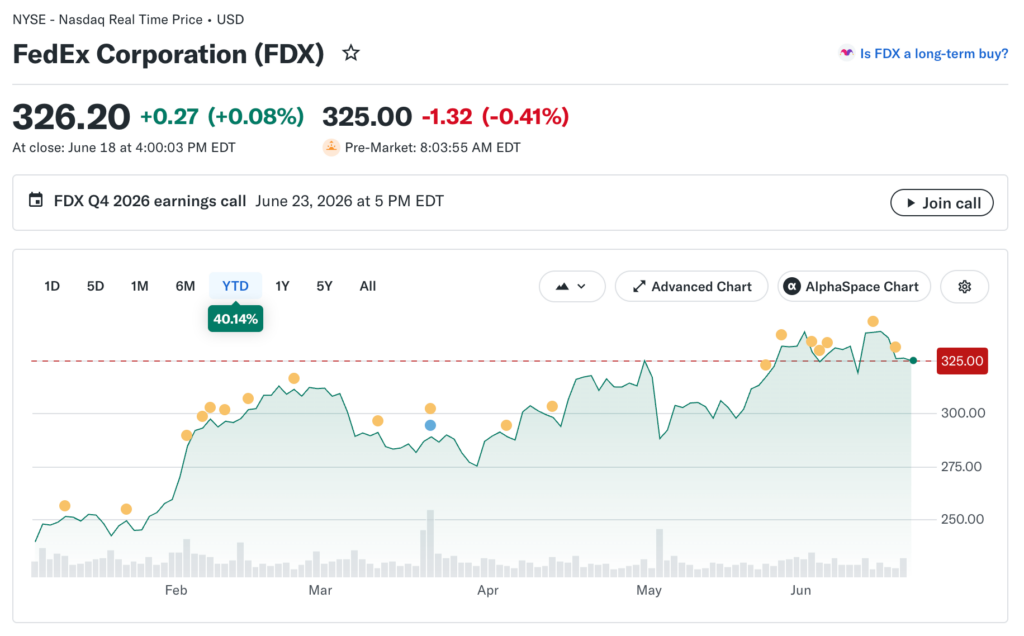
Analyst consensus heading into Tuesday’s report reflects cautious optimism that the DRIVE savings are materializing on schedule and that Express margins are recovering from their Iran war-period lows. A revenue figure confirming Ground volume stability and Express margin recovery, combined with a raised full-year outlook for the newly structured standalone company, would likely push FDX shares meaningfully higher in the session.
The risk scenario is an Express margin miss combined with conservative guidance that reflects residual uncertainty about route normalization timelines. At FDX’s current valuation, that combination would remove the multiple expansion premium the market has assigned to the post-spinoff business.
The Three Metrics Worth Watching on Tuesday
Investors monitoring FedEx on June 23 should focus on three specific outputs beyond the headline numbers. Express operating margin, Ground cost per package, and full-year revenue guidance for the standalone FDX business are the three figures that tell the most complete and actionable story about whether the spinoff thesis is actually delivering the shareholder value it promised when announced.
A constructive read on all three would establish FedEx as one of the cleaner recovery stories in the market heading into the second half of 2026. The business model is now structurally simpler, the ceasefire provides the international volume backdrop bulls have been waiting for, and the DRIVE program gives FDX a self-funded path to margin improvement that does not require a demand acceleration to succeed.