
Brokers from Gammance examine the latest EUR/USD forecast, as the pair continues to recover following renewed weakness in the US Dollar. Softer-than-expected US inflation figures have improved sentiment toward the euro, allowing EUR/USD to post gains for a second consecutive session.
Even so, the broader technical picture suggests that buyers still face challenges before confirming a stronger bullish trend.
Dollar Weakness Supports EUR/USD Recovery
EUR/USD is trading around 1.1435-1.1440, extending its rebound after pulling back from the important 1.1460-1.1470 resistance area. The move higher has been driven by a softer US Dollar after recent US consumer inflation data came in below market expectations.
The inflation report encouraged investors to reduce expectations of additional Federal Reserve rate increases, weakening demand for the US Dollar. Lower interest rate expectations typically reduce the appeal of the greenback, providing support for currencies such as the euro.
Despite this improvement, the broader macroeconomic picture remains balanced. Elevated crude oil prices continue to present inflation risks, while Federal Reserve Chair Kevin Warsh has reiterated the central bank’s commitment to maintaining price stability.
At the same time, increasing geopolitical tensions involving the United States and Iran have preserved a degree of safe-haven demand for the US Dollar, limiting the currency’s downside potential.
These competing forces explain why EUR/USD continues to trade within a range rather than developing into a decisive bullish breakout.
Technical Indicators Suggest Cautious Optimism
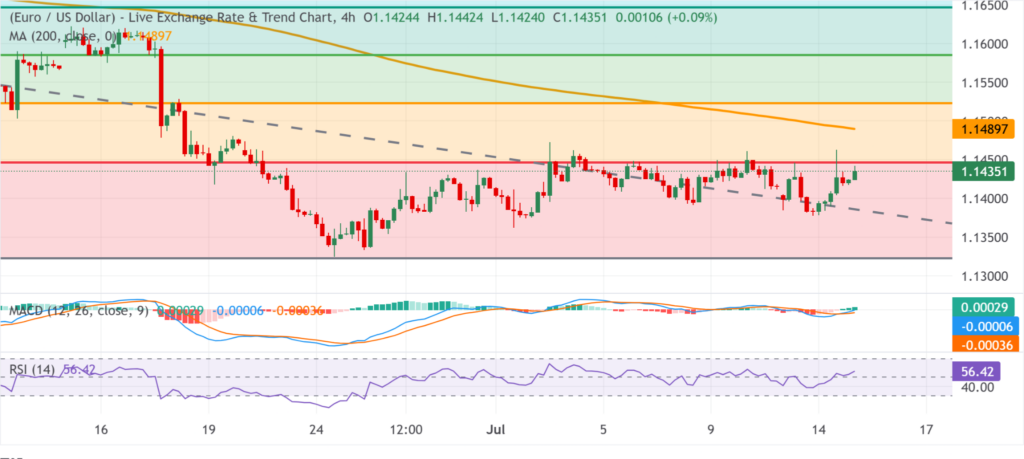
From a technical perspective, EUR/USD continues to encounter strong resistance near the 23.6% Fibonacci retracement of the broader April to June decline. Although buyers have repeatedly tested this zone, they have not yet generated enough momentum to establish sustained trading above it.
Several technical indicators nevertheless point toward improving conditions. The MACD has shifted into positive territory, indicating that short-term momentum is gradually strengthening after weeks of weakness. Meanwhile, the Relative Strength Index (RSI) currently stands near 56, reflecting moderate bullish momentum without entering overbought territory.
This combination suggests that buyers are slowly regaining confidence, although the recovery still lacks the strength needed for a confirmed trend reversal.
The broader structure therefore favors a cautious outlook rather than aggressive bullish positioning. Momentum continues to improve, but confirmation will require EUR/USD to overcome multiple technical barriers before a stronger upward trend can be established.
Key Resistance And Support Levels
The immediate resistance zone remains between 1.1460 and 1.1470, an area that has capped recent advances. A successful breakout above this range would represent an important technical development for the pair.
Beyond this level, traders are closely monitoring the 200-period Simple Moving Average (SMA) on the four-hour chart near 1.1490. This moving average often serves as an important trend indicator, making it an obstacle for buyers.
If bullish momentum continues, attention would shift toward the 38.2% Fibonacci retracement around 1.1523, followed by the 50% retracement close to 1.1585. Reaching these levels would significantly improve the medium-term technical outlook and suggest that the recovery from June’s lows is gaining traction.
On the downside, the most important structural support remains near 1.1323, corresponding to the Fibonacci anchor established during the recent decline. A decisive break below this level would reinforce the broader bearish structure and increase the likelihood of renewed selling pressure.
For now, the market continues to respect both support and resistance, leaving traders focused on identifying the next catalyst capable of breaking the current trading range.
What Traders Should Watch Next
The coming sessions are to be influenced by a combination of economic releases, central bank communication, and broader geopolitical developments.
Additional US inflation or labor market data could reshape Federal Reserve expectations, directly affecting US Dollar demand. Likewise, any meaningful changes in energy prices may alter inflation expectations and influence currency market positioning.
Technical traders will continue monitoring whether EUR/USD can sustain trading above nearby resistance while momentum indicators remain constructive. The current RSI and positive MACD provide encouraging signals, but confirmation requires stronger buying activity supported by higher trading volume.
Failure to overcome the 1.1470 barrier could trigger another period of consolidation, while a successful breakout may encourage additional buying interest toward higher Fibonacci objectives.
Conclusion
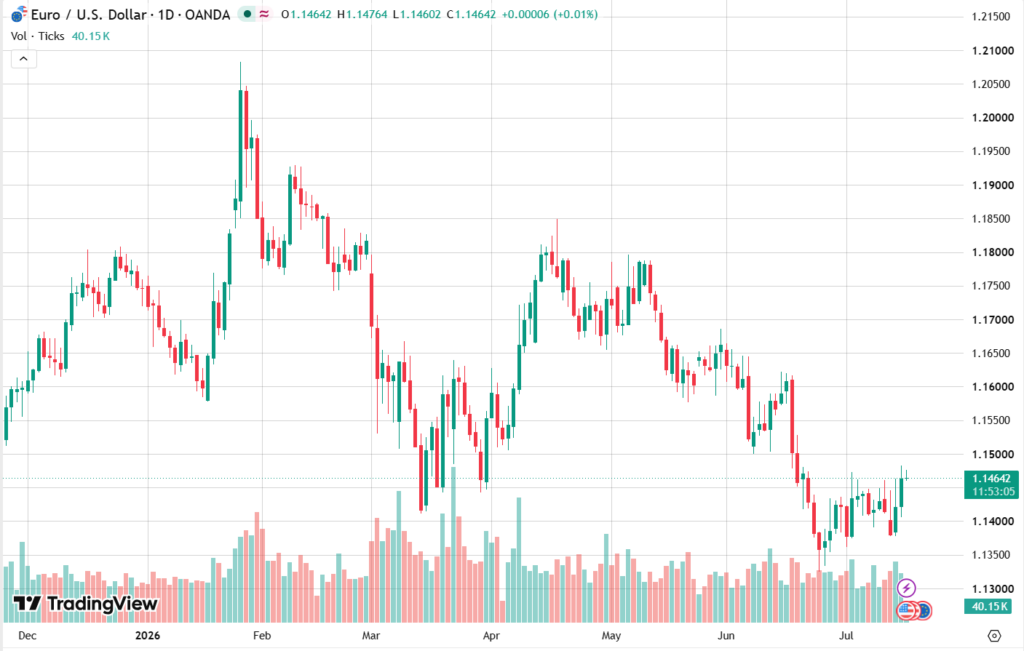
The latest EUR/USD recovery reflects improving sentiment following softer US inflation data, yet the broader technical picture continues to call for discipline. Positive momentum indicators, including a strengthening MACD and an RSI near 56, support further upside potential, but several important resistance levels remain directly ahead.
As long as EUR/USD stays above the critical 1.1323 support, buyers retain an opportunity to challenge 1.1490, 1.1523, and eventually 1.1585.
However, geopolitical uncertainty and expectations surrounding future Federal Reserve policy continue to limit the strength of the rally. For traders following this technical analysis, monitoring both momentum indicators and key price levels will remain essential in evaluating whether the current recovery can develop into a more sustained bullish trend.