
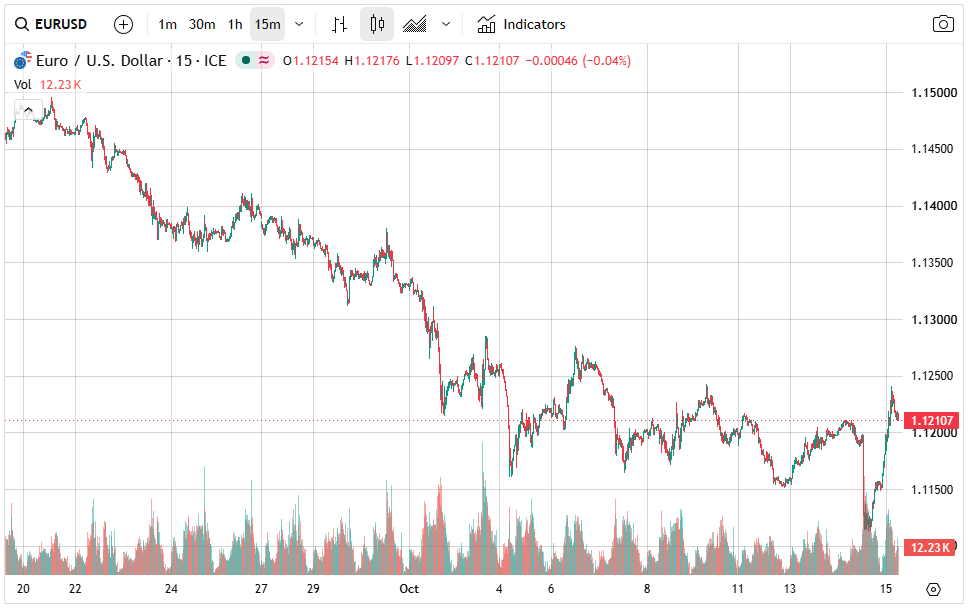
The EUR/USD pair edged higher to 1.1204 during Wednesday morning trading as the bearish momentum that began earlier in the week started to weaken. The recovery represents approximately 52 pips from the weekly low of 1.1152, but the broader market structure remains decisively bearish.
Lucovox’s specialists examine this subject in detail throughout the article.
Price action suggests that the current rebound may represent a technical correction rather than a confirmed trend reversal, particularly as traders await the latest US inflation figures and additional signals regarding Federal Reserve policy.
The pair remains vulnerable to renewed selling pressure because US inflation expectations, interest-rate differentials, and relative monetary policy expectations continue to favor the US dollar. Unless EUR/USD establishes a sustained recovery above its short-term trend indicators, sellers may retain control of the market.
US CPI Data and Federal Reserve Policy Expectations
The upcoming Consumer Price Index (CPI) report represents the primary fundamental catalyst for EUR/USD. Economists surveyed by Reuters expect headline inflation to increase from 3.4% to 3.6%, while core CPI is projected to rise from 2.4% to 2.5%.
Both measures would remain above the Federal Reserve’s 2.0% inflation target, highlighting persistent price pressures within the US economy.
An upside inflation surprise could strengthen expectations that the Federal Reserve will maintain restrictive monetary policy for longer. Higher expected policy rates generally support the US dollar by increasing the relative yield attractiveness of dollar-denominated assets.
Under this scenario, EUR/USD could resume its decline toward 1.1151, with a confirmed breakdown potentially exposing 1.1100.
A downside inflation surprise could trigger a reassessment of interest-rate expectations, weaken the dollar, and produce a short-covering rally in EUR/USD. Nevertheless, a temporary bullish reaction would not automatically invalidate the bearish technical structure.
Traders would need confirmation through a sustained break above resistance and the relevant moving averages.
Energy Prices, Treasury Yields, and Market Sentiment
Elevated energy prices represent an additional inflationary risk. Brent crude oil at $107 per barrel and WTI crude at $95.27 could contribute to higher transportation, manufacturing, and distribution costs.
Persistent energy-driven inflation may complicate the Federal Reserve’s efforts to return inflation toward 2.0%, potentially limiting the scope for monetary easing.
Meanwhile, US Treasury yields have eased slightly, with the 10-year yield at 5.22% and the five-year yield at 5.01%. Although declining yields can temporarily reduce the dollar’s yield advantage, the impact on EUR/USD will depend on whether the movement reflects changing monetary policy expectations or short-term positioning.
EUR/USD Technical Analysis: Key Support and Resistance
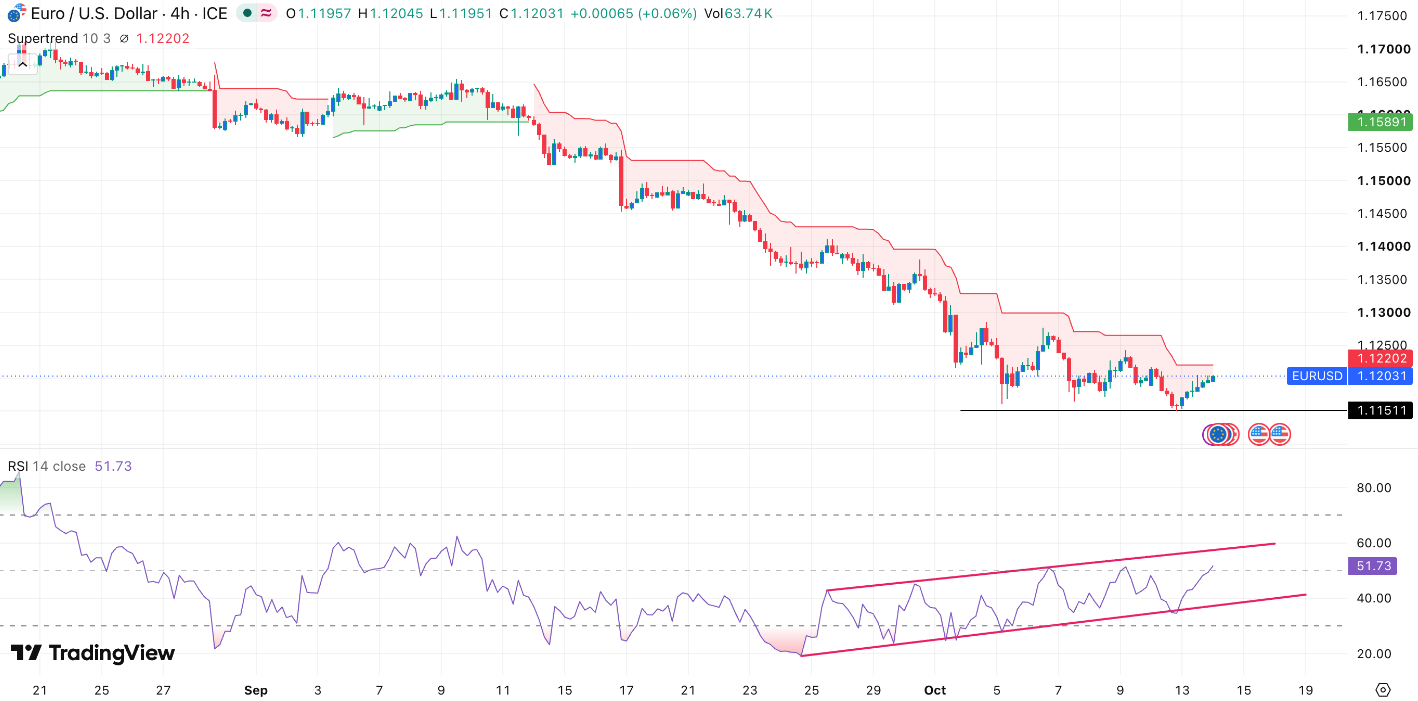
The four-hour chart indicates that EUR/USD remains within a bearish technical configuration despite recovering from 1.1151 to approximately 1.1202. The rebound has improved short-term momentum, but price remains below both the Supertrend indicator and the 50-period Exponential Moving Average (EMA).
Trading below the 50-period EMA suggests that the prevailing short-term price trend remains negative. Meanwhile, the position of the Supertrend indicator reinforces the bearish bias and indicates that buyers have yet to establish sufficient momentum to confirm a structural reversal.
The Relative Strength Index (RSI) has moved above its neutral 50 threshold and developed an ascending channel. This signals improving short-term momentum, but the divergence between the rising RSI and the bearish price structure suggests that the recovery could be corrective.
If the RSI fails to sustain its advance while price remains below dynamic resistance, renewed downside pressure could emerge.
The immediate support zone is 1.1151–1.1152, corresponding to the recent weekly low. A decisive four-hour close below this area would strengthen the bearish continuation scenario and expose 1.1100, approximately 51 pips below the 1.1151 support level.
A break beneath 1.1100 could extend losses further, depending on subsequent price action and market liquidity.
On the upside, 1.1204 represents the immediate reference level for the current rebound. A sustained move above this area would improve the short-term structure, but stronger confirmation would require a break above the 50-period EMA and the Supertrend resistance. Without these developments, upward movements may encounter renewed selling interest.
Conclusion: Bearish Momentum Remains Dominant
The EUR/USD outlook remains extremely bearish ahead of the US inflation report, with the pair trading below its principal short-term trend indicators. Although the RSI above 50 and the rebound from 1.1151 indicate improving intraday momentum, the broader technical structure continues to favor sellers.
An inflation reading above the expected 3.6% headline CPI or 2.5% core CPI could strengthen the dollar and accelerate a decline toward 1.1151 and 1.1100. Softer inflation could trigger a recovery, although a sustained break above key technical resistance would be necessary to challenge the bearish bias.
The primary trading signal remains bearish, subject to confirmation from inflation data, Federal Reserve commentary, and price action around critical support and resistance levels.