
Ethereum continues trading within a narrow range as buyers and sellers battle for control near a key technical level. While recent momentum indicators have improved, broader market sentiment remains cautious, preventing a decisive breakout despite encouraging signs on higher timeframes.
In its latest cryptocurrency market commentary, BCR Limited examines Ethereum’s current technical structure, highlighting how improving momentum, cautious investor sentiment, and on-chain activity are shaping the market outlook as traders wait for confirmation of the next major move.
Ethereum Trades Near a Critical Decision Point
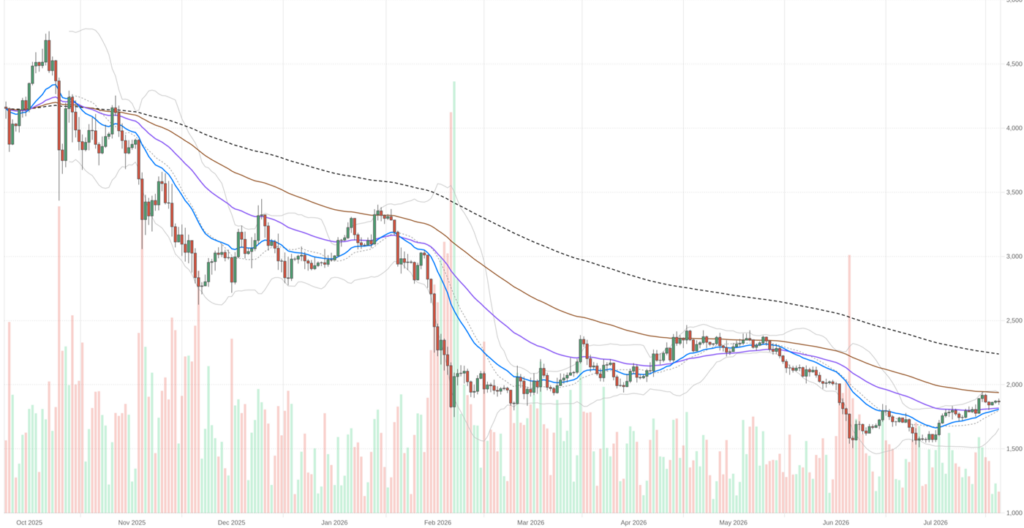
Ethereum is currently trading around $1,866, almost exactly at its daily pivot level, making this one of the most important technical areas for short-term price action. The cryptocurrency has managed to reclaim both its 20-day and 50-day Exponential Moving Averages (EMAs), a constructive signal that suggests buyers are gradually regaining control after several weeks of weakness.
However, the broader trend remains less convincing. Ethereum still trades well below its 200-day EMA, which remains near $2,239, illustrating that the longer-term market structure continues to favour caution despite recent improvements.
Daily momentum indicators have also become more supportive. The Relative Strength Index (RSI) has climbed above the neutral 50 level without entering overbought territory, while the MACD histogram has continued expanding into positive territory, suggesting that selling pressure is gradually easing.
Market Sentiment Still Limits Upside Potential
Although Ethereum’s technical picture has improved, the broader cryptocurrency market remains far from fully supportive.
Bitcoin dominance continues to hover above 56%, indicating that investors still prefer allocating capital to Bitcoin rather than rotating aggressively into alternative cryptocurrencies. At the same time, the Crypto Fear & Greed Index remains firmly within Fear territory, reflecting cautious positioning among market participants despite recent stabilization.
This combination creates a challenging environment for Ethereum. Even when technical indicators improve, broader market sentiment can limit upside momentum if investors remain reluctant to increase overall crypto exposure.
Macro conditions also continue influencing digital assets. Expectations surrounding interest rates, inflation trends, and institutional risk appetite remain important variables that could either strengthen or weaken demand for cryptocurrencies over the coming weeks.
Institutional participation also remains an important factor. Spot ETF flows, corporate treasury activity, and broader capital allocation decisions could significantly influence Ethereum’s medium-term direction.
If institutional demand strengthens alongside improving technical indicators, market confidence may gradually return and support a more sustainable recovery.
On-Chain Activity Shows Selective Strength
Blockchain activity offers a mixed but somewhat encouraging picture.
Decentralized finance activity has increased on several Ethereum-based protocols, with Uniswap V3 recording a notable jump in trading fees, suggesting renewed participation from active users. However, other major protocols have experienced softer activity, indicating that capital is becoming more selective rather than broadly returning across the decentralized finance ecosystem.
This uneven participation suggests investors are carefully choosing opportunities instead of aggressively re-entering the entire market.
Network activity, transaction volumes, and decentralized finance adoption continue providing valuable insight into investor behaviour. While these metrics have yet to signal a broad market expansion, they indicate that selective accumulation is taking place beneath the surface despite the cautious macroeconomic backdrop.
Key Technical Levels Investors Are Watching
From a technical perspective, several price levels may determine Ethereum’s next directional move.
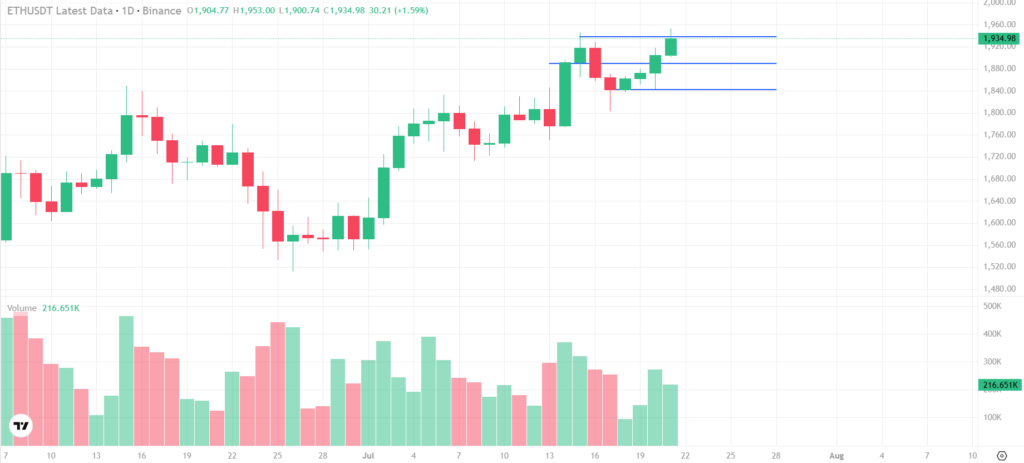
A sustained break above the resistance area near $1,890 could allow buyers to challenge the upper Bollinger Band around $1,939, potentially strengthening bullish momentum. Such a move would likely attract additional buying interest if accompanied by stronger trading volume.
On the downside, failure to hold support near $1,842 could expose Ethereum to renewed selling pressure, with traders then monitoring the 20-day EMA near $1,807 for signs of additional weakness.
Until one of these levels breaks convincingly, Ethereum may continue consolidating within its current trading range as investors wait for a stronger catalyst.
Trading volume will likely play a crucial role in validating the next breakout attempt. A move beyond resistance accompanied by rising participation would carry greater technical credibility than a breakout occurring under weak market volume and limited investor conviction.
Conclusion
Ethereum remains positioned at an important technical crossroads. Improving momentum indicators and stronger short-term price structure provide reasons for cautious optimism, yet broader market sentiment continues limiting confidence.
For investors, the coming sessions may prove decisive. A confirmed move above $1,890 could strengthen the recovery narrative, while a decline below $1,842 would likely shift attention back toward downside risks. Until then, patience and disciplined risk management remain essential as Ethereum trades within an increasingly compressed range.