
WTI Crude Oil opened Monday with a sharp downside gap, falling more than $5.00 at the open and trading just above $81.00, almost 9% below Friday’s settlement near $89.00. The move pushed prices beneath the 50-day moving average for the first time since mid-July, confirming a significant short-term deterioration in momentum.
Learn more about this topic through the insights shared by Rubinax’s brokers in the accompanying article.
The daily decline represented one of the largest single-session moves of the year, with Brent Crude Oil breaking below the $90.00 psychological threshold for its steepest drop since the April ceasefire period.
The market has now priced in a fourth wave of geopolitical de-escalation, but unlike previous episodes, there is still no formal agreement, confirmed framework, or evidence of normalized energy flows.
The current sell-off reflects a rapid unwinding of the war risk premium rather than a confirmed improvement in the global supply outlook. Futures markets have moved aggressively lower while the physical market remains constrained.
Physical Oil Supply Remains Disrupted Despite Futures Sell-Off
The most important divergence in the current market is between paper crude pricing and physical crude availability. While futures contracts have declined sharply, actual transportation flows remain impaired.
Commercial traffic through the Strait of Hormuz remained significantly below normal over the weekend, with daily vessel crossings dropping below 10. The reduction took place along a route responsible for approximately 20% of global oil supply movements, keeping the risk of prolonged shipping delays and energy supply disruptions elevated.
The Red Sea shipping route remains effectively unavailable due to continued security threats, forcing approximately 5 million barrels per day of Saudi crude exports onto longer routes around the Suez Canal. The additional distance increases shipping costs, extends delivery times, and reduces the immediate availability of replacement barrels.
Retail energy prices also reflect the ongoing physical pressure. The average US gasoline price climbed to approximately $4.11 per gallon, rising around $0.11 week-over-week and sitting roughly 38% above late-February levels.
The futures market has already priced a return to normal conditions, but tanker data does not yet confirm that assumption.
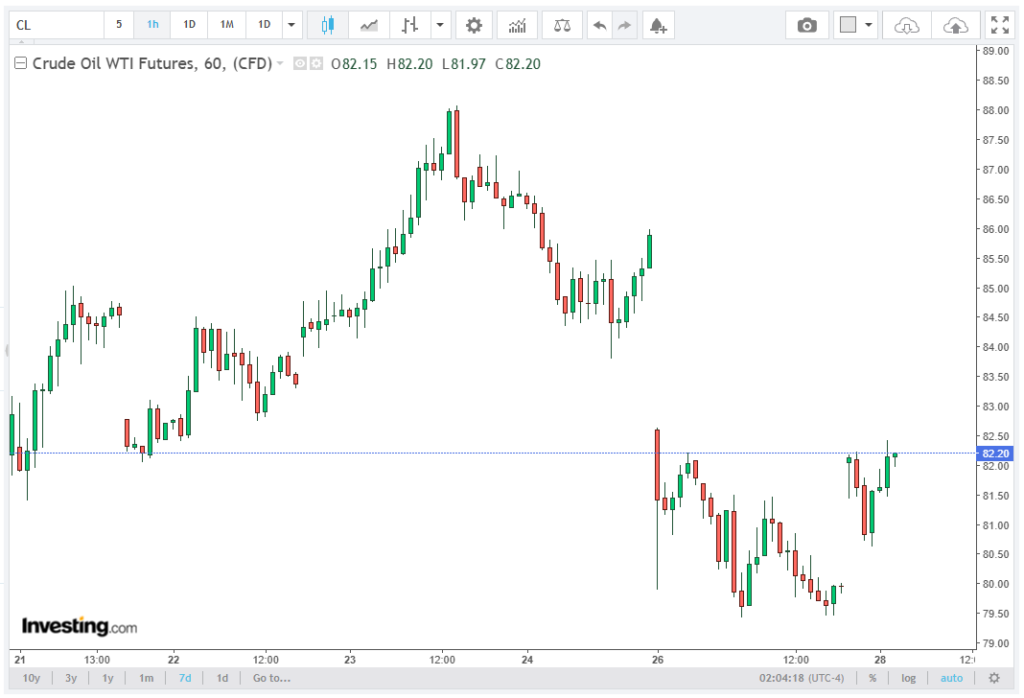
Crude Oil Technical Structure Turns Bearish Below $84.50
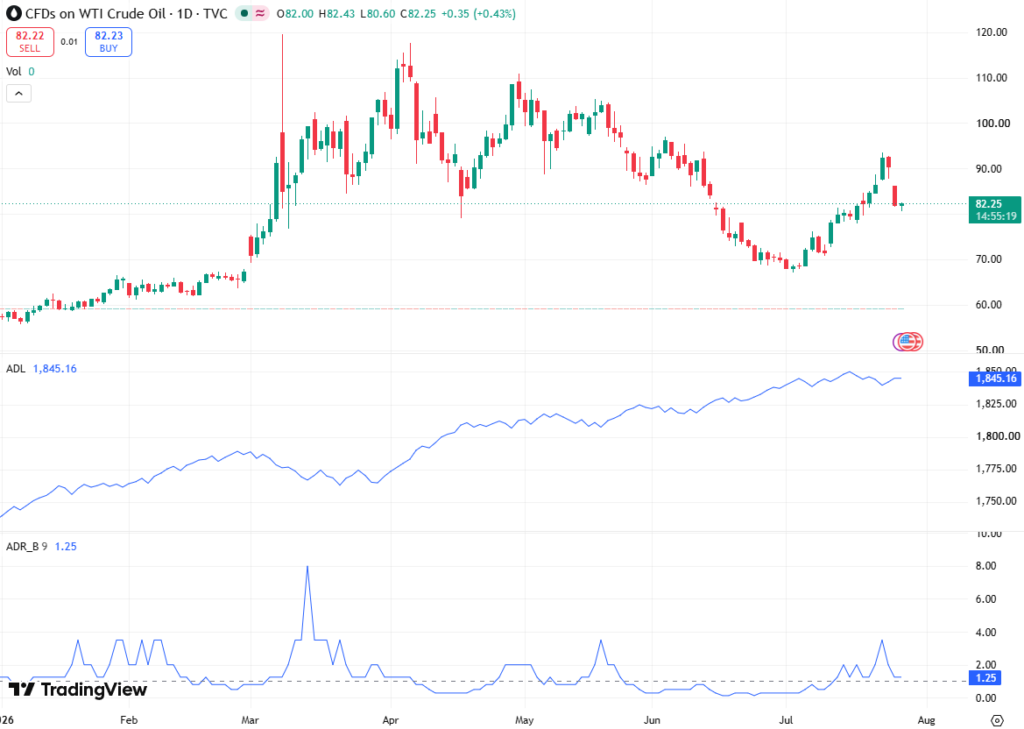
From a technical perspective, WTI Crude Oil has entered a high-volatility correction phase. The break below the 50-day moving average indicates weakening short-term trend strength, while the failure to reclaim the $84.50 resistance zone leaves sellers in control.
The first major downside level is the $80.00 psychological support, followed by the rising 200-day Exponential Moving Average (EMA) near $78.00. This area remains the most important long-term technical support because it has contained previous sell-offs since the spring.
Momentum indicators are stretched, with the daily Stochastic Relative Strength Index (RSI) above 94, showing extreme recent movement. However, the indicator should be interpreted cautiously because strong trends can maintain elevated momentum readings for extended periods.
The current technical bias remains constructively bullish above $78.00, but a daily close below the 200-day EMA would shift the structure toward a deeper bearish reversal.
Federal Reserve and Macro Data Become the Next Catalyst
The next major driver for crude markets is the broader economic calendar. The Federal Reserve policy decision is expected to maintain interest rates near 3.75%, with traders focusing on inflation commentary and future policy expectations.
Lower energy prices provide a direct disinflationary impulse, but weaker demand indicators could become a larger concern for oil prices. Second-quarter economic growth is expected around 2.1%, while core PCE inflation is forecast at 0.2% month-over-month and 3.3% year-over-year.
Additional data releases, including initial jobless claims near 204K, the Employment Cost Index at 0.8%, Chicago activity data near 56, consumer inflation expectations, and Chinese manufacturing PMI readings around the 50.0 expansion threshold, will influence expectations for global oil consumption.
The demand side of the crude equation has remained secondary to geopolitical headlines. If economic data weakens, sellers could gain a stronger fundamental argument beyond temporary peace speculation.
Market Outlook: Peace Priced Faster Than Supply Recovery
WTI Crude Oil has experienced a sharp repricing event, with nearly 10% of market value erased in one session as traders reduced geopolitical exposure. However, the physical energy market has not yet confirmed a return to normal conditions.
The current price action represents a market buying a potential diplomatic outcome while tanker movements, shipping routes, and supply logistics remain disrupted. Until Strait of Hormuz traffic, Red Sea shipping, and physical crude availability improve, the downside move remains driven primarily by expectations rather than confirmed supply recovery.
The key levels remain $84.50 resistance, $80.00 support, and $78.00 major trend support. Above $78.00, crude maintains a recovery structure, but below the 200-day EMA, the market would face a more significant technical breakdown.