
Recent macroeconomic data from China shows a clear divergence between consumption and production, reinforcing an increasingly imbalanced growth structure. In this article, Marbrisse brokers present a detailed and easy-to-understand overview of the subject.
Retail Sales fell -0.6% YoY in May, below expectations of 0.0% and down from +0.2% in April. This move back into negative territory is important because it signals a renewed contraction in nominal consumption momentum, not just a slowdown. On a sequential basis, this represents roughly a -0.8 percentage point deterioration, which is meaningful given the scale of China’s consumer base.
At the same time, Industrial Production rose 4.5% YoY, above forecasts of 4.3% and higher than the prior 4.1%, showing that output-side activity remains relatively resilient. However, Fixed Asset Investment fell -4.1% YTD YoY, worse than the expected -2.0% decline and deeper than the previous -1.6% contraction, confirming continued weakness in the investment cycle.
Retail Sales: Weak Consumption and Lower Import Sensitivity
The -0.6% decline in Retail Sales is particularly significant because it reflects weakening final domestic demand absorption. This category includes autos, appliances, discretionary goods, and services consumption, all of which have relatively high import content sensitivity.
A negative reading implies that nominal consumption growth has turned negative year-on-year, meaning either real consumption is contracting or price effects are no longer sufficient to offset volume weakness.
From a macro perspective, this reduces the marginal propensity to import, especially for commodities and intermediate goods. Even small deviations below zero in Chinese consumption data can have outsized effects on global expectations for raw material demand, given China’s central role in global trade flows.
The deterioration from +0.2% to -0.6% also signals weakening consumer confidence, which tends to correlate with reduced discretionary spending and lower cyclical multipliers.
Fixed Asset Investment: Structural Weakness Deepens
The -4.1% decline in Fixed Asset Investment is the most structurally negative component of the release. Investment drives demand for construction materials, machinery, and industrial inputs.
The deterioration from -1.6% to -4.1% reflects a meaningful additional contraction in capital formation, pointing to continued stress in real estate development and infrastructure financing.
From a financial perspective, this suggests a weakening credit transmission mechanism, where investment is no longer responding effectively to financing conditions.
This directly reduces demand for imported inputs, especially bulk commodities that are highly sensitive to the construction cycle. For Australia, this is a key channel because Chinese investment demand is one of the strongest drivers of iron ore and steel-related imports.
AUD Transmission: China Beta and Risk Sensitivity
The Australian Dollar (AUD) is structurally sensitive to Chinese macro data due to Australia’s exposure to commodity-linked exports.
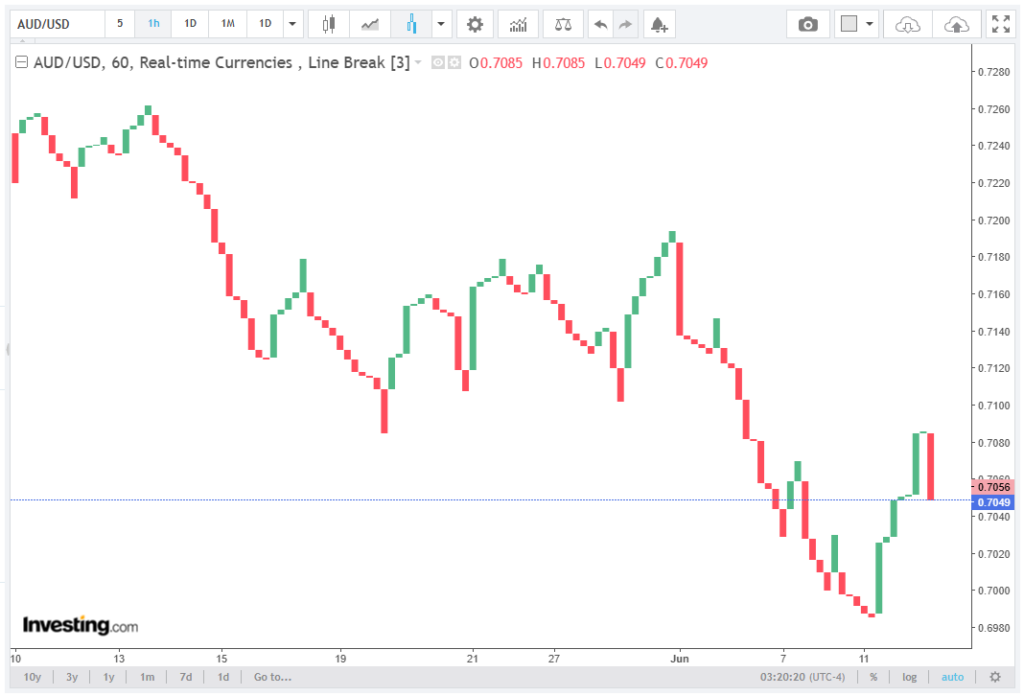
Following the release, AUD/USD fell 0.18% to 0.7060, reflecting a mild risk-off adjustment rather than a structural repricing.
The transmission mechanism operates through three channels. The first is commodity demand expectations, where weaker retail sales and investment reduce forward demand assumptions for industrial inputs.
The second is global growth expectations, where weaker Chinese consumption lowers synchronized global expansion expectations. The third is risk sentiment, where AUD behaves as a higher-beta G10 currency and tends to underperform during China-driven growth disappointments.
Technical Structure: AUD/USD Below Key Trend Resistance
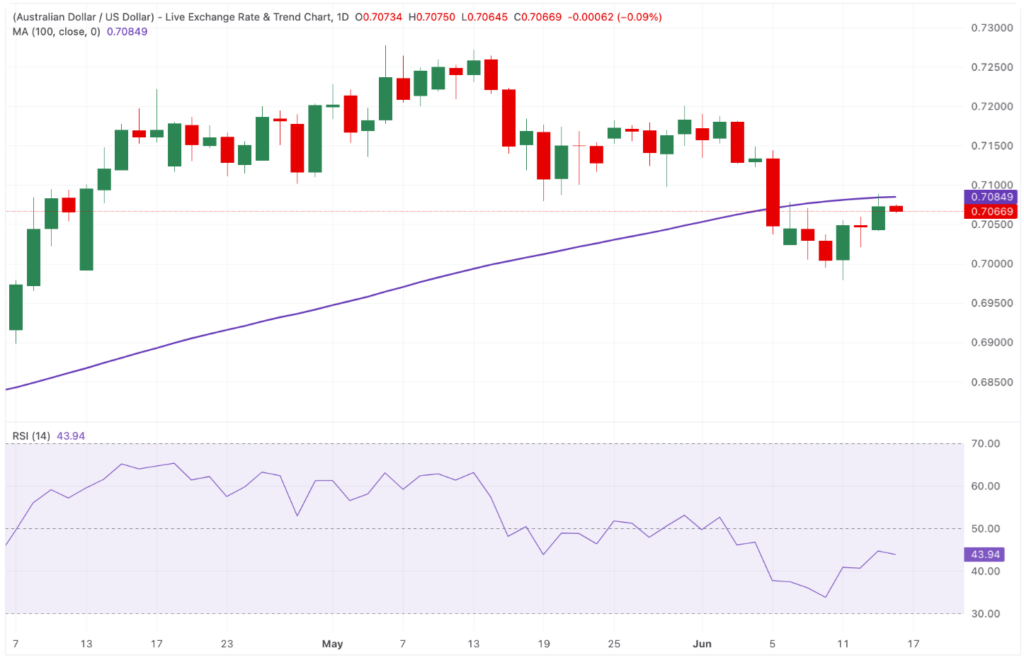
From a technical perspective, AUD/USD remains capped beneath the 100-day Simple Moving Average (SMA) at 0.7085, which continues to define the medium-term resistance level.
Price action around 0.7060 places the pair in a tight consolidation zone below this barrier. The failure to reclaim the 100-day SMA suggests that upside momentum remains structurally limited.
The Relative Strength Index (RSI) near 44 confirms weak momentum conditions, remaining below the neutral 50 threshold and reflecting a lack of bullish conviction.
As long as the price remains below 0.7085, the structure remains mildly bearish to neutral. A sustained breakout above this level would be required to shift momentum toward recovery.
On the downside, the absence of strong nearby support increases sensitivity to further macro-driven weakness, with 0.7000 acting as the next key psychological level.
Conclusion: Diverging Chinese Growth Signals Keep AUD Under Pressure
The latest Chinese data confirms a persistent macro divergence, where Retail Sales (-0.6%) contract, Fixed Asset Investment (-4.1%) weakens further, and Industrial Production (+4.5%) remains relatively stable.
This creates a growth structure that is supply-supported but demand-constrained, typically associated with weaker import intensity and softer commodity demand expectations.
For the Australian Dollar (AUD), the result is a persistent mild downside bias, reinforced by technical resistance at the 100-day SMA (0.7085) and subdued momentum signals.
Unless consumption stabilizes and investment contraction moderates, AUD/USD is likely to remain range-bound with a tendency to drift lower on China-linked macro disappointments rather than establish a sustained recovery trend.