
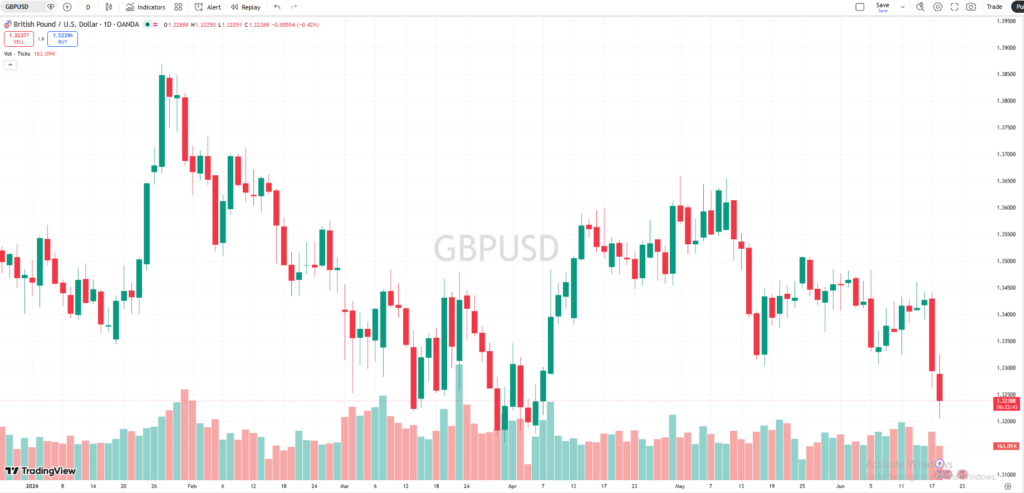
The international foreign exchange markets are demonstrating a pronounced divergence in monetary velocity as the British currency faces intense technical selling against a broadly strengthening greenback.
This localized capital flight has pushed the primary currency pair to its lowest trading levels in exactly two months. Currency experts at Gammance confirms that institutional trend-following algorithms accelerated their short positions immediately following the central bank’s decision to freeze baseline borrowing costs.
The sudden spot market contraction easily breached long-standing defensive buffers, dragging valuations beneath the vital 1.3220 structural baseline. Macro allocators continue to heavily penalize the asset as international capital seeks out higher-yielding sovereign fixed-income alternatives.
Monetary Policy Continuations And Internal Committee Hawkish Shifts
The domestic monetary authority concluded its highly anticipated June assembly by keeping the benchmark interest rate locked at a steady 3.75%, a neutral outcome that lined up perfectly with consensus market forecasts. However, beneath the flat headline decision, a notable hawkish transition emerged within the rate-setting committee as two prominent policymakers formally dissented to demand an immediate rate hike.
Compared to its April economic modeling data, the central bank lowered its near-term consumer inflation forecasts and raised its baseline economic expansion estimates.
Despite these minor internal domestic growth upgrades, currency traders rapidly discounted the hawkish policy friction due to overwhelming macro momentum originating from overseas credit channels. Institutional spot execution was heavily dictated by the aggressive posture of the domestic central bank’s global counterparts, which successfully overshadowed internal policy nuances.
As a direct result of this international rate premium disparity, multi-asset portfolios are prioritizing defensive cash allocations, capping near-term upside velocity for the currency pair near the 1.3200 psychological boundary.
Labor Market Adjustments And Unexpected Unemployment Contractions
The steep negative pricing trajectory materialized despite a surprisingly robust domestic labor market report published by national statistical departments earlier in the morning session. Official government data revealed that the aggregate domestic unemployment rate unexpectedly contracted to 4.9% for the three-month window concluding in April.
This surprise reading marked a clear drop from the 5.0% jobless rate printed during the previous operational period, defying consensus expectations that the structural metric would remain stagnant.
Furthermore, the employment health summary highlighted that the domestic corporate ecosystem generated exactly 100,000 net new positions during the stated analytical window. While this hiring pace reflects a moderate cooling compared to the massive 148,000 job increase logged in the prior period, the final figure comfortably exceeded Wall Street consensus targets which were anchored at a modest 80,000 hiring threshold.
This baseline resilience across commercial business fields suggests that while corporate expansion remains positive, it lacks the raw scale required to reverse systemic currency depreciation.
Persistent Wage Accumulation And Underlying Inflationary Pressures
Fuelling ongoing concerns regarding structural economic overheating, core domestic wage expansion maintained a highly rigid compounding trajectory through the end of the spring quarter.
Average employee earnings excluding variable corporate bonus distributions remained perfectly flat at a strong 3.4% annualized rate, soundly beating consensus forecasts that predicted a distinct moderation down to a 3.2% wage velocity floor. When factoring in volatile bonus pools, total headline salary growth maintained a high-velocity 4.4% yearly expansion rate, matching the previous month’s metrics.
This sticky wage inflation baseline suggests that consumer purchasing power remains highly insulated, which could force internal monetary policymakers to keep borrowing costs elevated for an extended calendar duration. However, the currency remains heavily pinned to its back foot due to an exceptionally aggressive policy stance delivered by the overseas central bank.
During its first formal policy assembly under freshly appointed executive leadership, the foreign committee finalized a hawkish interest rate freeze that catalyzed a massive, cross-asset reserve currency rally.
Overseas Central Bank Directives And Technical Breakdown Milestones
The foreign monetary authority maintained its primary benchmark corridor within a highly restrictive 3.50% to 3.75% band, but aggressively stripped out long-standing language that previously hinted at a systematic easing bias. Furthermore, newly published internal dot-plot forecasts confirmed that approximately half of the active voting board members now anticipate an additional interest rate hike before the current calendar year concludes.
This hawkish development sparked a rapid surge in global sovereign bond yields, drawing massive liquidity pools back into the greenback.
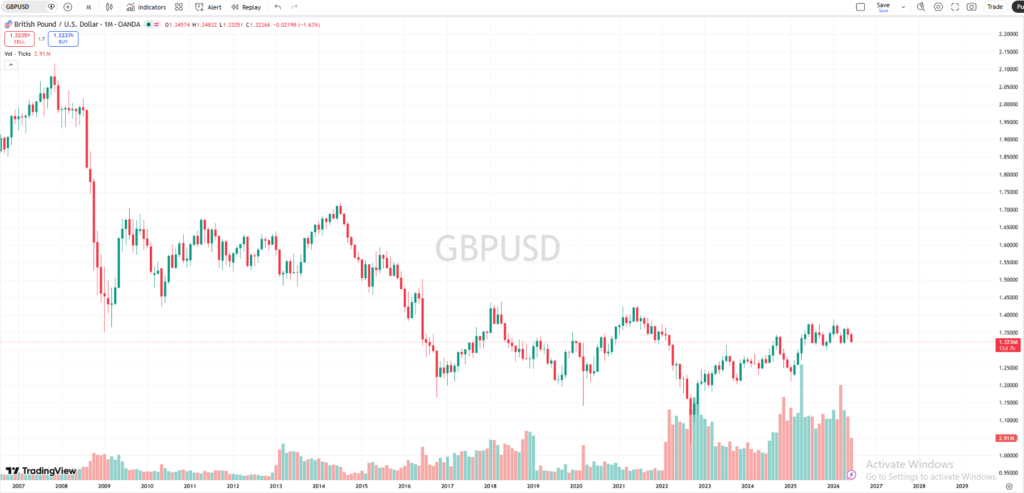
From a strict short-term technical perspective, this structural shift has left the currency pair deeply vulnerable to subsequent downside extensions if the immediate 1.3200 defensive floor fails to hold daily candle closures.
A decisive breakthrough beneath this near-term support zone would instantly open the path for a deeper bearish expansion toward the next historical demand pocket platted near 1.3140. Conversely, recovery programs attempting to spark a tactical bounce must successfully recapture the heavy overhead resistance cluster waiting at 1.3280 before macro trend followers will rotate back toward long positions.