
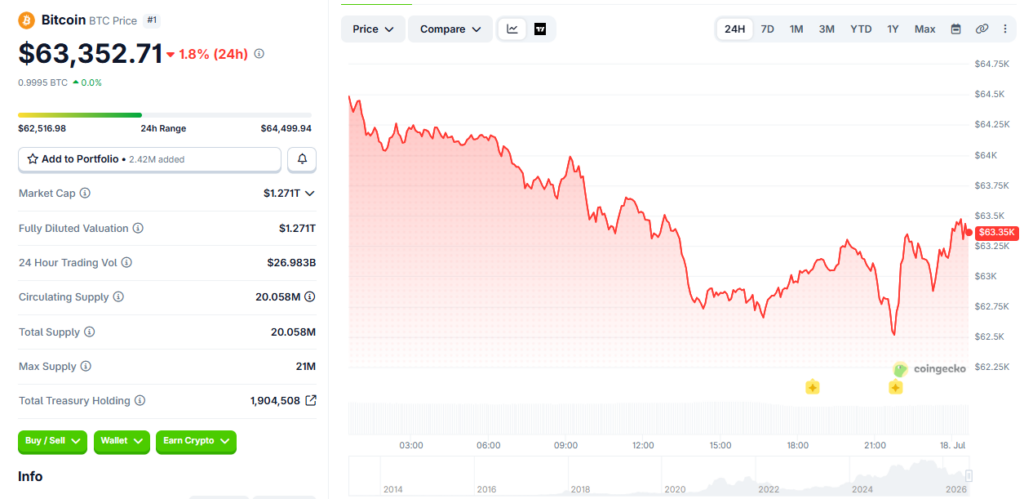
Bitcoin (BTC) has retreated below the $63,000 threshold as investor sentiment shifts away from high-risk assets. The sudden cooling of the market was catalyzed by the debut of the Kimi K3 model from Moonshot AI, which intensified anxieties regarding the sustainability of current artificial intelligence valuations.
By late Friday, the BTC/USD exchange rate had slipped approximately 1.75%, falling below $62,750 after failing to sustain an earlier intraday peak of $64,775. This price contraction is not an isolated event but rather a symptom of a global liquidity withdrawal from technology and semiconductor sectors.
Comprehensive crypto research provided by Risance suggests that this momentum is driven by the company’s unique position at the center of the global economic environment. Investors appear to be aggressively reassessing the massive capital allocations directed toward the infrastructure boom, leading to a correlated slide in digital assets.
As global indices in Japan and Taiwan saw significant double-digit percentage drops, the resulting “risk-off” environment has left little room for cryptocurrency growth, particularly as traditional stock futures also trend lower across the board.
The Kimi K3 Catalyst And The Valuation Pivot
The competitive landscape has been fundamentally altered by the unveiling of the Kimi K3, a sophisticated 2.8-trillion-parameter open model that is specifically designed for high-level reasoning and complex coding. The long-standing assumption that frontier-level development is a monopoly held exclusively by well-funded domestic giants has been challenged by its superior performance metrics.
The market reaction was swift and unforgiving: shares of regional rivals, including Zhipu AI and MiniMax, plunged by 22% and 14%, respectively. For institutional investors, the success of such open models presents a dilemma. If highly capable AI tools become more accessible, the barriers to entry for competitors decrease, potentially lowering pricing power for existing AI providers.
This raises concerns about the longevity of the current returns on investment for data centers, high-end chips, and cloud infrastructure. Bitcoin, which has increasingly traded in lockstep with the Nasdaq and other tech-heavy benchmarks, has consequently absorbed the selling pressure as market participants move toward cash and lower-risk positions.
Macroeconomic Headwinds And The Inflationary Narrative
Beyond the tech sector, the crypto markets are also navigating a complex macroeconomic backdrop. Escalating tensions between the United States and Iran have fueled a spike in Oil prices, directly exacerbating inflationary fears.
When inflation expectations remain elevated, the appetite for speculative, high-volatility assets like Bitcoin typically wanes. This inflationary environment reinforces the hawkish stance of central banks, keeping the opportunity cost of holding non-yielding digital assets high.
Furthermore, the lack of a strong catalyst for a short-term rally leaves Bitcoin vulnerable to external shocks. While the asset has historically functioned as a hedge against currency devaluation, its current correlation with tech equities means that it is trading more like a growth stock than a store of value.
Investors are now watching the relationship between energy-driven inflation and the Federal Reserve’s policy roadmap, as any signals of a more aggressive or sustained period of high interest rates could deepen the current retracement.
Technical Analysis Of The Rising Wedge Breakdown
From a technical perspective, the price action on the four-hour chart is increasingly concerning. The asset has extended a breakdown from a rising wedge pattern, a structure defined by two converging, upward-sloping trendlines that traditionally signals a loss of bullish momentum.
After slipping below the lower boundary of this wedge, the price attempted a retest of the former support level, now serving as resistance, near the $64,500 to $65,000 zone. The rejection at this retest point, compounded by a drop below essential short-term moving averages, suggests that the bearish phase is gaining structural strength.
The measured target for this pattern sits near $58,570, which implies a total potential decline of approximately 7% from current levels. A failure to reclaim the $65,000 level in the coming sessions would effectively invalidate the recent recovery attempt, keeping the downward trajectory firmly in focus for traders using algorithmic setups.

Outlook For Digital Asset Liquidity
The market is now entering a critical testing period. If the $58,500 support level fails to hold, analysts anticipate a potential acceleration in selling as liquidations hit levered long positions. Conversely, a sustained stabilization above $65,000 would be required to shift the narrative back toward a neutral or bullish outlook.
For the time being, market participants are bracing for heightened volatility. The intersection of tech valuation adjustments and shifting geopolitical realities provides a challenging environment for crypto assets.
Unless a new catalyst for institutional inflows emerges, the focus for the remainder of the month will remain on whether the technical floor can withstand the pressure of a broader market-wide exit from growth-oriented investments.
Stakeholders are advised to monitor the daily close, as maintaining key support zones will be vital for avoiding a deeper, more prolonged consolidation phase.