
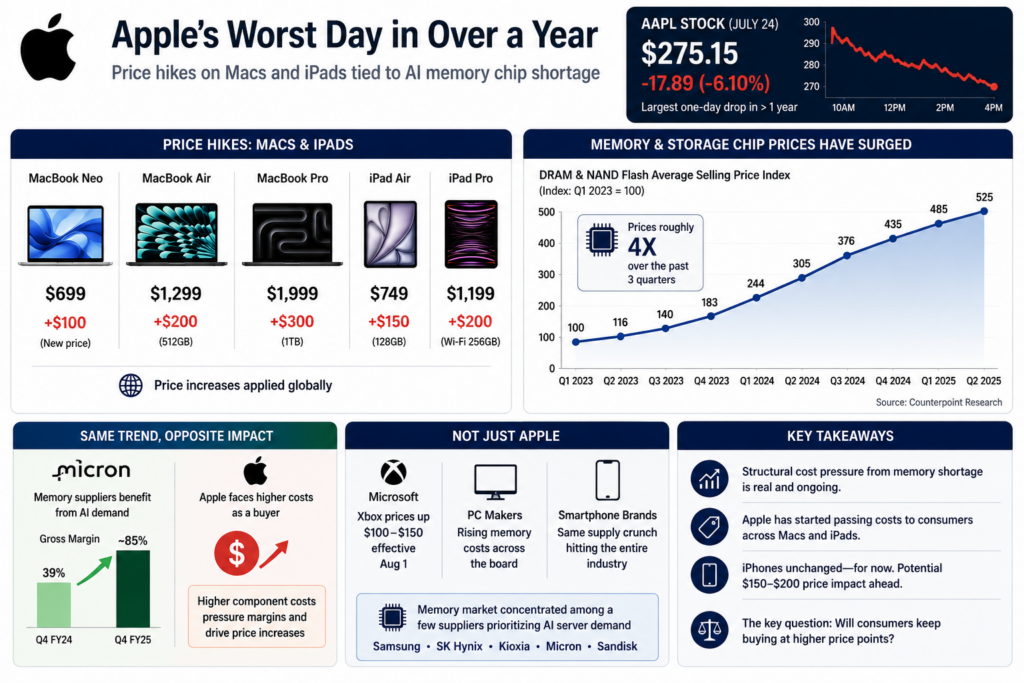
Apple (AAPL) shares dropped roughly 6.1% this week, closing at $275.15, the stock’s steepest one-day decline in more than a year. The cause wasn’t a weak earnings report or a product flop. It was a price increase, and the reasoning behind it ties directly back to the same memory chip shortage that just sent Micron’s stock soaring.
Brokers from Achievements AI broke down what changed, why it happened now, and what it might mean for the rest of Apple’s product line.

What Actually Changed: Price Hikes Across Macs and iPads
Apple raised prices on five specific Mac and iPad models this week.
The entry-level MacBook Neo rose $100 to $699. The MacBook Air with 512GB of storage climbed $200 to $1,299. The MacBook Pro 1TB configuration jumped $300 to $1,999. On the tablet side, the iPad Air 128GB model rose $150 to $749, and the iPad Pro Wi-Fi 256GB version increased $200 to $1,199.
Apple’s online store briefly went offline Thursday morning before reappearing with the updated prices already live, and the changes applied globally rather than in select markets.
Why Now: The AI Memory Shortage Behind It All
The driving force behind these increases is the same one that powered Micron’s blowout earnings report this week. Memory and storage chip prices have roughly quadrupled over the past three quarters, according to Counterpoint Research, as chipmakers redirect production capacity toward the high bandwidth memory used in AI servers.
That’s been a massive tailwind for memory suppliers like Micron, whose gross margin surged from 39% a year ago to nearly 85% in its most recent quarter. For companies on the buying side, such as Apple, the same trend works in reverse, creating a direct cost headwind that ultimately has to be reflected either in lower margins or higher product prices.
Apple described the situation as an unprecedented surge in component demand that it had previously chosen to absorb rather than pass on to customers. CEO Tim Cook had already signaled the shift in a recent interview, calling the current component cost environment unlike anything he had seen in more than four decades in the industry.
It’s Not Just Apple
Apple is far from the only company facing these pressures. Microsoft has announced Xbox price increases of $100 to $150, effective August 1, citing memory and storage costs that have already more than doubled and are expected to rise further by 2027.
The challenge extends across the technology industry. Game console makers, PC manufacturers, and smartphone brands are all dealing with the same global memory supply crunch.
With major suppliers including Samsung, SK Hynix, Kioxia, Micron, and SanDisk prioritizing high-margin AI server demand over consumer electronics, component costs are likely to remain elevated across the sector.
More Than One Headwind Hit the Stock at Once
The product price increases were only one of several factors weighing on Apple’s shares this week. The company had already lowered its gross margin guidance to 47.5%–48.5%, down from 49.3% in the previous quarter, signaling rising cost pressures.
At the same time, an unconfirmed social media report about a potential Apple-Intel manufacturing partnership added uncertainty without providing clear details. Investors also reacted to a new class-action lawsuit in the UK over iCloud pricing, while reports indicated that Apple insiders sold more than $111 million worth of stock over the past three months.
Individually, none of these developments fully explains the stock’s 6% decline. Together, however, they intensified investor concerns at a time when the market was already focused on higher component costs and margin pressure.
The iPhone Is Still Untouched, For Now
Notably, Apple held the line on iPhone, Apple Watch, and AirPods pricing this round, a decision that likely limited how much worse the selloff could have been.
That restraint may not last. Counterpoint Research estimates the higher component cost burden could add roughly $200 per iPhone unit for Apple, with eventual consumer price increases in the range of $150 to $200, weighted more heavily toward higher memory configurations.
With Apple Intelligence features increasingly tied to devices with more RAM, the company has an added incentive to push buyers toward pricier configurations regardless of how the memory shortage evolves.
Outlook
This week’s selloff highlights a structural cost challenge rather than a temporary setback, and Apple may not be finished adjusting prices if the memory shortage continues. The key question for investors is not whether Apple can pass higher costs on to consumers; it has already begun doing so, but whether demand will remain resilient as devices become more expensive.
If customers continue upgrading despite higher prices, Apple could protect its margins and earnings. However, slower upgrade cycles or weaker consumer spending could weigh on future revenue growth. The balance between preserving profitability and maintaining strong demand is likely to remain one of Apple’s biggest challenges, making it a central theme for investors to watch over the coming year.