
Amazon has held up better than most large technology stocks during a rough month for the market. The analysts at Vestronyx review the latest picture for the shares, which closed Monday at $266.93, and explain why the cloud backlog is now the number that matters most, together with a new political risk.
A Resilient Stock In A Weak Market
The Nasdaq slid more than 10% into correction territory in the weeks to November 5, yet Amazon has gained about 4.2% since early October. After its third-quarter report, the shares closed near $240 on October 30, then recovered to about $266 within days.
The sell-off on November 5 showed the difference. The Nasdaq fell 5.5% that day, while Amazon lost only 2.2%, a sign that investors see it as less exposed than chip makers.
Cloud Backlog Reaches $578 Billion
The key figure in the report is the cloud backlog, which measures contracts that customers have signed but that have not yet turned into revenue. It reached about $578 billion at the end of September, up 16.5% from June.
The mix behind it is just as important. Two leading AI labs, in which Amazon also invests, represent about 43% of the total, down from roughly half in June. The rest of the customer base grew by about a third in a single quarter, to around $330 billion.
New deals were signed with companies such as Meta, Nvidia, Oracle, Salesforce, Qualcomm and Verizon, which shows that demand is spreading and that the risk of depending on just a few clients is shrinking.
What Investors Pay For The Core Business
At $266.93 a share, Amazon is worth about $2.88 trillion. Its stakes in the AI labs are valued at roughly $289 billion, close to 10% of that total. Without them, and after adding net debt, the core business is valued at around $2.65 trillion, or about 25 times the $104 billion in operating profit earned over the last twelve months.
Management Targets Faster Cloud Growth
Management said that cloud revenue can grow by more than 40% in both 2027 and 2028, and that customer demand is already visible into 2029. The third quarter was the sixth in a row with faster growth, so the target extends a trend that is already in place.
Profit has kept up so far, with a cloud margin of 38.7% despite rising equipment costs. Higher prices for sold-out capacity and wider use of the company’s own AI chip are helping. If growth reaches the target, one independent estimate puts 2028 cloud operating profit near $133 billion, although such projections are uncertain.
The New Risk: Data Center Limits
The main new concern is political. Some states are considering pauses on approving new data centers. In Virginia, the world’s largest data center market, a bill would suspend new approvals from mid-2027 to mid-2030, and lawmakers will discuss it in January.
A slowdown in construction would delay revenue that is already booked. It would also hurt cash flow, since the company spent about $77 billion on investment in the third quarter alone and interest costs have risen sharply, so equipment sitting idle would be expensive.
Support And Resistance Levels
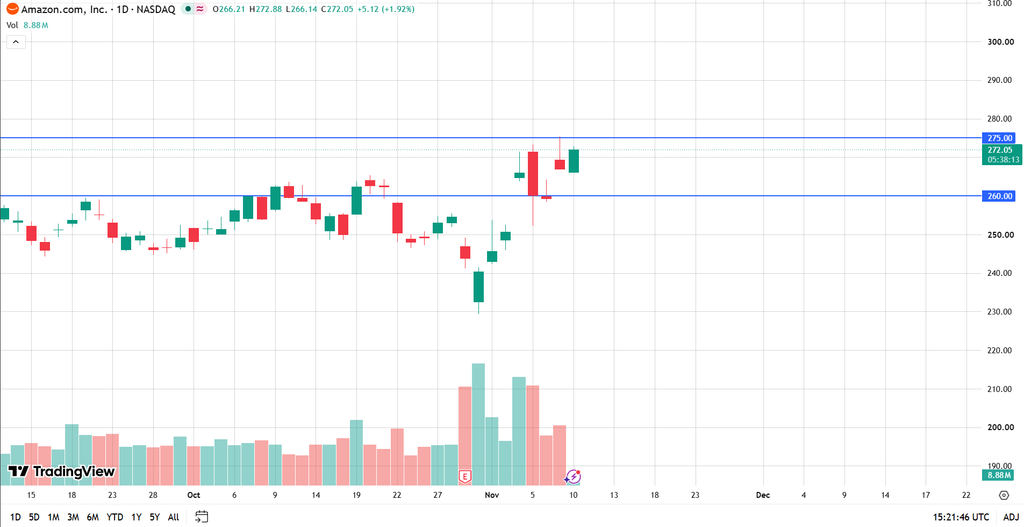
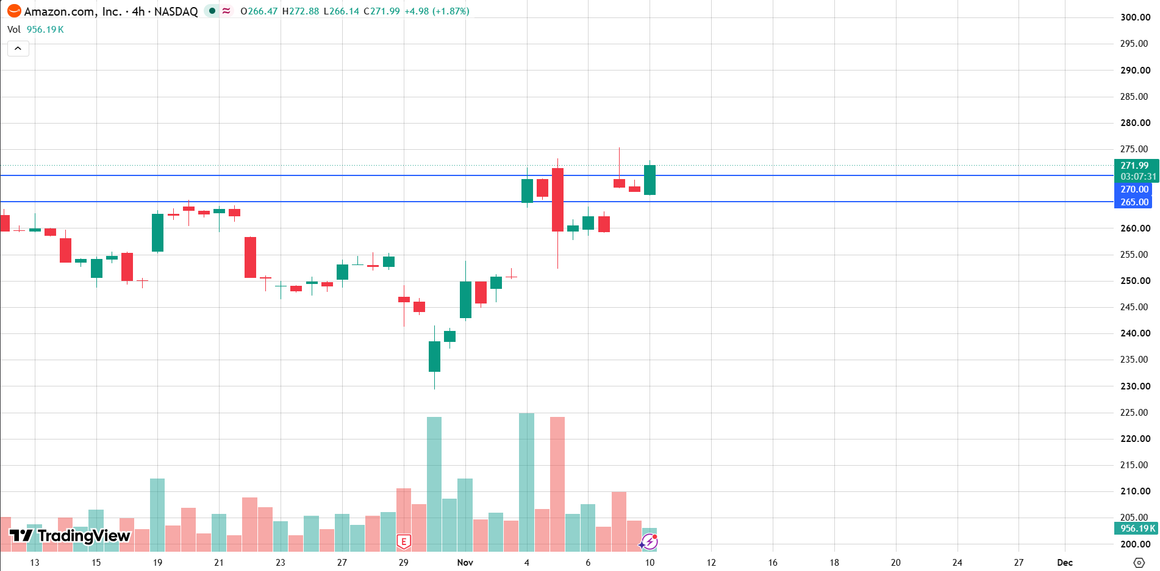
Amazon trades near $267. The round level of $270 is the first resistance, followed by $275. A close above that area would show that buyers are in control after the recent recovery.
On the downside, $260 is the first support, and a deeper floor is near $250. A fall under $240, the post-earnings close, would cancel the recovery.
What Traders Can Do
After a rebound of about 11% from the post-earnings close, some traders may wait for a small pullback toward $260 and look for buyers to defend it, with a stop-loss below. Others may prefer to wait for a close above $275 before entering. Headlines about data center rules can move the shares quickly, so position size deserves attention.
Strong demand does not remove the need for risk control, because even healthy companies can fall quickly when sentiment shifts.
Conclusion
Amazon enters the next phase with a wider customer base in the cloud, a strong growth target and a valuation that investors still debate. The $270 resistance and the $260 support are the levels to follow.
Traders following Stocks strategies should watch cloud growth, capital spending and the debate over data center limits, since these factors are likely to shape the next move in the shares.