
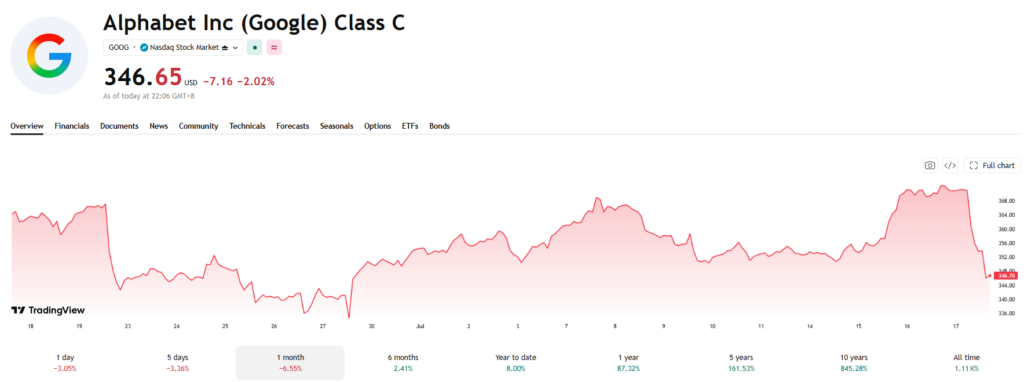
Shares of Alphabet Inc. experienced a downward trend on Thursday, retracting approximately 4% in value following reports that the release of its flagship artificial intelligence model, Gemini 3.5 Pro, has been deferred.
Market participants reacted to concerns that the primary search entity is encountering significant hurdles in its pursuit of maintaining a dominant position in the rapidly evolving sector of generative AI. The delay highlights the substantial pressure current technology leaders face to demonstrate consistent innovation in an increasingly crowded marketplace.
Professional analysis provided by Fonndure highlights that this setback is primarily driven by technical performance requirements, specifically regarding the model’s software coding capabilities, which have failed to satisfy internal performance benchmarks.
As the search giant works to refine these critical components, investors are recalibrating their expectations for the firm’s growth trajectory throughout the remainder of the 2026 fiscal year.

Technical Deficiencies And The Competitive Landscape
The decision to postpone the public rollout of Gemini 3.5 Pro comes at a precarious time for the organization. While the company initially announced the model during its Google I/O developer conference in May, noting at the time that the system was operational for internal teams, the subsequent transition to a wider, customer-facing release has faced unexpected complexity.
Sources familiar with the internal development cycles report that recent attempts to optimize the model’s performance via late-month data updates did not yield the required improvements. This operational struggle is amplified by the accelerated pace of innovation currently being demonstrated by competing labs.
Organizations such as OpenAI, Anthropic, and Meta have consistently debuted new iterations of their respective architectures that reportedly outpace the current public-facing tools developed by the search firm, particularly in high-demand tasks such as automated code generation and agentic reasoning.
Structural Complexity And Internal Development Friction
Industry analysts suggest that the organization’s massive scale, while beneficial in many operational aspects, may be introducing friction into the product development cycle.
The requirement for seamless integration across a diversified portfolio (ranging from Search and Maps to YouTube and advertising infrastructure) necessitates rigorous testing protocols that are inherently more time-intensive than those of smaller, specialized competitors.
This internal structural complexity, combined with the presence of multiple, potentially competing development teams, has contributed to the current timeline shift. Furthermore, the firm is navigating an increasingly scrutinized regulatory environment.
Ongoing, productive engagements with the U.S. government regarding safety, reliability, and security standards for advanced artificial intelligence have necessitated additional layers of quality assurance.
These measures are essential for ensuring that the most advanced systems function within the established guidelines, though they undoubtedly introduce additional delays that the market may not have previously factored into its valuation of the tech giant.
Corporate Communications And Market Reaction
In an official statement provided to media outlets, an Alphabet spokesperson sought to contextualize the current development status, emphasizing the firm’s commitment to balancing speed with economic efficiency.
The representative noted that the organization is actively testing 3.5 Pro, an upgraded Flash model, and several other variations with key strategic partners. This engagement is aimed at ensuring that the final output provides tangible value to enterprise customers while remaining cost-competitive.
Despite the continued availability of the Gemini 3.5 Flash model across existing APIs and products, the absence of a confirmed launch window for the Pro flagship has negatively impacted investor sentiment.
Market participants who had previously interpreted the firm’s rapid AI infrastructure investment as a precursor to total market dominance are now adjusting their outlook.
The current shift suggests a broader market recognition that the path to deploying next-generation reasoning systems is fraught with technical, organizational, and logistical challenges that are not easily overcome.
Long-Term Strategic Implications For The Sector
As the technology sector moves forward, the ability to successfully execute on these ambitious product roadmaps will become the definitive indicator of long-term value creation. The recent market volatility serves as a reminder that even the most established giants are not immune to the pressures of a cycle defined by rapid, high-stakes development.
For stakeholders, the priority remains monitoring the frequency and quality of future model releases, as these will eventually determine the firm’s ability to defend its market share.
Whether this temporary delay is viewed as a minor hiccup or a signal of deeper structural challenges, the pressure to deliver a performant coding assistant remains the most immediate hurdle in maintaining investor confidence through the upcoming calendar quarters.
Anticipating Future Market Volatility
Ultimately, shareholders should prepare for continued instability as the firm manages these development timelines.
The coming months will likely see increased sensitivity to any official announcements, as the market remains hyper-focused on the technical feasibility of the Gemini 3.5 Pro release.
Success will depend on the firm’s capacity to streamline internal processes without sacrificing the core standards that have historically defined its technological leadership in the global AI market.