
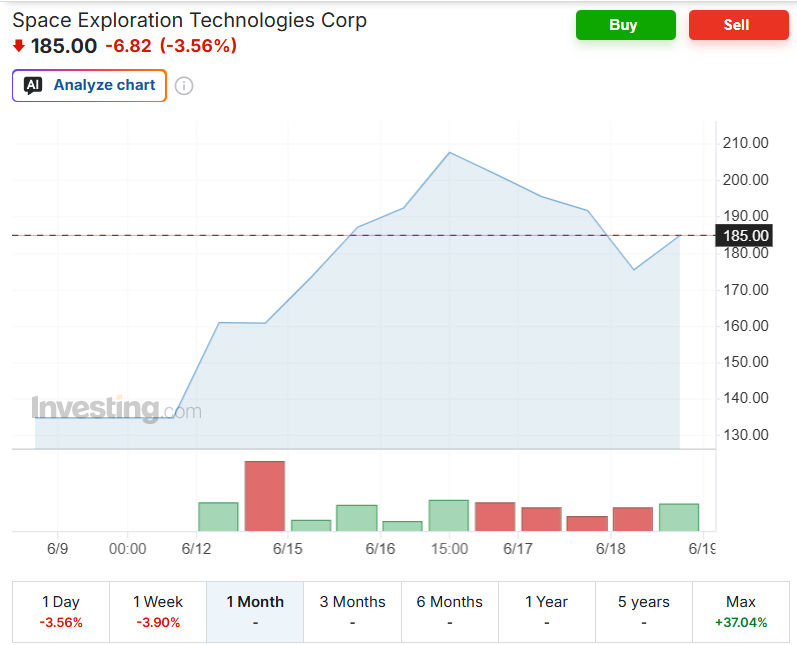
SpaceX’s (SPCX) record-breaking IPO is officially behind it. The company was priced at $135 a share, valuing the business at roughly $1.75 trillion at its debut, and shares have since climbed well above that level on strong early demand, making it the largest IPO in stock market history. Now the spending phase is just getting started.
Fondesia‘s research desk has gone through the company’s IPO prospectus, and the priority spending target isn’t rockets, it’s artificial intelligence.
AI, not rockets, is the growth story in the prospectus
SpaceX’s own filing lays out a total addressable market of roughly $28.5 trillion, and more than 90% of that figure is tied directly to AI rather than launch services or satellite broadband. In effect, the company is telling investors that its long-term valuation now hinges on how successfully it scales an AI compute business, not on Falcon or Starship cadence.
The energy bottleneck investors can’t ignore
There is, however, a significant challenge attached to that vision: AI infrastructure depends on data centers, and data centers require enormous amounts of electricity. In its prospectus, SpaceX acknowledges that global energy supply is struggling to keep pace with the rapidly growing demand for AI computing power.
The company’s proposed long-term solution involves orbital data centers powered directly by solar energy in space. However, many industry analysts remain skeptical about the timeline and commercial viability of deploying such technology at scale.
As a result, SpaceX and the broader AI industry will likely remain reliant on Earth-based power sources for the foreseeable future. While wind and solar energy are expected to contribute to meeting future demand, advanced nuclear energy technologies are increasingly being considered by AI infrastructure planners as a potential solution to the sector’s growing power needs.
.
Why small modular reactors are suddenly an AI story
Big Tech’s interest in nuclear power isn’t new Alphabet, for instance, is already backing the construction and restart of several nuclear facilities to secure reliable, low-carbon baseload power. The problem with conventional nuclear plants is the timeline: large-scale builds routinely take a decade or more before they generate a single watt.
Small modular reactors (SMRs) are positioned as the fix. According to a recent Bank of America research note, SMRs require less land and shorter construction windows than traditional plants, along with improved safety design characteristics that BofA believes could meaningfully reshape nuclear supply chains over the next decade.
The AI-to-energy investment thesis is gaining momentum well beyond SpaceX. Over the past year, major technology companies and hyperscale data center operators have increasingly embraced nuclear power as a way to secure reliable baseload electricity, helping offset the intermittency associated with wind and solar energy generation.
What makes SpaceX’s prospectus noteworthy is that it draws a more direct and urgent connection between AI growth and future energy demand than many previous corporate disclosures.
For investors seeking exposure to this trend, there is a challenge: most Small Modular Reactor (SMR) developers are either privately held companies or subsidiaries of large industrial groups, limiting opportunities for direct public-market investment.
As a result, only a small number of publicly traded companies provide relatively direct exposure to the emerging SMR and advanced nuclear power sector, with two companies standing out as notable exceptions.
Two pure-play SMR stocks: NuScale Power and Oklo
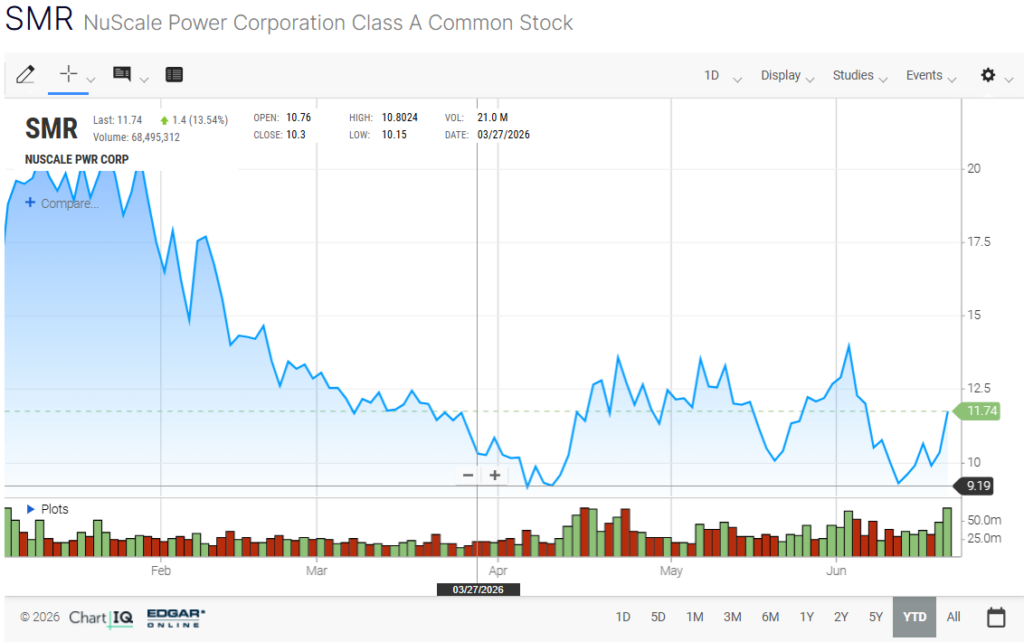
NuScale Power (SMR) and Oklo (OKLO) are the closest things to pure-play SMR investments currently trading. Both posted sharp single-day gains around the SpaceX IPO news NuScale up 13.54% and Oklo up 4.00% reflecting how tightly the SMR trade has become linked to AI power-demand headlines.
The two companies aren’t pursuing identical strategies. NuScale is largely focused on partnering with electric utilities for grid-scale SMR deployment. Oklo is leaning harder into direct sales to data center operators a natural fit given that one of its early backers is Sam Altman, CEO of OpenAI.
The risk side of the ledger
Neither company has commercialized a single SMR unit as of today. Both have built out sizable customer pipelines, but pipeline interest and signed, operating contracts are very different things.
BofA’s own note strikes a measured tone on the economics modular design offers theoretical cost and construction advantages, but real-world SMR demonstration projects have a track record of cost overruns and schedule delays. That’s a meaningful risk given that wind and solar costs keep falling, which could erode the relative economics SMRs are counting on.
Outlook: a long-duration, high-risk-tolerance bet
SpaceX’s IPO didn’t create the AI-power-demand story, but it has put a very large, very public spotlight on it. NuScale and Oklo are the two most direct ways for public-market investors to play the SMR side of that trade, but both remain pre-commercialization names whose pipelines have yet to convert into revenue.
This is a position sized for long-term holding periods and investors with genuine tolerance for technology and execution risk not a near-term trade on AI infrastructure headlines.