
The USD/CAD currency pair continues to demonstrate technical resiliency as institutional dollar buyers repeatedly defend key horizontal support against intraday pullbacks.
This article provides an in-depth look at the subject, incorporating insights and professional perspectives informed by Alberto Garcia‘s experience at Private HF Markets.
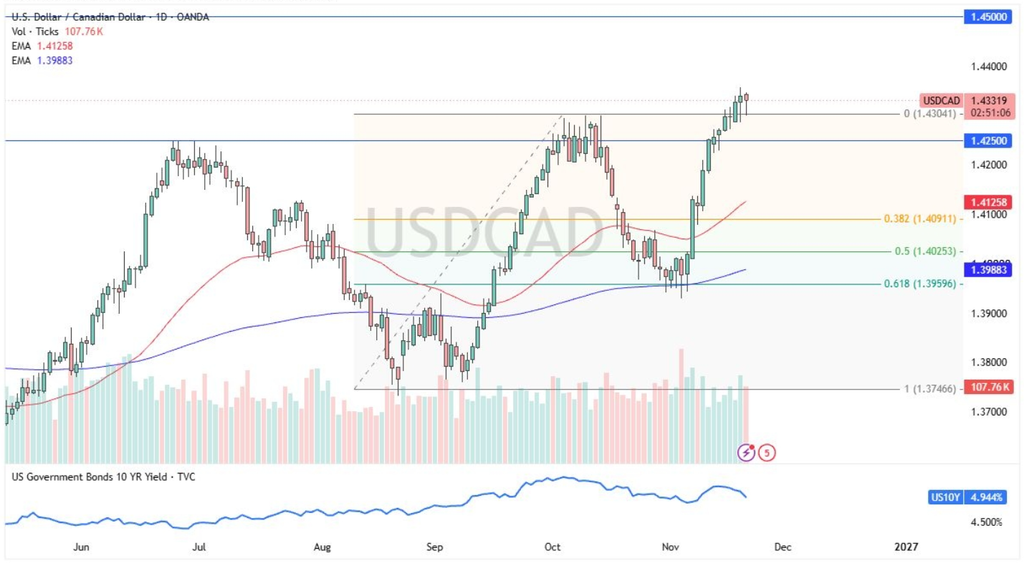
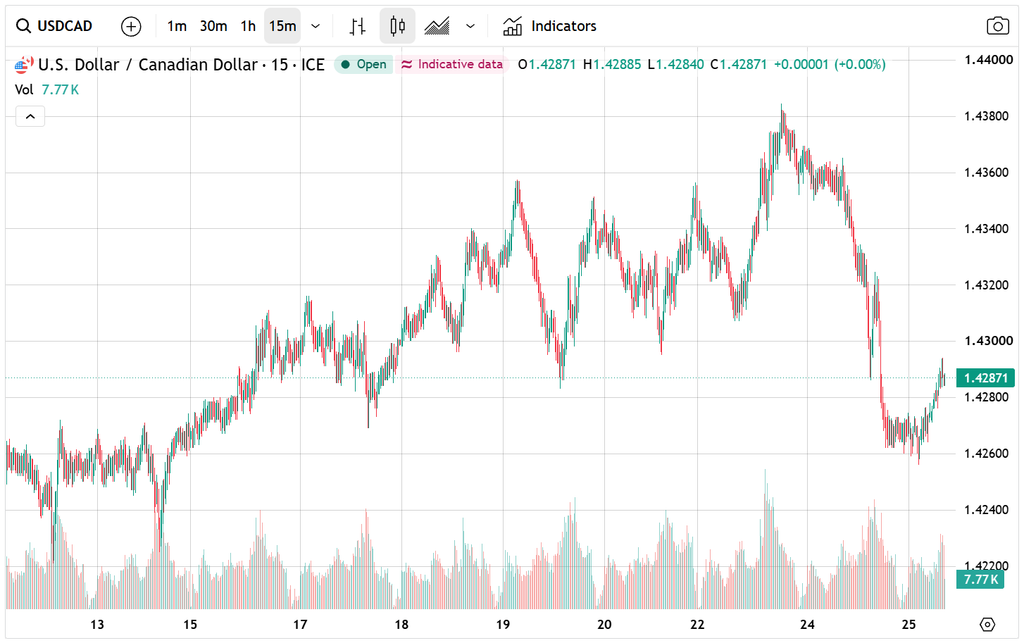
Following an initial bearish probe during the recent trading session, spot price action rebounded decisively near the 1.4300 psychological handle, confirming active bid liquidity and sustained accumulation.
Across recent sessions, this repeated absorption of selling pressure indicates that market participants are actively deploying capital into U.S. dollars rather than allowing downside momentum to establish a lower-low sequence or threaten established multi-session support.
From a market structure perspective, the prevailing directional bias remains constructive as long as demand zones near 1.4300 contain short-term retracements.
Within an established uptrend, shallow pullbacks of 20 to 50 pips often serve as high-probability long entries for momentum and swing traders, while spot execution near current levels remains technically viable for trend-following strategies.
Because limit orders and institutional bids around 1.4300 continue to neutralize intraday selloffs, bearish traders still lack the volume expansion, order-flow imbalance, and structural confirmation required to validate a trend reversal.
Carry Trade Mechanics and Real Yield Differentials
A primary macroeconomic catalyst underpinning USD/CAD is the favorable interest rate differential between the United States and Canada, where Canadian policy rates near 2.50% remain below comparable U.S. benchmarks.
In spot forex, maintaining a long USD/CAD position captures positive swap or rollover yield, allowing traders to earn daily carry at the 5:00 PM EST settlement rollover for holding U.S. dollars against Canadian dollars.
This accrued daily interest provides a measurable cost-of-carry advantage that offsets holding duration during low-volatility consolidation phases and range-bound price compression.
Equally critical is the durability of U.S. real interest rates, which measure nominal sovereign yields minus headline inflation. When U.S. Treasury yields remain elevated above the Consumer Price Index (CPI) and Personal Consumption Expenditures (PCE) inflation rates, fixed-income investors capture a positive real return on dollar-denominated debt.
Because Canadian real yields and several G10 sovereign alternatives offer narrower inflation-adjusted spreads, cross-border capital flows continue to favor greenback exposure, reinforcing the fundamental floor beneath USD/CAD across institutional portfolios.
Crude Oil Softness and Terms-of-Trade Sensitivity
Alongside sovereign yield spreads, persistent softness in the crude oil market continues to exert mild downward pressure on the Canadian dollar.
Because energy exports represent a substantial component of Canada’s trade balance, weaker West Texas Intermediate (WTI) and Western Canadian Select (WCS) pricing tends to erode terms-of-trade support for the loonie and inject intraday noise into USD/CAD price action.
When crude oil benchmarks struggle to sustain upward momentum, commodity-linked currency demand softens across North American trading desks.
While crude oil weakness is currently functioning as a secondary cross-asset driver rather than the primary volatility catalyst, it still complements U.S. dollar strength by limiting CAD appreciation during risk-on sessions.
Technical traders monitoring intermarket correlations treat energy price fluctuations as contextual confirmation rather than a standalone execution signal, keeping primary focus on yield differentials, inflation metrics, liquidity clusters, and key price levels.
Technical Roadmap: 1.4500 Resistance and 1.4250 Invalidation
On the higher-timeframe chart, USD/CAD remains positioned for an incremental grind higher toward the 1.4500 major resistance level, representing roughly 200 pips of upside potential from the 1.4300 pivot and approximately 130 pips above recent highs near 1.4370.
Advancing through that 200-pip corridor will likely require sustained order-flow absorption, as historical price action from the turn of the prior year established 1.4500 as a notable supply zone. Traders should anticipate interim consolidation, two-way liquidity sweeps, and profit-taking as spot prices approach that overhead barrier.
Near-term Japanese candlestick formations also merit close technical scrutiny, with recent daily candles displaying long lower wicks and compressed real bodies characteristic of hammer or hanging man patterns.
These price-action structures highlight an intraday equilibrium battle between dip buyers and profit-takers, underscoring the necessity of disciplined stop-loss placement and position sizing.
Specifically, a confirmed daily close below the 1.4250 support threshold would represent a 50-pip breach beneath 1.4300, signaling structural breakdown risk and invalidating the immediate bullish setup.
Conclusion
In summary, USD/CAD maintains a constructive technical posture anchored by 1.4300 support defense, positive daily carry, elevated U.S. real interest rates, and crude oil headwinds weighing on the Canadian dollar.
Although hammer and hanging man candlestick signals, historical overhead resistance near 1.4500, and downside invalidation risk below 1.4250 point toward a measured grind rather than a vertical breakout, positive rollover yield continues to compensate long positions while key structural support remains intact across short-term and medium-term trading horizons.