
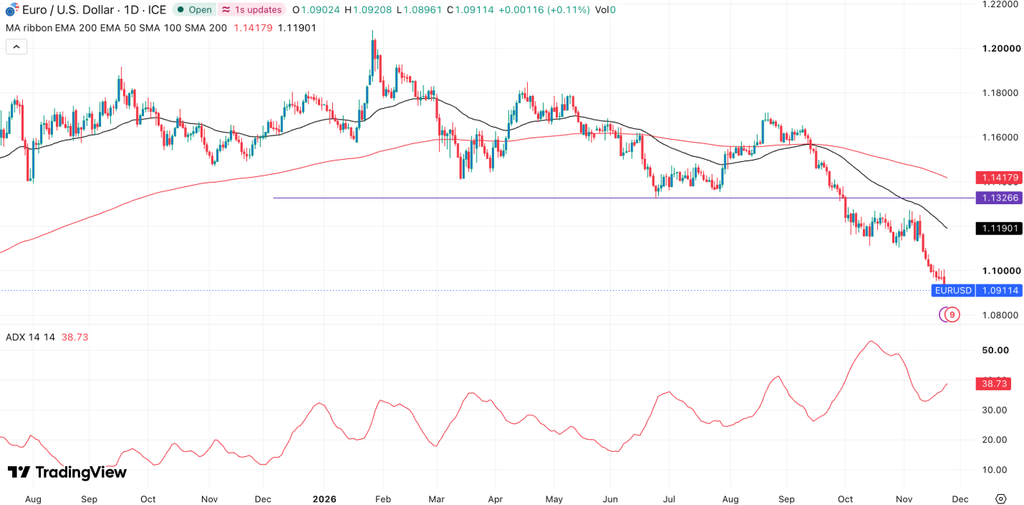
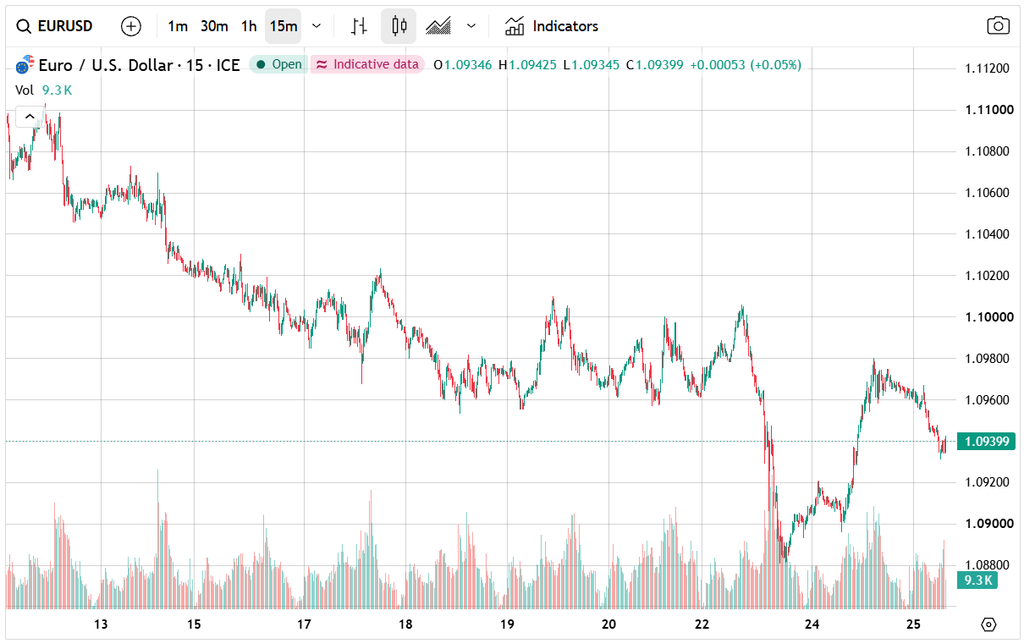
The EUR/USD currency pair has extended its bearish impulse wave, depreciating by more than 3.2% over recent sessions as an aggressive US dollar rally dominates global G10 foreign exchange liquidity.
Breaking decisively below intermediate horizontal support at 1.0980 and 1.0945, the spot exchange rate recently printed an intraday trough of 1.0905, registering its lowest valuation since the spring of last year.
With insights from Private HF Markets broker Alvaro Carbajosa, this article examines the topic from an industry perspective, highlighting key observations and practical expertise.
This sustained downward price action has driven the pair directly into the 61.8% Fibonacci Retracement level at 1.0900, a high-probability institutional inflection zone where short-covering and algorithmic mean-reversion frequently emerge.
While the primary macroeconomic downtrend and bearish market structure remain firmly intact, oversold oscillator readings indicate that a short-term corrective rebound is plausible as traders position ahead of high-impact US consumer confidence and core inflation data.
Macroeconomic Catalysts: Labor Tightness, Inflation Persistence, and Yield Spreads
The foundational driver behind the sustained EUR/USD sell-off is the widening transatlantic interest rate differential favoring the greenback. The US Dollar Index (DXY) recently surged past the 104.50 threshold to reach its strongest valuation in over 12 months, fueled by resilient US macroeconomic releases that forced institutional desks to reprice monetary policy expectations.
Recent Non-Farm Payrolls (NFP) data confirmed that the US unemployment rate compressed to 4.1%, supported by a net gain of 165,000 jobs, demonstrating persistent labor market tightness and sustained wage growth pressure.
Concurrently, disinflation momentum across the United States has stalled above central bank thresholds. Latest readings confirmed that US inflation held firm, with the headline Consumer Price Index (CPI) remaining elevated above the Federal Reserve’s 2.0% inflation target and core CPI holding near 3.3% year-over-year.
When 4.1% unemployment intersects with above-target price growth, FOMC policymakers face a compelling mandate to maintain restrictive policy rates rather than initiating an easing cycle.
Yield curves have adjusted accordingly, pushing 2-year US Treasury yields higher and compressing the EUR-USD 2-year swap spread deeper into negative territory, which structurally penalizes long euro exposure.
Attention now shifts to the upcoming Personal Consumption Expenditure (PCE) price index, which serves as the Federal Reserve’s preferred inflation benchmark. Consensus econometric models project that headline and core PCE will continue advancing at a 0.2% to 0.3% monthly pace, reinforcing the narrative of sticky domestic inflation.
Alongside the PCE deflator, institutional traders will dissect incoming Conference Board Consumer Confidence figures, personal income growth, and real personal spending metrics. Together, these datasets will calibrate forward guidance ahead of the next policy decision, where fed funds futures currently price in a high probability of a 25-basis-point (0.25%) interest rate hike.
EUR/USD Technical Analysis: Fibonacci Confluence and Moving Average Structure
On the daily timeframe, the EUR/USD pair remains entrenched within a well-defined descending channel that has governed price discovery for several months. Following the breakdown beneath psychological parity-adjacent resistance at 1.1000, bearish order flow accelerated toward the 1.0900 demand zone, establishing a sequence of lower highs and lower lows.
Confirming this structural weakness is a textbook death cross formation recorded earlier in the autumn, triggered when the 50-day Simple Moving Average (SMA) crossed beneath the 200-day Simple Moving Average (SMA) near 1.1065. Both moving averages now slope downward, acting as dynamic overhead resistance and validating institutional bearish momentum.
Price action has currently stalled precisely at the 61.8% Fibonacci Retracement level near 1.0900, calculated by anchoring the major swing low from the prior year around 1.0600 to the current cycle’s swing high near 1.1215.
Alongside this golden ratio confluence, the 14-day Relative Strength Index (RSI) has dipped toward the 30.0 oversold threshold, while price hugs the lower Bollinger Band, signaling short-term bearish exhaustion.
This technical confluence elevates the probability of a tactical relief bounce targeting the 1.1000 psychological barrier and the 50% Fibonacci Retracement near 1.0990. A decisive daily close above 1.1000 would squeeze late short positions and open a path toward the 1.1080–1.1120 resistance cluster, signaling a potential medium-term trend reversal.
By contrast, a sustained breakdown below 1.0885 would invalidate the rebound scenario and expose the 78.6% Fibonacci level near 1.0730.
Conclusion
The EUR/USD exchange rate sits at a critical technical and macroeconomic juncture where hawkish Federal Reserve rate expectations meet oversold Fibonacci support at 1.0900.
While the death cross and negative yield spreads keep the broader bearish bias intact, short-term momentum indicators favor a corrective rebound toward 1.1000 ahead of key US PCE inflation and consumer confidence releases.
Until buyers reclaim 1.1000 on a closing basis or softer US macroeconomic data erodes the dollar’s yield advantage, rallies remain vulnerable to renewed institutional selling.