
Relentless US Dollar accumulation has aggressively repriced G10 foreign exchange cross rates, propelling the US Dollar Index (DXY) to a fresh 20-month peak during recent interbank trading sessions.
Institutional capital inflows into USD-denominated assets have compressed risk-adjusted carry opportunities across major sovereign currencies, forcing GBP/USD into a structural breakdown toward a 19-month trough adjacent to the 1.3000 institutional psychological barrier.
This article explores the subject in greater detail, drawing on the professional insights and industry experience of Private HF Markets broker Raul Zamora.
While Sterling exhibits relative strength against lower-yielding European and commodity-linked peers, bilateral yield spreads and liquidity preference continue to penalize Cable on every intraday uptick.
In addition, broader cross-asset positioning reflects heightened sensitivity to real rate differentials and sovereign debt repricing across developed markets.
Institutional desks have steadily reduced net-long Sterling exposure in favor of liquid US money market instruments, reinforcing downward order-book imbalances whenever intraday liquidity thins between European and North American session overlaps.
Quantitative Fundamental and Monetary Policy Analysis
GBP/USD fundamental valuation reflects a divergent central bank reaction function between Threadneedle Street and the Federal Reserve.
At its most recent policy meeting, the Bank of England (BoE) Monetary Policy Committee executed a 25-basis-point tightening increment, lifting Bank Rate from 3.75% to 4.00% via an 8–1 vote split in which one dissenting hawk advocated for a 50-basis-point rate hike to counter entrenched domestic price pressures and above-trend output.
Headline Consumer Price Index (CPI) inflation accelerated to 3.6% year-over-year, exceeding the 2.0% statutory mandate by 160 basis points, while BoE staff macroeconomic projections indicate wholesale energy pass-through could propel headline CPI toward 5.0% by mid-2027.
Bullish Sterling repricing has stalled because headline CPI missed the 3.7% consensus estimate by 10 basis points, core CPI stagnated at 2.8%, and average weekly earnings growth decelerated across private-sector payrolls.
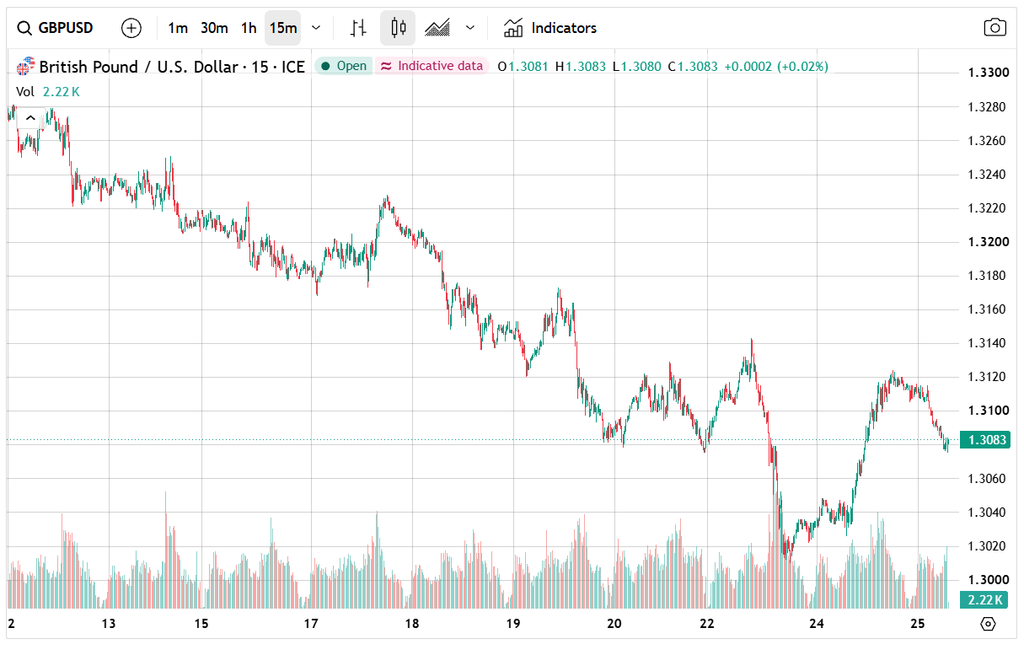
Overnight Index Swap (OIS) forward curves have subsequently trimmed implied tightening probabilities for the December BoE rate decision, capping front-end UK Gilt yields and eroding Sterling’s marginal rate differential against the greenback.
US Dollar fundamental momentum remains underpinned by persistent core inflation and restrictive Federal Open Market Committee (FOMC) forward guidance.
Fed Funds futures price a high probability of a 25-basis-point rate hike at the December FOMC meeting, lifting the federal funds target range from 3.75%–4.00% to 4.00%–4.25%, alongside additional 25-basis-point increments projected across 2027.
Federal Reserve policymakers continue to flag asymmetric upside inflation risks, projecting year-end inflation near 3.5% and delaying 2.0% target convergence until 2028 amid elevated energy input costs.
Real Treasury yield differentials and safe-haven USD demand during equity index drawdowns reinforce Dollar appreciation, though Personal Consumption Expenditures (PCE) price index data remains a binary volatility catalyst because a sub-consensus PCE print would trigger long-USD position unwinding given that 25 basis points of December tightening is already discounted in front-end rates.
Multi-Timeframe Technical and Price Action Analysis
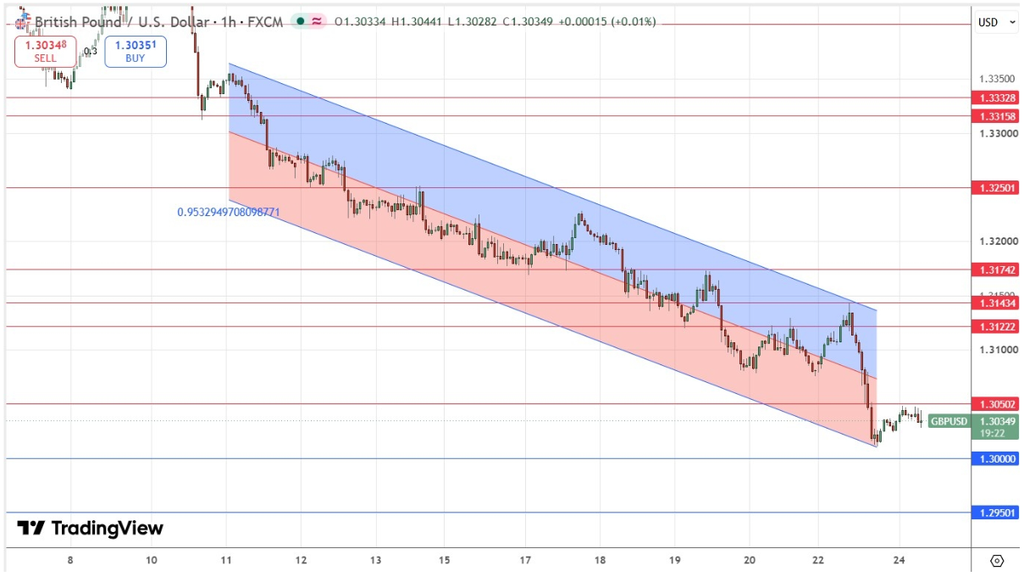
Technical market structure on GBP/USD confirms accelerating downside momentum following a high-volume breakdown to a 19-month low directly above 1.3000.
Despite a shallow 15-to-25-pip intraday bounce off session lows, order flow shows no confirmed accumulation, double-bottom divergence, or higher-timeframe demand zone capable of absorbing institutional supply.
Price action remains strictly governed by a descending linear regression channel spanning nearly two weeks of trading data, with spot quotes oscillating cleanly between the median regression line and the minus-one standard deviation band.
Short-term intraday structure reveals a low-momentum Fibonacci retracement stalling directly beneath horizontal supply and previous support-turned-resistance at 1.3050, where bearish rejection wicks confirm renewed institutional selling.
Downside continuation toward sub-1.3000 liquidity pools, specifically 1.2950 and 1.2900, will require expanded sell-side volume and stop-loss cascades beneath 1.3000 to overcome resting option barriers and psychological bid defense.
Counter-trend long entries near 1.3000 offer unfavorable risk-to-reward ratios and expose accounts to sharp momentum slippage while moving averages, linear regression slopes, and yield spreads remain aligned bearish.
Trend-following execution favors short entries on failed retests of the 1.3050 resistance zone, placing protective stop-loss orders above 1.3075–1.3085 and scaling out profits immediately ahead of 1.3000 to insulate gains against algorithmic mean-reversion bounces.
Traders monitoring order-book depth should also watch for transient liquidity vacuums around 1.3015–1.3025, where resting limit orders may briefly slow execution before sellers reassert directional control.
Conclusion
Superior US Treasury yield spreads, hawkish FOMC rate expectations, and elevated inflation projections secure a decisive fundamental advantage for the US Dollar over GBP/USD despite BoE tightening to 4.00%.
Bearish linear regression containment and repeated technical rejections at 1.3050 validate short-biased execution aligned with the 19-month downtrend, while 1.3000 serves as the primary profit-protection threshold against short-covering volatility.