
The German stock market has recovered most of its early-November dip and now sits a short distance from its highest levels of the year. The research team at Sylverix studies the DAX 40, which trades near 26,350 points, the way the recovery has developed and the levels that could decide whether it turns into a breakout.
From The October Lows To A New Test
The index ended Wednesday’s session with a gain of about 0.3%, adding roughly 80 points to reach 26,347. That price is about 6% above the low of around 24,800 seen in October, so the market has regained a large part of the autumn decline in only a few weeks.
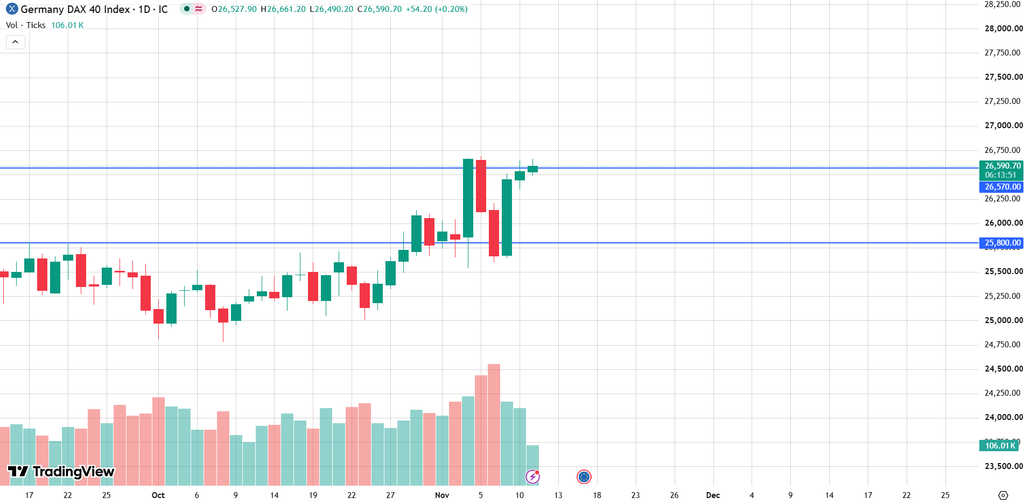
The path was not a straight line. In early November the index touched a high near 26,430, then fell back toward 25,800 within days. Buyers appeared quickly at that level, and the market climbed again, which shows that dips are still being bought.
How Close Is The Ceiling?
The current price is only about 0.85% below the August peak of 26,570, which is the highest point of the recent months. Between the two sits the early-November high near 26,430, so the index faces two barriers in a very narrow space.
Such a situation often leads to hesitation. Traders who bought at the lows may be tempted to take profits as the price approaches the old peak, and newer buyers may wait for a clear close above it. For this reason, the reaction at 26,430 and 26,570 will be more important than the daily move.
A Quiet Change In How Shares Are Traded
Away from the price chart, there is news about the structure of the market. Digital versions of shares of every company in the DAX 40 are now offered on a platform connected to the operator of the Frankfurt exchange. They can be traded at all hours, including nights and weekends, and are reachable from over a hundred countries.
Each token mirrors a real share that a licensed custodian keeps in safekeeping, and a tokenized version of a large European gold security is part of the offer.
Supporters say that this opens German companies to a new audience that already uses digital wallets, and that this demand may eventually reach the shares themselves. That link is not proven, so it should be seen as a long-term theme and not as a reason for the current rise.
The Market Behind The Idea
The product category itself has grown fast. Since its start in June 2025, the framework behind these tokens has expanded to well over 1,300 assets, with over $1 billion under management, trading of more than $45 billion and above 500,000 holders.
The platform that lists the DAX products has operated under supervision from February 2026, within a European pilot scheme for distributed ledger technology.
Reading The Chart
On the daily chart, the structure is constructive. The lows of the last two months have risen step by step, from around 24,800 in October to about 25,800 in November, while the highs have moved closer to the previous peak. That pattern of higher lows usually reflects growing confidence among buyers.
Volume has also increased during the latest advances, which supports the idea that the rise is not just a thin-market move. Still, a market that has rallied for several weeks needs a rest, and a pause or a pullback would be normal before any new push.
Support And Resistance Levels
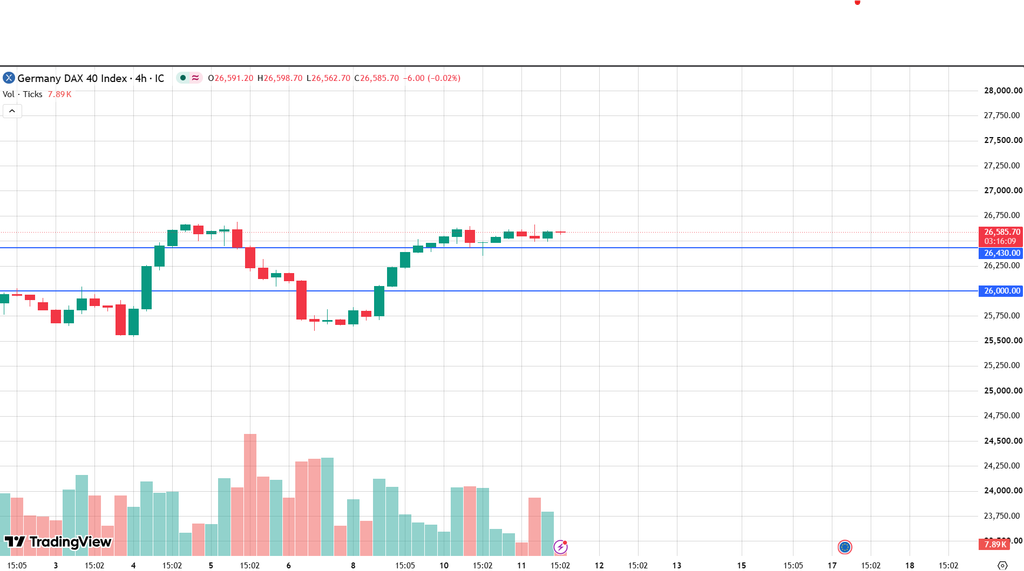
On the upside, the first resistance is 26,430, followed by 26,570. A daily close above the second level would take the index to its best point in months and suggest that the uptrend is gaining speed.
On the downside, the first support is the round number of 26,000, followed by 25,800, the low of the early-November dip. Under it, the area near 25,000 would be a deeper test, and a fall to that region would erase much of the recent gain.
What Traders Can Do
With the price so close to resistance, patience is useful. Buyers may wait for a daily close above 26,430, then aim for 26,570, placing a stop-loss beneath 26,000 to keep the risk under control. A close above 26,570 would improve the outlook and open space for a larger advance.
Sellers may prefer to wait for a close below 26,000, with 25,800 as the first target. Position size should stay moderate, since economic data, central bank comments and global market moves can change the direction of the index within hours, and a stop-loss should always be set before entering.
Conclusion
The DAX 40 is trading near its yearly peak after a steady recovery, and the market now faces a decisive test. The 26,430 and 26,570 resistances and the 26,000 and 25,800 supports are the levels to follow.
Traders following Indices strategies should watch global risk sentiment, economic data and the reaction at these levels, since these factors are likely to guide the next move in the DAX.