
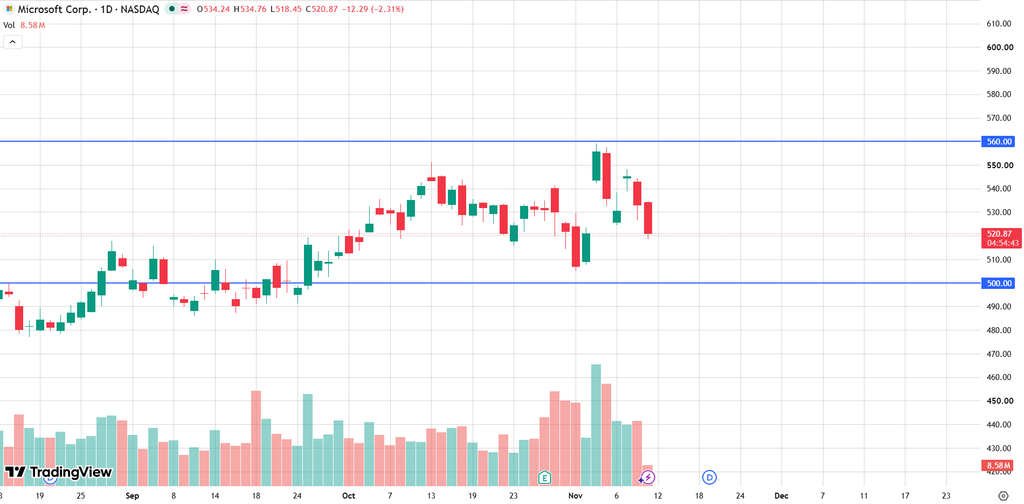
Microsoft shares have lost ground after touching an all-time peak close to $560, as a new rival product in office software overshadowed a very strong earnings report. The research desk at AchievementsAI looks at MSFT, now trading around $530, the reasons behind the retreat and the price zones that matter next.
Why The Stock Turned Lower
The first week of November was kind to buyers. After dipping to the $500 area, the stock climbed almost without pause and printed a fresh record near $560, as risk appetite returned to the sector even though many investors still question how much money is being poured into data centers.
That momentum faded quickly. On Tuesday the price gave back roughly 3% and slid to $530.39. A drop of this size just below a record shows that sellers are active at the top.
A Rival Enters The Office Software Arena
The trigger was a product announcement from Anthropic, the artificial intelligence developer.
Its new bundle for the workplace covers a meeting assistant, dashboards for business data and a spreadsheet tool named Claude Sheets, which targets the territory held by Microsoft’s Excel and Alphabet’s Google Sheets. Early versions are said to be open to paying customers as a test.
The company also wants corporate clients to connect the programs they already use. If that works, an AI chat window could become the place where employees do most of their daily tasks, instead of opening separate applications.
This matters because the office suite is a pillar of Microsoft’s business. Its 365 cloud products brought in $27.78 billion in the quarter ending in September, up about 17% and close to a third of the company total. That number also includes consumer plans, so it is not only about spreadsheets, but it shows how much rides on this franchise.
Earnings Were Strong
The latest report left little to complain about. Quarterly sales reached about $90.6 billion, well above the roughly $78 billion booked in the same period of the previous year. Profit climbed 32% to $36.6 billion, which translates into $4.92 a share, while Wall Street had pencilled in about $4.27.
The wider cloud division produced $63.9 billion of revenue, an increase of 30%. These are excellent numbers, yet the share price reacted to the future rather than the past. Investors want proof that all this growth can continue without squeezing margins or cash flow.
The Cost Of Staying Ahead
Building AI capacity is expensive. Facilities, servers, networking gear and custom chips all require heavy upfront payments.
A regulatory document tied to Anthropic mentions contracts worth a minimum of $44.9 billion with Microsoft, running until mid-2033 and depending on delivery conditions. It confirms strong demand, but it also shows how large the bill for new capacity may become.
The company is also working on a homegrown processor named Maia 300. Reports say it should deliver around 40% more AI output for each unit of electricity than top graphics chips. Lower running costs could follow, but only after years of spending.
Weak Spots Outside The Cloud
Not every division is growing. Consumer products and devices posted $15.5 billion, a drop of 3%. Search advertising rose 12%, but gaming content and services edged down 2%, and Windows sales tied to hardware makers fell by about 22%.
There is also a regulatory angle. Britain’s competition watchdog has suggested labeling Microsoft as a firm with special market power in some software segments, which might bring closer review of pricing, licensing and bundled products. Add the push from Google and Anthropic, and the subscription model could face more pressure.
Support And Resistance Levels
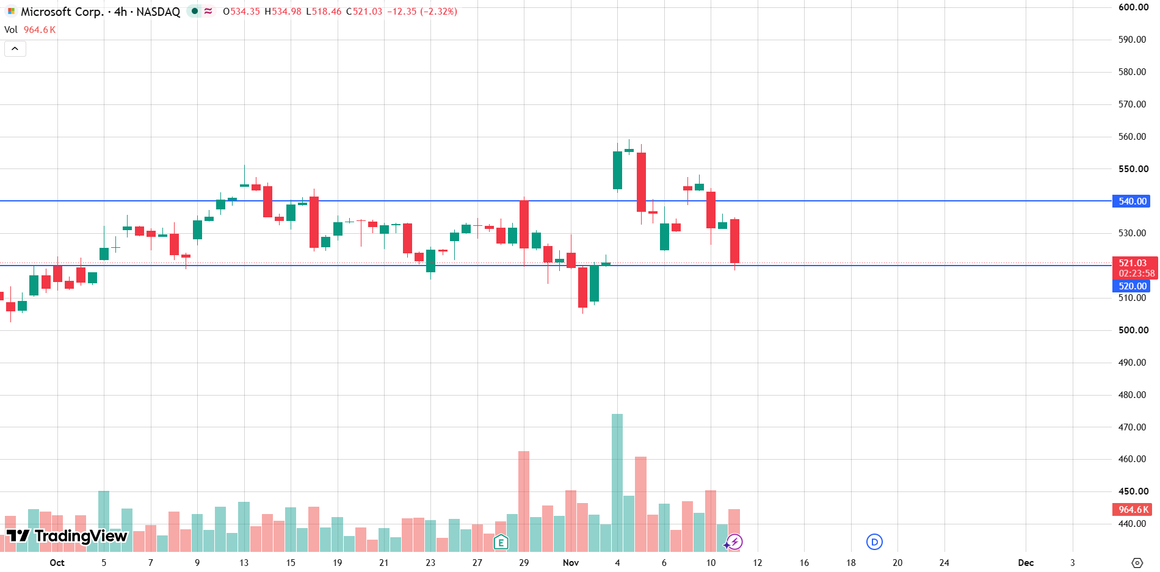
The first resistance sits at $540, a round number just above the current price. Above it, the $555 to $560 band is the real ceiling, because it hosts the record high and is where buyers recently ran out of strength. A daily close above that band would send the stock into uncharted territory.
On the downside, the first support is $520. Below it, $500 is the main floor: it halted the previous decline and also marks a major psychological threshold. Falling under it would suggest that the correction has more room to run.
What Traders Can Do
After a sharp turn from a record, there is no rush. Buyers may wait for a daily close above $540, or for a calm retest of $520 that holds, and then target $555 to $560 with a protective stop below $500.
Sellers may look for a daily close under $520 and aim at $500. Whatever the plan, position size should stay moderate, because news about AI rivals, spending or regulation can shift the price within hours. A stop-loss should be placed before entering any trade.
Conclusion
Microsoft keeps posting outstanding profits and cloud expansion, but investors are now more concerned with rivals and what it costs to scale up. The $555 to $560 resistance and the $500 support are the key levels to follow.
Traders following Stocks strategies should watch AI competition, cloud results and the reaction at these levels, since they are likely to guide the next move in MSFT.