
The analysts at AchievementsAI are following JPMorgan Chase, the largest US bank, whose shares opened Wednesday at $342.13. The stock is sitting in the middle of its yearly range while investors balance a disappointing quarter against a higher payout and a mixed flow of news.
Where The Shares Stand Today
At the current price, JPM carries a market value of about $908 billion. The stock trades roughly 7% below its twelve-month peak of $366.50 and about 22% above its yearly low of $279.10, so it has recovered most of the ground lost earlier in the period.
The trend indicators are constructive but flat. The 50-day average is at $341.28, almost exactly where the price is now, while the 200-day average sits lower at $324.17. Because the stock is hugging the shorter average, the market looks undecided in the near term, even though the longer trend still points upward.
Valuation is not demanding. The shares change hands at about 14 times earnings, and the beta of roughly 1.03 shows that the stock tends to move in line with the broader market rather than much faster.
A Third Quarter That Fell Short
The latest report was published in mid-October and did not meet expectations. Earnings came in at $5.75 a share, below the forecast of $5.94, a gap of $0.19. Revenue reached $50.17 billion, while analysts had expected closer to $51.23 billion.
The picture is less negative when compared with last year. Revenue grew by 8.1%, and profit per share was about 13% higher than the $5.07 recorded a year earlier. Profitability stayed high, with a net margin near 21.9% and about 18.5% earned on shareholders’ capital, which is solid for a large lender.
So the miss was small, and it was mainly a question of expectations. When a stock trades near the upper part of its range, even a modest shortfall can slow the buying.
A Higher Dividend For Shareholders
The bank recently paid a quarterly dividend of $1.65 per share, up from $1.50 in the previous period. On an annual basis this equals $6.60 and gives a yield close to 1.9%. Only about 28% of earnings goes to the dividend, which leaves plenty of room for further increases and for investment in the business.
For long-term holders, this is a clear sign of confidence. It does not guarantee a rising share price, but it can limit declines because income-focused investors tend to buy weakness.
News That Shapes Sentiment
Several headlines are influencing the mood around the stock this week.
On the positive side, the bank’s chief executive is expected to join an online event with the head of Anthropic to discuss that company’s planned public offering, which could carry a very large valuation. The report links JPMorgan to a high-profile deal, but it does not confirm a specific role or any impact on revenue.
On the neutral side, the bank foresees a slower year for corporate deals in 2027 and lower advisory income as a result. Private equity exits may offset part of that, so the net effect is still unclear.
The negative item concerns software lending. A group led by the bank is said to be considering the sale of roughly $2 billion of Qualtrics loans for about 85% of face value. Selling at that discount could mean a realized loss and suggests that investors now value technology credit less highly.
Support And Resistance Levels
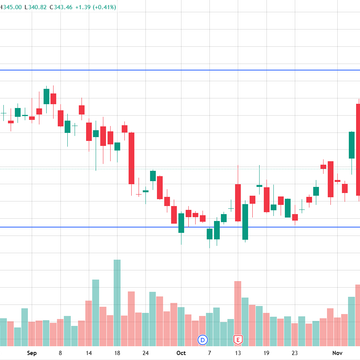
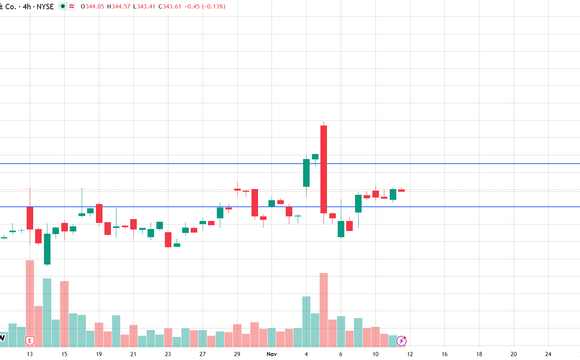
On the upside, the first resistance is the round figure of $350, followed by the yearly high at $366.50. A daily close above $350 would show that buyers are regaining control, and a break of the peak would open new highs.
On the downside, the first support is $340, right next to the 50-day average. Below it, $330 is the next floor, followed by the 200-day average near $324. A fall under that zone would put the whole uptrend at risk and bring the $279 low back into focus.
What Traders Can Do
With the price pinned to its average, patience can pay off. Buyers may wait for a daily close above $350 and then aim for $366.50, placing a stop-loss below $340 to control the risk. Others may prefer a bounce from $340 or $330 with a tight stop under the level.
Sellers may look for a daily close under $340, targeting $330 first and the 200-day average afterward. Position size should stay moderate, because news about deals, lending and interest rates can move bank stocks quickly, and a stop-loss should be set before every entry.
Conclusion
JPMorgan is balancing a small earnings miss and some weak spots in dealmaking against solid profitability and a rising dividend. The $350 resistance and the $340 support are the levels to follow.
Traders following Stocks strategies should watch bank earnings trends, deal activity and the reaction at these levels, since these factors are likely to guide the next move in JPM.