
Platinum prices rebounded sharply from their October lows during the first week of November 2026, with XPT/USD climbing back above $1,500 per ounce after touching a 52-week nadir near $1,430 on October 27.
The recovery has reignited debate among precious metals analysts over whether the fundamental supply shortfall will eventually override the persistent bearish sentiment that has weighed on the metal for much of 2026.
Brokers from Fonndure analyse the structural dynamics underpinning this recovery and evaluate key technical levels that could define platinum’s trajectory into year-end.
The metal’s discount to gold has widened to historically extreme levels, adding a relative-value dimension to the supply-driven investment thesis.
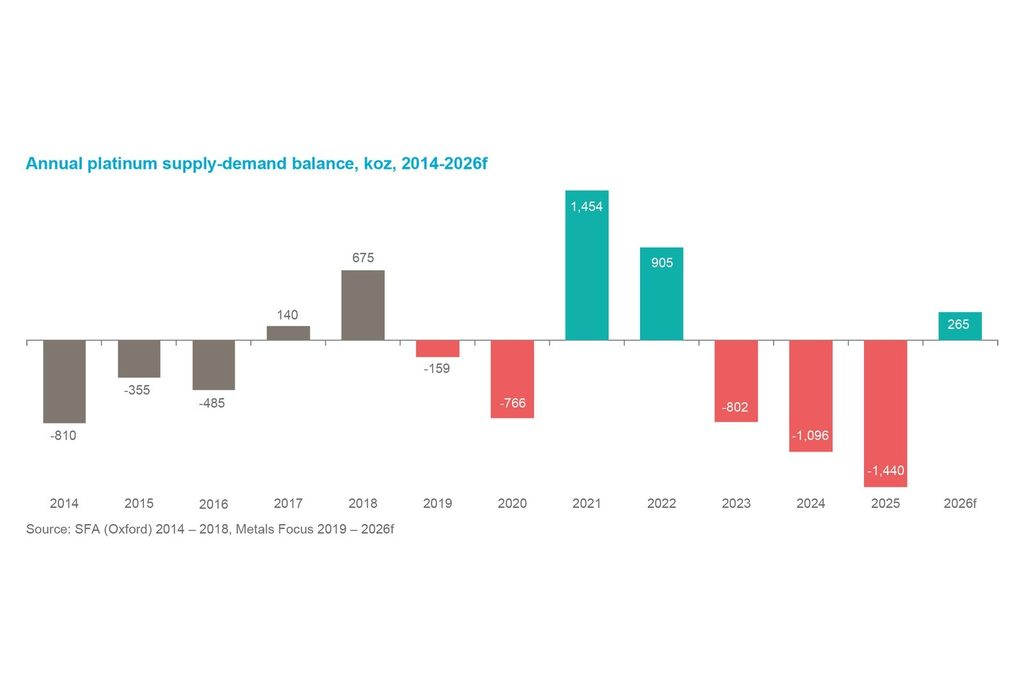
Supply Squeeze: WPIC Projects Record-Breaking Deficit Streak
The World Platinum Investment Council (WPIC) forecasts a 297,000-ounce supply deficit for 2026, marking the fourth consecutive year in which mine production and recycling fail to meet total demand.
Cumulative shortfalls since 2023 now approach 1.2 million ounces, a figure that has steadily eroded above-ground stockpiles to levels that raise questions about the market’s ability to absorb future supply shocks.
South Africa, which accounts for roughly 70% of global mine supply, faces ongoing operational challenges that show no signs of near-term resolution.
Ageing shaft infrastructure across the Bushveld Complex, persistent load-shedding disruptions from Eskom, and above-inflation labour cost increases have constrained output growth. Refined production is expected to remain flat at approximately 4.2 million ounces for the full year.
Above-ground stocks have declined to an estimated three months of demand cover, the lowest level since the WPIC began tracking this metric in 2013.
While this tightness has yet to produce the acute price spikes seen during palladium’s deficit years between 2018 and 2022, the buffer against unexpected supply disruptions is visibly thinning with each passing quarter.
Demand Divergence: Industrial Growth Offsets Automotive Decline
Industrial applications, including glass manufacturing, chemical processing, and petroleum refining, are expected to grow by 5% in 2026, driven partly by capacity expansions in Asian fiberglass production and rising demand for silicone-based materials used in electronics.
Automotive demand, traditionally platinum’s largest end-use segment through diesel catalytic converters, is forecast to decline by 4% this year as Europe’s diesel market share continues to erode.
The substitution of platinum for palladium in gasoline autocatalysts has partially offset this decline, with thrifting ratios shifting in platinum’s favour, but the net effect on total automotive demand remains negative.
Investment demand presents a mixed picture. ETF holdings have declined by 240,000 ounces during the first three quarters of 2026, reflecting investor frustration with platinum’s underperformance relative to gold.
Bar and coin demand, concentrated in Japan and Germany, has provided a modest floor but lacks the scale to compensate for institutional outflows.
Hydrogen Economy: The Long-Duration Catalyst That Markets Discount
Fuel cell electric vehicles and green hydrogen electrolyser capacity represent platinum’s most significant long-term demand catalyst, yet markets continue to assign minimal near-term premium to this theme.
Current hydrogen-related platinum consumption stands at approximately 90,000 ounces per year, a modest figure against total demand near 7.5 million ounces.
Industry projections from the Hydrogen Council estimate that platinum loadings for fuel cells and electrolysers could reach 400,000 ounces annually by 2030, representing a fourfold increase from current levels.
Much of this growth hinges on policy support in the European Union, Japan, and South Korea, where hydrogen roadmaps have allocated substantial public investment to electrolyser deployment and refuelling infrastructure.
Technical Outlook: Key Levels to Monitor Into Year-End
The bounce from the $1,430 low has brought XPT/USD back to the $1,500 to $1,540 consolidation zone that defined most of October’s trading range.
The 200-day moving average at $1,520 serves as the critical pivot; a sustained break above this level on meaningful volume would open the path toward $1,600 and potentially attract trend-following systematic flows.
The 14-day RSI has recovered to 48 from oversold readings below 30 in late October, indicating momentum is neutralising without yet turning decisively bullish. The MACD on the daily chart shows a narrowing bearish histogram, with a potential bullish crossover signal developing that technical traders will monitor closely.
On the downside, a failure to hold $1,470 would expose the October low and potentially trigger stop-loss orders clustered below $1,420.
Platinum’s discount to gold, currently exceeding $1,100 per ounce, remains near historic extremes, a ratio that supply-driven reversion strategies have targeted with mixed success in previous market cycles.
The metal’s near-term direction hinges on whether the fourth consecutive deficit year translates into physical tightness visible in lease rates and exchange-registered inventories.
Until that tightness materialises in observable market data, platinum’s recovery remains a fundamentally compelling thesis that awaits confirmation from price action.