
Natural gas surged at the start of the week to its best level in a month, and the move caught many traders on the wrong side of the market. The analysts at Fonndure explain what is behind the rally and which price levels could decide whether it continues, as futures hold their gains near the $3 area.
Colder Forecasts Lift Heating Demand
The first spark came from the weather. Updated models now show chillier conditions across the middle of the country and along the Atlantic coast, and the cold is expected to last until about November 20. Colder days mean more homes burning gas for heat, so the market rushed to adjust its demand expectations.
This matters because traders had been betting on the opposite. Many had prepared for a mild winter linked to a very strong El Niño, a climate pattern that often brings warmer conditions to the northern United States. A colder outlook challenges that story, and prices reacted.
Record LNG Exports Add Support
A second driver comes from foreign demand. Shipments of gas arriving at American liquefied natural gas plants hit an all-time high of about 21.6 billion cubic feet per day over the weekend. That gas is leaving the domestic market for buyers abroad, which leaves less supply at home.
Strong exports show that the structural demand for American gas keeps growing. Together with colder weather, they give buyers a solid reason to feel more confident.
Why Hedge Fund Shorts Matter
Weather and exports lit the fire, but short positions supplied much of the fuel. The most recent weekly positioning data shows that large speculators are still deeply pessimistic, with a net bet against the market of roughly 259,000 contracts. They even increased that bet in early November.
When so many traders expect a fall, a surprise in the other direction can set off a scramble. Those who sold earlier have to buy contracts back to limit losses, and that purchasing lifts prices, which pushes even more traders to exit. Monday’s jump looks like a textbook case, and it hints that part of the advance reflects forced buying rather than lasting optimism.
If forecasts turn warmer again, those traders could return to selling quickly, and the rally might soon lose its fuel.
Technical Picture: The Trend Turns Up
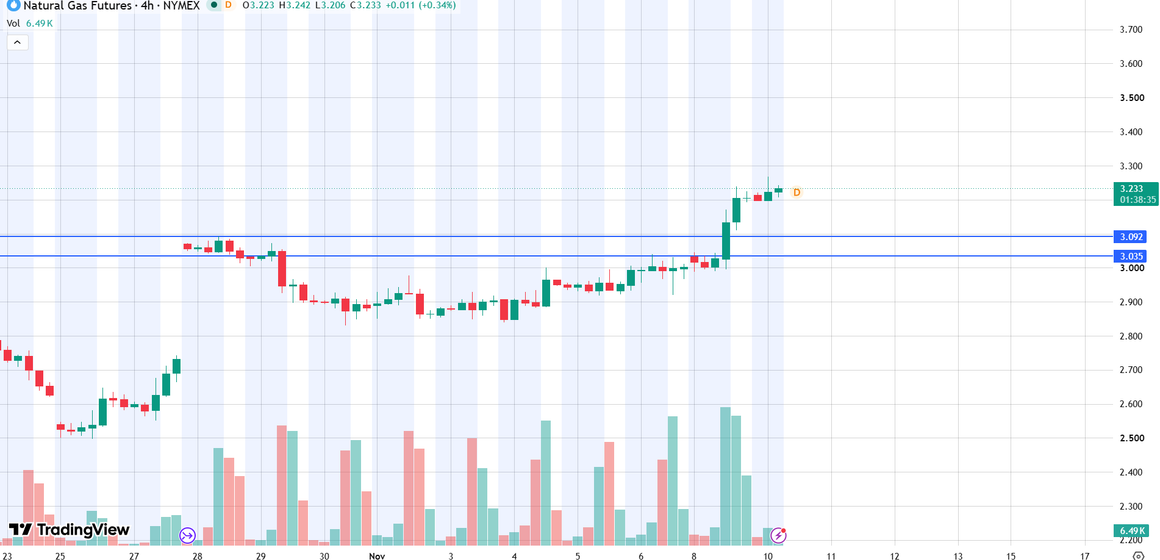
On the daily chart of December futures, Monday’s surge carried the price above $3.092, a recent peak, and that was enough to flip the main trend to the upside. The trend would turn negative again only after a trade below $2.830.
The next hurdle is $3.241, the halfway mark of the intermediate drop. Monday’s high of $3.239 ended just short of it. Higher up, two signals pile together around $3.327 and $3.338: the 50-day moving average and a Fibonacci retracement line. A push beyond that area could point toward the earlier highs around $3.65 and $3.71.
Support And Resistance Levels
On the upside, an early barrier appears near $3.10, then comes $3.241, followed by the pair of signals at $3.327 and $3.338.
On the downside, the first support band runs from about $2.99 to $3.04. If it gives way, attention turns to the $2.83 to $2.84 area, and a drop under it would cancel the bullish setup.
What Traders Can Do
The market will probably stay unsettled until a fresh long-range weather outlook arrives, and swings could continue for roughly ten sessions. For that reason, position size and stop placement deserve extra care.
Traders who like to follow the trend may let the price dip toward the $2.99 to $3.04 band first and look for evidence that buyers step back in. Others may prefer to see a close above $3.241 before entering. Running after a sharp rally is dangerous when forced buying is a big part of the move, so patience can pay off.
Conclusion
Natural gas is rising on colder forecasts, record export flows and a scramble among funds that had bet on lower prices. The trend has turned up, but the move is young and exposed to quick reversals. The $3.241 resistance and the $2.99 to $3.04 support band are the levels to follow.
Traders following Commodities strategies should watch weather updates, export data and the reaction at these levels, since they are likely to shape the next move in natural gas.