
The research team at Fonndure looks at crude oil after a sharp drop that pulled WTI below an important cluster of technical levels. The market is trading in the mid-$80s per barrel, and the question for the next sessions is simple: will sellers keep the upper hand, or will buyers drag the price back into the zone?
Hopes Of Diplomacy Drain The War Premium
Crude has been sliding because traders are starting to believe that the conflict with Iran might not last much longer. Washington has sent signals that it does not want a bigger confrontation, and there are reports of messages being carried to Tehran in an attempt to open a negotiating path. Each of these stories chips away at the extra price that investors had been paying for supply risk.
Not every headline points toward peace, though. A regional diplomat pushed back on stories saying that Tehran was ready to loosen its grip on the Hormuz shipping lane and stop charging ships for passage. A large share of the world’s energy moves through that narrow waterway, so any news about it can shift prices within minutes.
Fuel Costs Add Pressure For A Deal
High pump prices have turned into a sensitive subject for American voters, and that gives leaders another reason to look for a settlement. Real progress on shipping through the strait would point to calmer supplies and lower crude, while a breakdown in talks could bring the premium back almost overnight.
Three Technical Markers In One Place
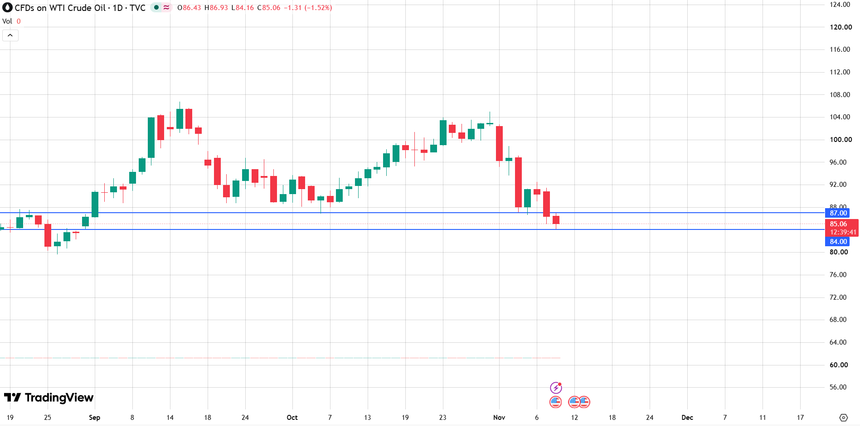
The decline sliced through three markers that sit almost on top of each other. One is the average of the last hundred daily closes, near $87.17. Another is the same measure over two hundred sessions, at about $87.10. The third is the halfway point of the advance that started at the July low, at $86.93.
All three fit within a band of less than 25 cents. When indicators pile up like this, traders tend to read them as a single zone, because many market participants watch the same prices and leave orders there. Oil dropped through the whole band within a very short time, a sign that sellers had the momentum.
Two Ways This Can Develop
A single break does not settle the matter. What happens when the price returns to the zone will say much more, and there are two broad paths.
In the bearish path, crude attempts a recovery but runs out of strength under $86.93, then rolls over again. A floor that has been lost turns into a ceiling, and that pattern would encourage more selling and open the way toward lower prices.
In the bullish path, oil climbs back into the band, pushes through $87.17 and holds above it for a while. The earlier drop would then look like a trap. Traders who sold the breakdown would need to buy back their positions, and that covering could fuel a stronger rebound.
Support And Resistance Levels
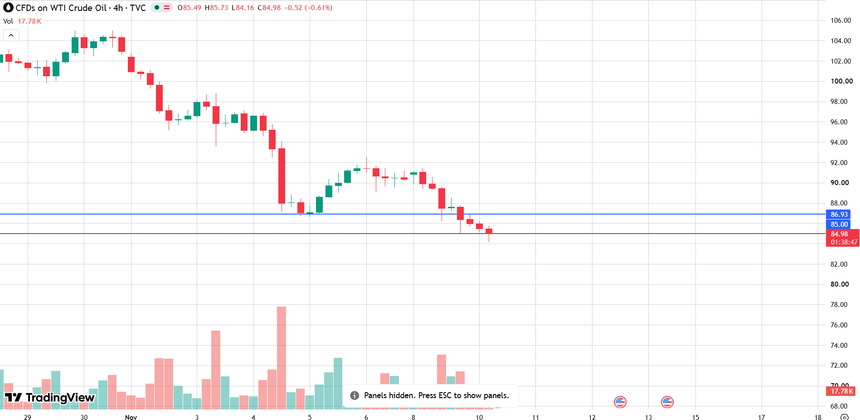
The area from $86.93 to $87.17 is the main resistance. Its lower edge is where bearish traders may look to sell a bounce, while its upper edge is the mark that bulls must close above and maintain to change the story.
Below the market, the round number of $85 is the first stop, with $84 next. A move under both would show that more of the war premium is leaving the price.
What Traders Can Do
Because headlines drive oil right now, risk control comes first. Those who plan to sell a rebound can set their protective stop just above $87.17, since a sustained move over that line would weaken their idea. Those who prefer buying may wait for a clear hold above the band before entering.
Neither approach is risk free, so discipline always matters here.
Smaller positions are sensible, as one news item about the strait or the negotiations can move the market quickly, and price gaps can appear at the open.
Conclusion
WTI now sits beneath a bundle of technical markers while hopes of a deal weigh on the price. The $86.93 to $87.17 band is the reference to follow, and the reaction around it should show how firm the selling really is.
Traders following Commodities strategies should keep an eye on the strait, the diplomatic headlines and the behavior of price at this zone, since they are likely to shape the next leg for oil.