

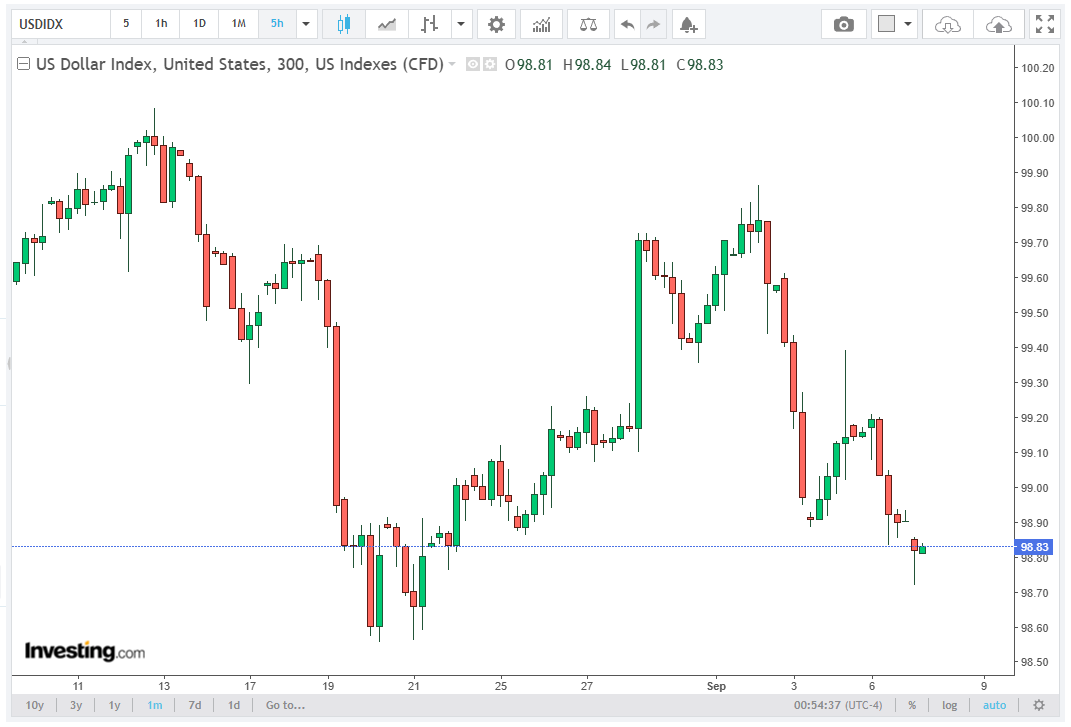
The US Dollar Index (DXY) remains under sustained selling pressure below the 99.00 psychological level, extending its decline for a second consecutive session and falling in four of the past five sessions.
The index is trading around 98.80, down roughly 0.10%, after slipping to a more-than-two-week low during the Asian session. Lucovox’s experts offer an in-depth analysis of this topic in this article.
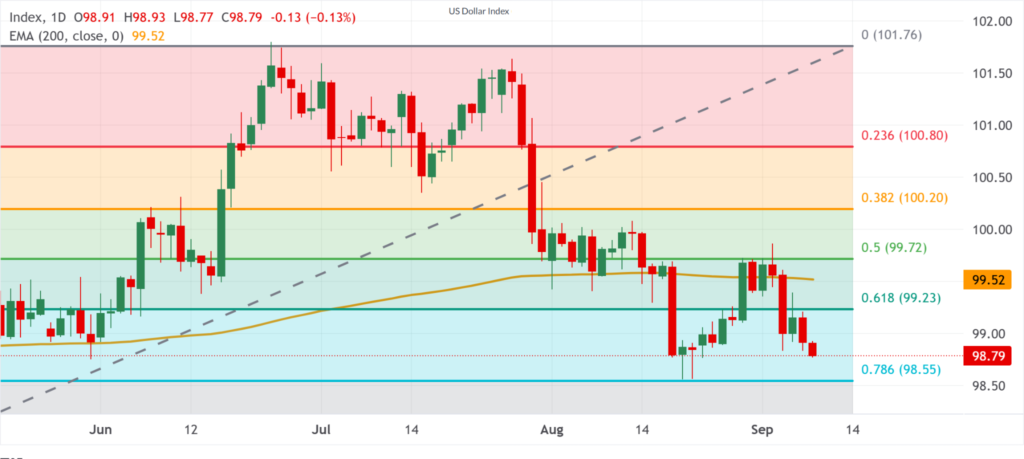
The latest price action continues to confirm a short-term bearish structure. The DXY failed to move back above the 61.8% Fibonacci retracement at 99.23, showing that selling pressure remains present on recovery attempts. The index is also trading below its 200-day Exponential Moving Average at 99.52, keeping the broader technical outlook tilted to the downside.
US CPI and PPI Could Trigger a Volatility Expansion
US inflation data is becoming the main focus, with the upcoming PPI and CPI releases likely to determine the next major move in the DXY. The results could materially change expectations around the Federal Reserve’s rate path, with potential effects on Treasury yields and USD positioning.
A stronger-than-expected CPI reading would likely raise expectations for a more restrictive monetary-policy outlook. Higher US Treasury yields could then encourage renewed USD demand and lift the DXY back above 99.00.
Technically, a move above 99.23 would provide the first indication of improving momentum. A further break above 99.52, especially on a daily closing basis, would be more important as it would place the index back above its 200-day EMA. The next upside targets would be 99.72, 100.20, and 100.80.
Conversely, weaker-than-expected inflation would increase the chances of additional USD long-position liquidation. A decisive move below 98.55 would expose the 97.67 structural floor and significantly reinforce the bearish setup.
JPY Strength Amplifies USD Downside
Recent Japanese Yen (JPY) appreciation is creating additional pressure on the DXY. As the yen has a significant weighting in the Dollar Index, stronger JPY performance can directly contribute to further weakness in the broader USD measure.
The failure of the DXY to reclaim 99.00 and 99.23 shows that USD sellers remain active during rebounds. From a momentum perspective, the rejection at 99.23 continues to support a bearish short-term outlook.
A move back above 99.23 would be the first sign that selling momentum is losing strength, while 99.52 remains the more important confirmation level.
Strong Employment Data Provides Fundamental Support
Recent NFP data continued to show US labor-market resilience, supporting expectations for potentially restrictive monetary policy if inflation stays elevated. Higher expected rates and Treasury yields can strengthen USD demand.
However, employment data alone may not be enough to reverse the DXY trend. Markets require confirmation from CPI and PPI; strong employment combined with persistent inflation would materially improve the dollar’s fundamental outlook.
Oil Prices and Geopolitical Risk Remain Supportive
Elevated crude oil prices are adding further inflationary pressure. Concerns over possible supply disruptions around the Strait of Hormuz, along with rising geopolitical tensions, have kept the risk premium in energy markets elevated.
Higher oil prices can lift headline inflation, potentially delaying monetary-policy easing and supporting higher Treasury yields. Meanwhile, geopolitical uncertainty can generate additional safe-haven demand for the US Dollar, potentially limiting further downside in the DXY.
Technical Outlook: 98.55 Is the Key Downside Trigger
The DXY’s technical bias remains bearish, with the index struggling beneath the 99.23–99.52 resistance zone. The first hurdle is the 61.8% Fibonacci retracement at 99.23, while the 200-day EMA at 99.52 marks the next major barrier.
A decisive break above 99.52 would improve the broader technical picture and shift focus toward 99.72, the 50.0% Fibonacci retracement. Further gains could then open the door to 100.20, aligned with the 38.2% retracement, followed by 100.80, near the 23.6% retracement.
On the downside, attention remains firmly on 98.55, which represents the 78.6% Fibonacci retracement and the key near-term support level. A sustained break below 98.55 would expose the next downside target at 97.67.
CPI May Determine the Next Major Breakout
The DXY remains biased lower while trading below 99.23 and 99.52, with 98.55 acting as the critical downside trigger.
A hotter-than-expected CPI could drive a recovery toward 99.23, 99.52, 99.72, and potentially 100.20. A softer inflation reading could instead accelerate the decline below 98.55, opening the path toward 97.67.
Until either 98.55 or 99.52 is decisively broken, the DXY remains within a high-risk consolidation structure. The upcoming US inflation releases are therefore likely to determine the next major volatility expansion, yield repricing, and directional breakout.