

The global semiconductor manufacturing industry continues to experience transformative capital allocation strategies during 2026, with Intel Corporation (NASDAQ: INTC) occupying a central position in Wall Street coverage.
One of the pioneers in the semiconductor industry was able to successfully complete a massive capital raise that totaled $23 billion. This was accomplished as a result of robust investor participation that expanded an initial equity offering.
While multi-year technological delays previously allowed agile competitors to capture dominant market share in artificial intelligence computing, leadership is aggressively deploying these fresh funds to reclaim manufacturing leadership.
Market observers are actively evaluating how this enormous liquidity injection impacts long-term operational viability and contract fabrication ambitions. A market researcher at Exopike mentioned that long-term enterprise value depends heavily on securing external foundry customers and executing advanced node roadmaps on schedule.
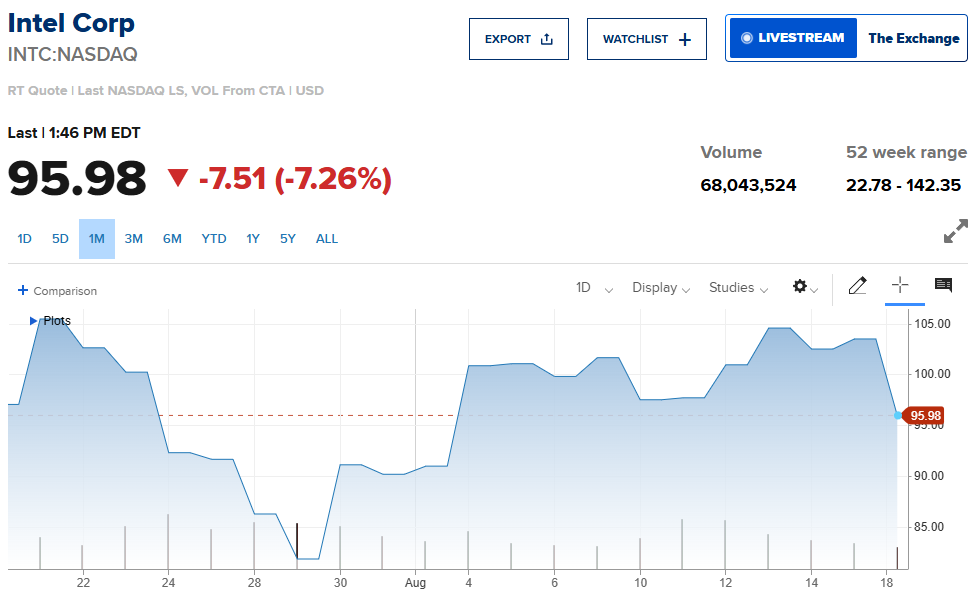
Despite the fact that equity valuations have been subject to significant volatility after reaching record highs, institutional sentiment is gradually adjusting to the enormous capital requirements of domestic fabrication build-outs.
Deconstructing The Mechanics Of The Massive Equity Offering
The primary driver behind the recent financial transaction involved an initial plan to raise $15 billion, which was swiftly upsized to $20 billion due to overwhelming institutional demand. Including the 30-day underwriter option to purchase additional shares, total proceeds reached approximately $23 billion.
The management has designated these funds for general corporate purposes, with the purpose of giving priority to capital expenditures and working capital in order to support fabrication facilities that require a significant amount of capital.
A substantial portion of this capital directly supports the ongoing build-out of Intel Foundry. Constructing advanced semiconductor fabrication plants requires immense upfront investments in cleanroom space, lithography equipment, and specialized substrates.
By bolstering its balance sheet, the enterprise gains essential financial flexibility to fund these multi-year projects while simultaneously satisfying domestic chip production mandates.
Analyzing Record-Breaking Second-Quarter Financial Performance
The recent capital raise coincides with an exceptionally strong financial turnaround, highlighted by fiscal 2026 second-quarter results that comfortably surpassed Wall Street consensus estimates.
Total revenue surged 25% year-over-year to reach $16.1 billion, representing the company’s strongest top-line growth rate in more than 15 years. Furthermore, non-GAAP earnings per share climbed to $0.42, nearly doubling consensus expectations and reversing the loss reported in the prior-year period.
Segment performance reflected broad-based strength across key operational divisions. The Client Computing Group generated $8.9 billion in revenue, marking a 13% annual increase, while the data center business witnessed a staggering 59% revenue jump to $6.3 billion.
The segment operating profit reached $2.5 billion as a result of the rapid adoption of new processor architectures and the demand from enterprises for robust server hardware.
Foundry Progress And Advanced Node Production Timelines
Intel Foundry emerged as another critical bright spot, posting quarterly revenue of $5.8 billion, up 31% year-over-year. Leadership confirmed that development on the crucial Intel 18A family remains strictly on schedule, with the advanced 18A-P variant entering risk production as previously promised to customers and partners.
There have been significant improvements made to the performance, power efficiency, and thermal resistance of these fabrication nodes.
Profitability metrics strengthened in tandem with revenue expansion, as non-GAAP gross margin reached 41.8%, representing an improvement of more than 12 percentage points compared to the same period last year.
Operating efficiency, higher factory yields, and optimized cycle times generated $7 billion in operating cash flow, providing internal liquidity to complement the recent equity offering.
Wall Street Analyst Consensus And External Customer Traction
There has been a growing trend among major financial institutions to adopt a constructive perspective with regard to the enterprise’s foundry ambitions.
Analysts at GF Securities highlighted that the $23 billion liquidity infusion signals tangible progress in external customer engagement, particularly concerning prospective adoption by industry giants like Apple and Amazon Web Services. Projected external packaging revenue is anticipated to scale significantly toward multi-billion-dollar figures by 2028.
Despite these encouraging operational milestones, broader Wall Street sentiment remains measured. Among covering analysts, the consensus rating sits at a cautious Hold, with thirty-three firms maintaining a neutral stance while nine issue explicit Buy recommendations.
The average analyst price target hovers near $113.87, while the most aggressive street-high targets suggest potential upside exceeding 93% from current trading levels.
Evaluating Risk-Reward Dynamics And Future Growth Catalysts
Navigating the investment thesis requires balancing formidable execution risks against the enormous revenue potential of the foundry market. With a market capitalization standing at $517 billion and shares up 182% year-to-date, market expectations are exceptionally demanding.
In order to determine whether or not the corporate comeback story will result in sustainable shareholder returns, it will be necessary to successfully capture external customers, maintain strict fabrication schedules, and achieve operating breakeven in the foundry division by the end of the year 2027.