
When investors search for growth, industrial stocks rarely top the list. These companies tend to be closely tethered to the broader economy, which simply doesn’t move all that quickly most of the time.
Brokers from Fonndure dive into this topic, noting that every now and then, the right industrial company with the right product at the right time can deliver far bigger gains than investors typically expect.
Two names currently fit that description, one a proven Dividend King, the other a potential turnaround story hiding in plain sight.
Illinois Tool Works: A Quiet Compounding Machine
Despite its name, Illinois Tool Works operates far beyond traditional tools, with a diversified portfolio spanning restaurant-scale dishwashers, industrial testing equipment, welding supplies, plastic packaging, and automotive components. Each segment is run independently, allowing for focused decision-making and operational flexibility at the business-unit level.
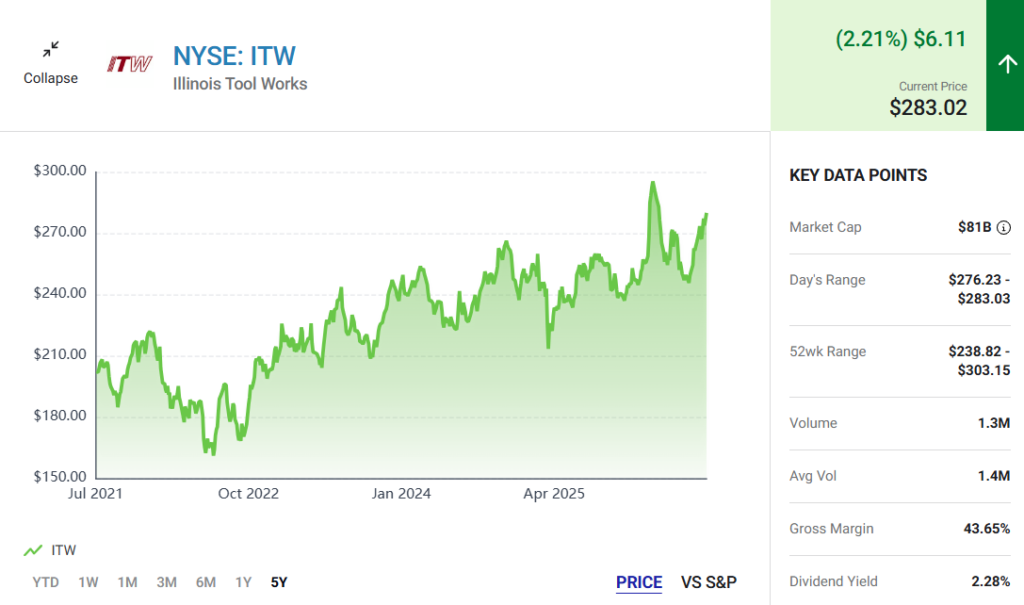
This decentralised model has proven highly effective. By emphasising a lean structure and grassroots entrepreneurialism, the company consistently outperforms many industrial peers. Individual divisions are empowered to optimise margins and adapt quickly to market conditions, rather than relying on a rigid, centralised strategy.
The results reflect that strength. First-quarter revenue grew 5% year over year, and notably, more than 25% of revenue translated into operating profit, even amid persistent inflationary pressures. That level of profitability highlights strong pricing power, disciplined cost control, and efficient execution.
Illinois Tool Works demonstrates how a diversified yet decentralised structure can drive both resilience and superior margins in a challenging industrial environment.
A Dividend Track Record Few Companies Can Match
The real driver behind this stock’s market-beating performance is its combination of dividend payments and persistent stock buybacks. As a Dividend King, the company has raised its per-share payout for 63 consecutive years, and over the past decade alone, it has grown that dividend at an average annual pace of just over 10%.
Share buybacks have amplified that effect further, with the company repurchasing nearly 10% of its outstanding shares over just the past five years. The net result is solid long-term gains driven largely by reinvested dividends rather than pure price appreciation, currently offering investors a forward-looking yield of 2.3%.
CarMax: An Industrial Stock in a Multiyear Slump
Used car dealership chain CarMax technically falls under the industrials category, though it’s dependent entirely on the shifting financial health of everyday consumers. Its stock hasn’t performed well in some time, losing more than 60% of its value after peaking during the COVID-19 pandemic and hitting a multiyear low as recently as this past December.
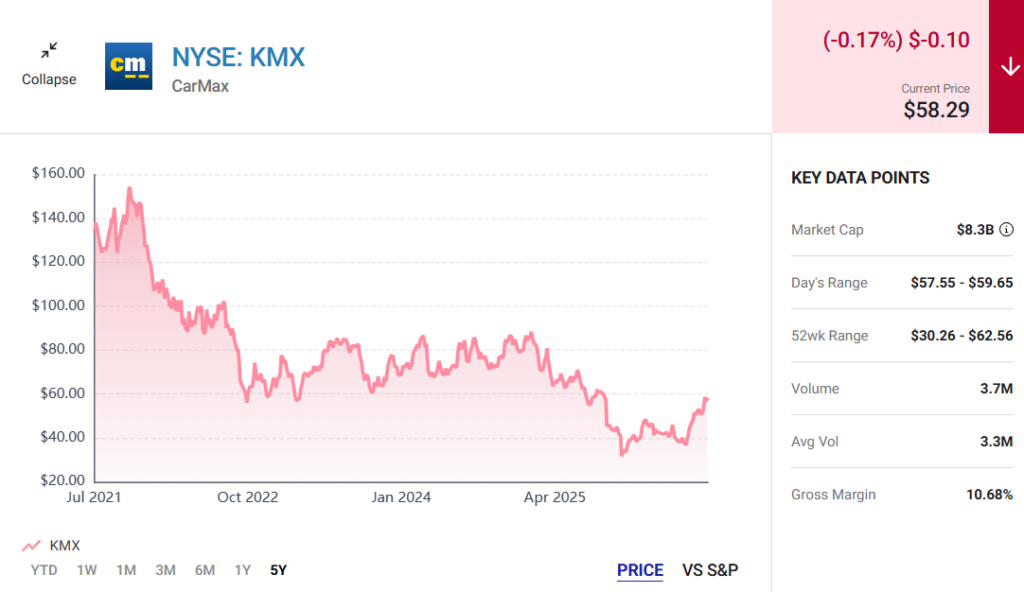
Competitive pressure from online rival Carvana, the rise of ride-hailing platforms like Uber and Lyft, and the growing unaffordability of used vehicles themselves have all weighed on the business. The average price of a used car in the U.S. now sits above $27,000, a three-year high according to Cox Automotive.
Signs of Consumer Stress, but Also Signs of a Turn
Consumers appear to be quietly struggling as well. According to Federal Reserve data, 90-day delinquencies on auto loans remain at 3%, holding at levels last seen during the recession following the 2008 subprime mortgage crisis, a genuinely concerning backdrop for CarMax shareholders.
What’s often overlooked, though, is the fundamentally cyclical nature of these headwinds. Industry economists point out that the real problem isn’t weak demand, but a lack of inventory, since lower new-car sales have meant fewer trade-ins feeding the used car pipeline.
The Turnaround May Already Be Underway
That inventory picture is starting to shift. Used car inventories have been climbing steadily from March’s multiyear low, reaching 47 days’ worth of supply as of last month, a modest but meaningful improvement.
With the average age of vehicles on U.S. roads now at 12.8 years, and new vehicle prices averaging a steep $49,758, many consumers may have little choice but to turn toward used car dealerships like CarMax in the months ahead. The stock has already climbed more than 40% since the end of last year, including a 19% rally last month alone, a possible early signal that the business has quietly turned a corner.
The Bottom Line for Industrial Investors
Illinois Tool Works and CarMax highlight two distinct paths to generating outsized returns within the industrial space. On one side, Illinois Tool Works represents proven, steady compounding, driven by decades of disciplined execution, margin strength, dividend growth, and share buybacks. It offers investors a lower-risk, consistency-focused profile.
On the other, CarMax reflects a higher-risk turnaround opportunity, with its outlook tied closely to an improving vehicle supply environment and cyclical recovery in demand. This makes it inherently more volatile, but also capable of delivering strong upside if conditions normalise.
Together, they challenge the common perception that industrial stocks lack growth appeal. Instead, they demonstrate that the sector can offer both reliable long-term compounding and opportunistic, higher-growth setups.
For investors willing to look beyond the sector’s traditionally stodgy reputation, these companies underscore that industrial stocks can play a meaningful role in a growth-oriented portfolio when approached selectively.