
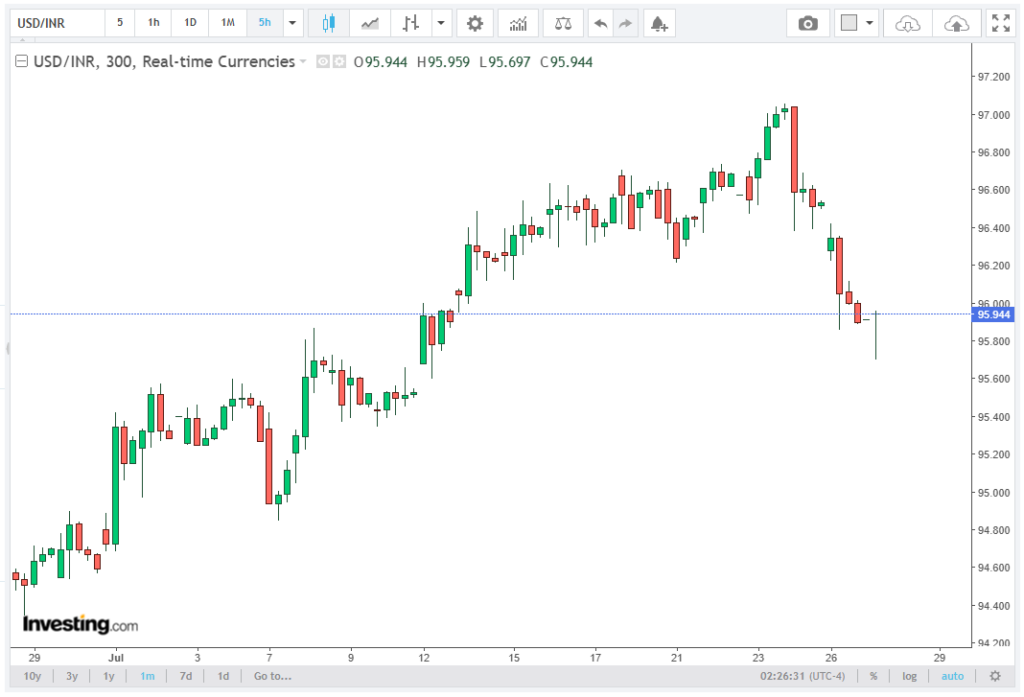
The Indian Rupee continued to strengthen on Tuesday, marking its third straight day of gains against the US Dollar. As a result, the USD/INR exchange rate slipped further, trading near the 95.65 level.
The currency’s appreciation has been primarily supported by a renewed decline in crude oil prices, which has improved India’s external balance outlook and reduced pressure on import-related foreign currency demand. Rubinax’s brokers break down this topic and its key aspects in the accompanying article.
The MCX Crude Oil August 19 futures contract declined 1.4% during the opening session, trading near Rs. 7,848, its lowest level in approximately one week. The continued weakness in energy prices has provided a direct benefit to the INR, given that India imports around 85% of its total energy requirements.
Lower oil prices reduce India’s import bill, decrease demand for US Dollars from oil importers, and support improvements in the current account balance. A sustained decline in crude prices can also ease domestic inflationary pressures, creating additional room for supportive Reserve Bank of India (RBI) policy measures.
Geopolitical Risk Premium Declines as Iran-US Tensions Ease
The recent decline in oil prices has also been driven by reduced expectations of an immediate escalation in Middle East tensions. A pause in military exchanges and renewed diplomatic discussions have lowered the geopolitical risk premium embedded in global energy markets.
However, energy markets remain sensitive because supply conditions have not fully normalized. The status of the Strait of Hormuz, a major global oil transit route, continues to represent a significant risk factor.
Any disruption to energy flows could quickly reverse recent oil declines and create renewed pressure on currencies of major oil-importing economies such as India.
For the Indian Rupee, the direction of crude oil remains one of the most important external variables. A decline toward lower oil price levels would likely remain supportive, while a sharp recovery in crude prices could increase demand for foreign currency and limit INR gains.
Federal Reserve Decision Creates Volatility Risk for USD/INR
The next major catalyst for global currency markets is the upcoming Federal Reserve monetary policy announcement. The decision is expected to influence the near-term trajectory of the US Dollar Index (DXY) and emerging-market currencies.
Market pricing indicates a 62% probability that interest rates will remain unchanged within the 3.50%-3.75% range. However, expectations of a potential September rate increase remain present, depending on upcoming inflation data, employment indicators, and broader economic conditions.
A more restrictive Federal Reserve policy stance could strengthen the USD, creating upside pressure on USD/INR. Conversely, a more accommodative policy signal could weaken the dollar and provide additional support for the rupee.
India GDP Forecast Shows Moderate Growth Slowdown
India’s economic outlook remains positive but is facing expectations of slower expansion. The latest Reuters economic survey forecasts GDP growth of 6.6% YoY for the fiscal year ending March 2027, compared with an estimated 7.7% growth rate in FY2025-26.
Growth is expected to recover slightly to 6.8% in FY2027-28, but economists highlight risks from weaker private investment, higher financing costs, and potential volatility in global energy markets.
The central bank’s next policy decision will be closely monitored for signals regarding interest rates, liquidity conditions, and economic support measures.
USD/INR Technical Analysis: Bearish Momentum Builds Below Key EMA
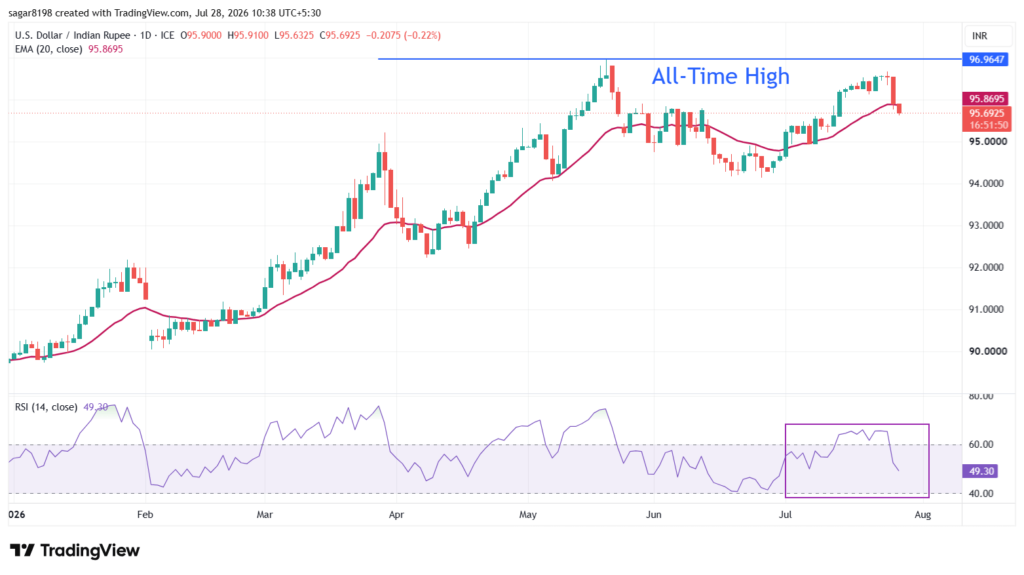
The USD/INR pair remains in a corrective phase after failing to sustain recent gains. The pair is currently trading around 95.65, below the 20-day Exponential Moving Average (EMA) positioned at 95.93.
The break below the 20-day EMA indicates weakening short-term bullish momentum and suggests that sellers have gained temporary control. The Relative Strength Index (RSI) is currently at 50.6, reflecting a neutral market condition with limited directional strength.
A sustained move below the 95.93 resistance zone keeps the short-term bias tilted toward further downside. For bullish momentum to return, buyers would need to reclaim the 20-day EMA and target the previous resistance area near 97.10, which represents the recent all-time high.
On the downside, the 95.00 support level remains the key technical zone. A decisive break below 95.00 could accelerate selling pressure and expose the pair toward lower support areas.
INR Outlook: Oil Prices and Central Bank Policies Remain Key Drivers
The Indian Rupee’s near-term trend will depend on the interaction between crude oil prices, Federal Reserve policy expectations, and RBI monetary guidance. The recent decline in oil prices has created a favorable environment for the INR by reducing import costs and improving external stability.
Technically, USD/INR remains vulnerable below 95.93, while the 95.00 support level will determine whether the rupee can continue extending its recovery. Future movements will likely be shaped by changes in global liquidity conditions, energy market volatility, and incoming macroeconomic data.